Four Horsemen
The Time of Jacob’s Trouble
Then Jacob departed from Beersheba and went toward Haran. (Genesis 28:10)
Yeshua warned His disciples that the wars, rumors of wars, earthquakes, disasters, and famines in various places marked the beginning of the birth pains of Messiah predicted by the prophets. Likewise, the Prophet Jeremiah compared the coming day of tribulation to the painful contractions of childbirth. He called it "the time of Jacob's distress." Jeremiah foresaw the birth pains as a time of trouble for the Jewish people:
Ask now, and see if a male can give birth. Why do I see every man with his hands on his loins, as a woman in childbirth? And why have all faces turned pale? Alas! For that day is great, there is none like it; and it is the time of Jacob's distress, but he will be saved from it. (Jeremiah 30:6-7)
In the context of the full oracle (Jeremiah 30), the time of Jacob's trouble comes upon the nation just prior to the final redemption. It's a season of suffering that prefaces the Day of the LORD. Jeremiah says that the tribulation of that day will be unprecedented, but in the end, the Jewish people "will be saved from it." The LORD will deliver His people from bondage and servitude under foreign nations. The LORD will save the exiles of Israel "from afar" and bring them "from the land of their captivity." The people of Israel will live in peace and security, but the nations to which they were once scattered will face God's wrath in the Day of the LORD. Henceforth, instead of serving strangers, the people "shall serve the LORD their God and David their king, whom I will raise up for them" (Jeremiah 30:9), that is, they will serve King Messiah.
Jacob's Trouble = A season of suffering that comes on the Jewish people just prior to the final redemption and the Day of the LORD.
References
This lesson is adapted from Daniel Lancaster's teachings in The End of Days, as presented by First Fruits of Zion for the Torah Club.
Jacob Goes into Exile
He came to a certain place and spent the night there, because the sun had set; and he took one of the stones of the place and put it under his head, and lay down in that place. (Genesis 28:II)
Jacob's trouble began with his departure from Canaan. When Jacob's mother, Rebekah, heard that Esau plotted to kill Jacob, she advised her younger son to flee to Haran and stay with her brother Laban for a few days until Esau's anger cooled. She promised to send word to let him know when it was safe to return (Genesis 27:43-45). Twenty years later, no word had come. It still wasn't safe to return.
Jacob's exile from the land of promise and his sojourn in Aram is a prophetic picture of the exile of the Jewish people from the land of Israel. Jacob expected that his exile from Canaan might last a year, perhaps two years. He could not have guessed that he would be absent from the land of promise for over two decades.
In the days of the prophets, the Assyrians and the Babylonians played the role of Esau. The first exile occurred under the Assyrian-Babylonian captivity, culminating with the destruction of Jerusalem and the Temple (586 BCE) by the forces of Nebuchadnezzar (the first beast). The people of Israel and Judah were scattered across the Middle East. Many of Jacob's children found themselves living in captivity in Mesopotamia, the land of their father Jacob's sojourning.
After seventy years, in the days of Ezra and Nehemiah, a remnant returned and reestablished Jewish presence in the Holy Land. They returned under the authority of the king of Persia (the second beast), but most of Israel remained dispersed among the nations.
Centuries later, the Jewish people went into exile a second time. Like Esau venting his wrath against Jacob, the Roman Empire (the fourth beast) pounced on the people, forcing them to flee from the promised land. They sacked Jerusalem and destroyed the Temple (70 CE). A vast number of the survivors went to the slave markets. A second war with Rome brought a complete end to Jewish sovereignty in the land of Israel (Bar Kochba Revolt, 135 CE). The rabbis refer to the exile that began under Rome as the Edomite Exile— a reference to Jacob fleeing from Esau. The so-called Edomite exile of the Jewish people has endured for almost two thousand years. For nearly two millennia, Jewish communities have lived as minorities in foreign lands where they have endured subjugation, persecution, and pogroms.
Less than a century ago, the current state of exile and Jewish suffering at the hands of the nations reached a furious crescendo in the Holocaust. It's a period of history that can rightly be referred to as the time of Jacob's trouble. European anti-Semitism erupted into a demonic frenzy against the chosen people. Six million died in the Nazi death camps-a third of the world's Jewish population. The travail and the tribulation of those days birthed the modern State of Israel, the first flowering of redemption. As Jeremiah predicted, "It is the time of Jacob's distress, but he will be saved from it" (Jeremiah 30:7).
References
This lesson is adapted from Daniel Lancaster's teachings in The End of Days, as presented by First Fruits of Zion for the Torah Club.
Exile, Diaspora, Redemption
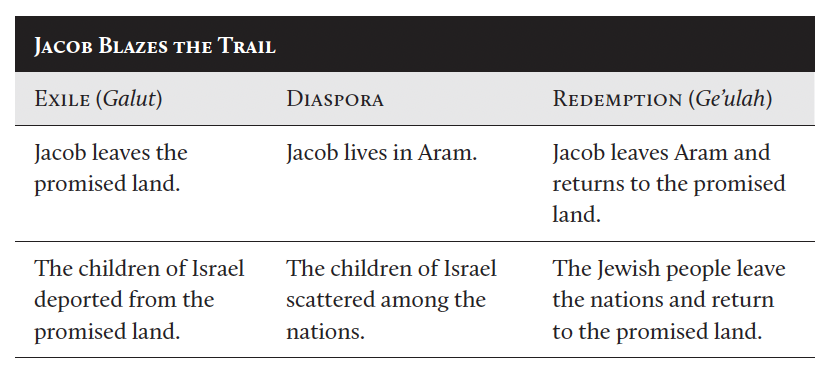
Exile (galut, גָּלוּת) is a central theme in Bible prophecy, apocalyptic literature, and in Jewish history. It refers to the loss of Israel's homeland and the scattering of the Jewish people among the nations. The Bible's prophecies about the coming of the Messiah are primarily concerned with the coming of a redeemer who will bring an end to the exile.
Moses predicted the punishment of exile for Israel's covenant infidelity. Moses warned the children of Israel that, if they broke the covenant, God would remove them from the land, scatter them "among all peoples, from one end of the earth to the other end of the earth" (Deuteronomy 28:64). The scattering of the Jewish people among the nations is called Diaspora, a Greek word (διασπορά) used in the Septuagint (Greek) version of Deuteronomy to describe Israel's dispersion among the nations. The word was later applied to describe all Jewish communities living outside the land of Israel.
The same covenant terms that threaten exile also promise repentance and return. The end of the exile is called the redemption (ge’ulah, גְּאֻלָּה). Moses predicts that the nation will repent, invoking the LORD's compassion. God will restore the fortunes of Israel, gathering the people from the nations into which they have been scattered and returning them to the land. He will circumcise their hearts and establish them in the Holy Land, thus fulfilling His promises to the forefathers. Then the people of Israel will serve God wholeheartedly (Deuteronomy 30:1-8). The final redemption will complete the story arc of the Bible.
Galut (גָּלוּת) = Exile. Israel's displacement from its land and scattering among the nations as a consequence of covenant unfaithfulness.
Diaspora (διασπορά) = The scattering of the Jewish people among the nations. Jewish communities living outside the land of Israel.
Ge’ulah (גְּאֻלָּה) = Redemption. Restoration from exile and return to the land of Israel.
Following the lead of Moses, later prophets such as Amos, Isaiah, Jeremiah, and Ezekiel interpreted foreign invasions and deportations as God's judgment for covenant infidelity. The same prophets spoke of a future restoration: a return to Zion, rebuilding Jerusalem, and a restored kingdom. They envisioned the final redemption as the Day of the LORD that would usher in a new age. Jewish apocalyptic literature heightened the messianic expectations of those prophecies and made them explicit. The Davidic King, also called the Messiah, will be the agent of redemption; that's why He is called the Redeemer. The Messiah will gather the people of Israel back to the land of Israel, restore the Davidic kingdom, and defeat the nations that oppress the Jewish people. He will establish the new age of the kingdom of God. That's what is meant by the gospel message, "The kingdom is near."
References
This lesson is adapted from Daniel Lancaster's teachings in The End of Days, as presented by First Fruits of Zion for the Torah Club.
The Four Beasts and the Four Angels
He had a dream, and behold, a ladder was set on the earth with its top reaching to heaven; and behold, the angels of God were ascending and descending on [him]. (Genesis 28:12)
As he left the promise land, Jacob had a dream of a ladder to heaven on which angels ascended and descended. The Hebrew can be read to mean that they ascended and descended on "him." The sages suggested that the plural word "angels" implies a minimum of four angels in the dream: a pair of angels ascending and a pair descending.
One ancient Jewish interpretation correlates the four angels with the four beasts in Daniel's vision of four foreign empires destined to dominate Israel. (Don't worry about whether that's the literal meaning of the dream. It isn't. But it is a traditional interpretation common in rabbinic literature.) An angelic prince rules each of the empires. Accordingly, as Jacob entered his portentous exile, he foresaw the angelic princes of Babylon, Media-Persia, Greece, and Rome rising and falling, ascending and descending on him:
The prince of Babylon ascending and descending, the prince of Persia ascending and descending, the prince of Greece ascending and descending, the prince of Edom (Rome) ascending and descending. (Midrash Tanchuma, Vayetze 1)
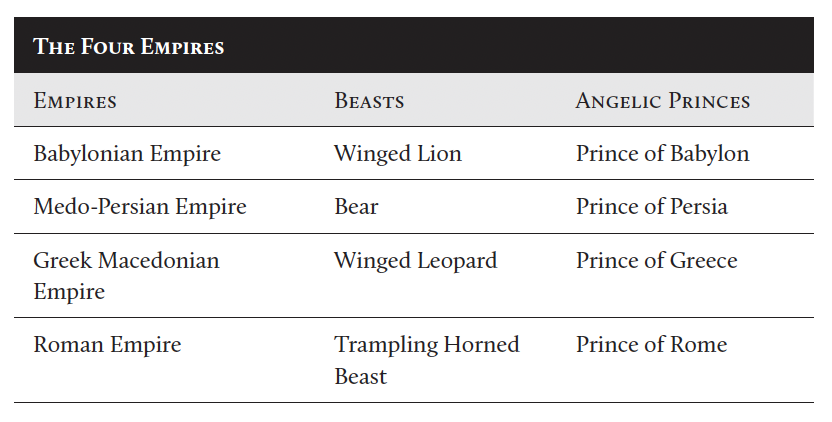
In the book of Daniel, "the prince of the kingdom of Persia" appears as a malevolent angelic being, the spiritual head of the Persian Empire. The Prince of Persia resists the angels Gabriel and Michael, who must fight him to get through to Daniel in exile and answer his prayer. After delivering his message to Daniel, the angel Gabriel says he must return to the fight against "the prince of Persia ... and behold the prince of Greece is about to come" (Daniel 10:20). The apostles referred to angelic authorities over the nations as "powers and principalities" (Romans 8:38; Ephesians 6:12). Jewish teaching suggests that seventy angelic beings currently hold power over the nations of the world— and they aren't the good kind of angels.
Accordingly, Jacob was frightened when, in his dream, he saw the four powers and principalities descending on him. He discerned that they intended to harm him. Then he saw God protecting him, as the Torah says, "behold, the LORD stood above [him]" (Genesis 28:13, cf. b.Chullin gib).
References
This lesson is adapted from Daniel Lancaster's teachings in The End of Days, as presented by First Fruits of Zion for the Torah Club.
Four Beasts in Hosea
So I will be like a lion to them; like a leopard I will lie in wait by the wayside. I will encounter them like a bear robbed of her cubs ... I will also devour them like a lioness, as a wild beast would tear them. (Hosea 13:7-8)
There's another cryptic reference to the four beasts and the birth pains of the Messiah in the haftarah portion from the prophets for Parashat Vayetze. In Hosea 13, the LORD warns the apostate nation of Israel that, because they have forgotten Him and abandoned Him to worship Baal and the golden calves, He will bring the punishment of exile upon them. "The pains of childbirth come upon him," the prophet declares (Hosea 13:13). But the birth of the child is delayed. He does not leave the womb. The LORD asks, "Where now is your king that he may save you in all your cities? ... I gave you a king in my anger and took him away in My wrath!" (Hosea 13:I0-I1). The LORD's wrath comes against the apostate nation like the attack of a wild animal. The prophet compares it to four wild animals: a lion, a leopard, a bear, and a lioness.
According to the nineteenth-century Torah scholar Malbim, the four beasts represent the empires that have oppressed the people of Israel. The lion represents Assyria/Babylonia, as in Daniel 7:4, "The first was like a lion and had the wings of an eagle." The bear represents the kingdom of Medo-Persia, as in Daniel 7:5, "Behold, another beast, a second one, resembling a bear." The leopard is the Hellenist Empire of Alexander the Great, as it says in Daniel 7:6, "After this I kept looking, and behold another one, like a leopard." Finally, the fourth beast (the lioness) is the Roman Empire, as it says in Daniel 7:7, "Behold, a fourth beast, dreadful and terrifying and extremely strong; and it had large iron teeth."
The dream of the four angels ascending and descending the ladder frightened Jacob. According to the interpretation that sees the four angels as symbols of the four empires, Jacob asked the LORD, "Will these years of exile last forever?"
The LORD assured him:
Fear not, O Jacob My servant... do not be dismayed, O Israel; for behold, I will save you from afar and your oftspring from the land of their captivity. And Jacob will return and will be quiet and at ease, and no one will make him afraid. (Jeremiah 30:10, Midrash Tanchuma, Vayetze 1)
In that day, the LORD will pour out His wrath on the nations that have afflicted His people, but the Jewish people will be gathered from the four corners of the earth and carried back to the land of Israel on the four winds.
References
This lesson is adapted from Daniel Lancaster's teachings in The End of Days, as presented by First Fruits of Zion for the Torah Club.
Four Winds and Four Corners
Your descendants will also be like the dust of the earth, and you will spread out to the west and to the east and to the north and to the south; and in you and in your descendants shall all the families of the earth be blessed. (Genesis 28:14)
History has certainly seen more than those four empires rise and fall. But the number four symbolizes a global scope. The "four kingdoms" can be understood to mean all the kingdoms of the earth. That's because the Bible refers to the four compass points as the "four corners of the earth." The "four winds" ("four spirits") refer to the four directions. The Bible says that the nations of the world are spread out to the four winds and they occupy the four corners of the world (Jeremiah 49:36).
As Jacob descended into exile from Canaan, the LORD told him that, in the future, his descendants would spread out to the four directions, "to the west and to the east and to the north and to the south." He told Jacob not to be afraid of the coming days of exile: "Behold, I am with you and will keep you wherever you go, and will bring you back to this land; for I will not leave you until I have done what I have promised you" (Genesis 28:15).
In Daniel's vision by night, he sees "the four winds of heaven" stirring up the great sea until four fearsome beasts come up from the sea, each one symbolizing a world empire (Daniel 7:2-3). Likewise, four horns of the third beast (Greece) extend their kingdom "toward the four winds of heaven" (Daniel 8:8). Under those empires, the LORD scattered His people to the four directions, as Moses predicted, "The LORD will scatter you among all peoples, from one end of the earth to the other end of the earth" (Deuter-onomy 28:64). The LORD said, "I have dispersed you as the four winds of the heavens" (Zechariah 2:6).
As the people went into exile, the presence of the LORD also departed from Jerusalem and went into exile. The Prophet Ezekiel saw a vision of the LORD being borne on a chariot drawn by four living creatures that carried the expanse of heaven above them (Ezekiel I). The four living creatures represent the four directions of the earth. Each creature had four faces, one facing each direction. The four faces symbolize the dwellers on earth: the face of a man (human beings), the face of a lion (wild animals), the face of a bull (domesticated animals), and the face of an eagle (birds).
When the time for the redemption arrives, the Messiah will lift up His standard for the nations and assemble the exiles "from the four corners of the earth" (Isaiah II:I2). In preparation for that day, the "four angels standing at the four corners of the earth" hold back "the four winds of the earth" (Revelation 7:1). The LORD will beckon to His people, "Ho there! Flee from the land of the north!" ", and He will summon them from the four winds (Zechariah 2:6-7):
Do not fear, for I am with you; I will bring your offspring from the east, and gather you from the west. I will say to the north, "Give them up!" and to the south, "Do not hold them back." Bring My sons from afar and My daughters from the ends of the earth." (Isaiah 43:5-6)
The redemption extends even to those who have perished in exile. In his vision of the redemption and resurrection of the dead, the Prophet Ezekiel calls on "the four winds" to return the spirits of his countrymen who have died in Babylon, "and breathe on these slain, that they come to life" (Ezekiel 37:9). The LORD explains that He will unlock their graves and return them to the land of Israel. Isaiah says that the sons of Israel "will be gathered up one by one" from Assyria (northeast) and from Egypt (southwest) and brought to the holy mountain at Jerusalem when a great trumpet is blown (Isaiah 27:13). Therefore, when the Messiah comes, "He will send forth His angels with a great trumpet and they will gather together His elect from the four winds, from one end of the sky to the other" (Matthew 24:31).
Meanwhile, Satan wants to deceive "the nations which are in the four corners of the earth, Gog and Magog, to gather them together for war" against the children of Jacob (Revelation 20:8). But not all the people from the nations can be seduced by his deceits. The redeemed from among the nations "will come from east and west and from north and south, and will recline at the table in the kingdom of God" (Luke 13:29).
References
This lesson is adapted from Daniel Lancaster's teachings in The End of Days, as presented by First Fruits of Zion for the Torah Club.
The Four Horsemen in Isaiah
When he sees riders, horsemen in pairs ... let him pay close attention, very close attention. (Isaiah 21:7)
The Bible speaks of the four angels, four winds, four corners, four beasts, four empires, and four directions to convey a sense of global scope. Similarly, the four horsemen of the apocalypse play a global role. The four horsemen are not literal horses and riders. Apocalyptic writers used images of warriors and fantastic beasts to depict peoples, nations, and spiritual powers. The four horsemen represent a tumult among the nations, "wars and rumors of wars ... nation will rise against nation, and kingdom against kingdom, and in various places there will be famines and earthquakes" (Matthew 24:7). The rhythmic beat of their galloping hooves pounds out "the beginning of birth pangs" (Matthew 24:8). More specifically, they represent the fall of Jerusalem and the beginning of the exile.
Long before the four horsemen go riding out from the sixth chapter of Revelation, they make their first appearance in the prophecies of Isaiah. The prophet describes a terrifying vision that he cannot explain, which grips him "like the pains of a woman in labor":
For this reason my loins are full of anguish; pains have seized me like the pains of a woman in labor. I am so bewildered I cannot hear, so terrified I cannot see. My mind reels, horror overwhelms me; the twilight I longed for has been turned for me into trembling. (Isaiah 21:3-4)
In the vision, he sees warriors at ease, unaware of and unprepared for the coming calamity. They are reclining and feasting when they should be preparing their weapons and armor. Meanwhile, a lookout on the city walls reports riders approaching in pairs. The LORD says to Isaiah (the watch-man), "When he sees riders, horsemen in pairs, a train of donkeys, a train of camels, let him pay close attention, very close attention" (Isaiah 21:7). The term "horsemen in pairs" implies a minimum number of four horsemen.
Paying careful attention, the watchman sees horsemen in pairs approaching the city. They are messengers riding hard with news of a recent battle. One of them calls up to the watchman, "Fallen, fallen is Babylon; and all the images of her gods are shattered on the ground" (Isaiah 21:9).
References
This lesson is adapted from Daniel Lancaster's teachings in The End of Days, as presented by First Fruits of Zion for the Torah Club.
Four Horsemen in Zechariah
The angel replied to me, "These are the four spirits of heaven, going forth after standing before the Lord of all the earth." (Zechariah 6:5)
The Prophet Zechariah also sees a vision of four horsemen. He sees a rider on a fiery red steed at the head of a company of three others. The horsemen have been sent out from heaven on a global mission to patrol the earth and report back to the LORD. The horsemen are specifically tasked with reporting on the geopolitical situation to determine if the time for redeeming Zion and rebuilding Jerusalem is at hand:
I saw at night, and behold, a man was riding on a red horse, and he was standing among the myrtle trees which were in the ravine, with red, sorrel and white horses behind him. Then I said, "My lord, what are these?" And the angel who was speaking with me said to me, "I will show you what these are." And the man who was standing among the myrtle trees answered and said, "These are those whom the LORD has sent to patrol the earth."
So they answered the angel of the LORD who was standing among the myrtle trees and said, "We have patrolled the earth, and behold, all the earth is peaceful and quiet." (Zechariah I:8-II)
Each horseman rides a horse of a different color. The Greek version of the text (LXX) lists four colors.
In a later vision, the prophet sees four teams of horses (red, black, white, and piebald) drawing chariots from between the heavenly mountains as they go forth on reconnaissance. Zechariah is told, "These are the four spirits [i.e., winds] of heaven, going forth after standing before the Lord of all the earth" (Zechariah 6:5). They are sent out to the four winds, that is, the four directions. They are angelic beings sent out on a global mission to ensure God's judgment is carried out and that the wrath of the LORD against "the land of the north" is satisfied (Zechariah 6:1-8).
References
This lesson is adapted from Daniel Lancaster's teachings in The End of Days, as presented by First Fruits of Zion for the Torah Club.
The Scroll with Seven Seals
I saw in the right hand of Him who sat on the throne a book written inside and on the back, sealed up with seven seals. And I saw a strong angel proclaiming with a loud voice, "Who is worthy to open the book and to break its seals?" (Revelation 5:1-2)
In the year 95 CE or thereabouts, the Emperor Domitian relegated the Apostle John to the Aegean island of Patmos. The sentencing of John was part of the emperor's broader campaign against the disciples of Yeshua. The believers suffered persecutions, arrests, imprisonments, seizure of property, and, in many cases, death sentences. While imprisoned on Patmos, the apostle experienced the apocalyptic vision that became the book of Revelation.
In the fourth chapter of the Revelation, John sees the throne of glory. He hears the angelic worship of the heavenly Temple. He sees the Seraphim above the expanse who burn like torches in the presence of the Almighty as they chant, "Holy, Holy, Holy" (cf. Isaiah 6:1-2). He sees the four living creatures from below the throne offer an acclamation of glory to God.
In the fifth chapter, John sees a scroll with seven seals held in the right hand of the One who sits on the throne. The seven seals must be broken so that the heavenly scroll, detailing the final redemption, can be unrolled and its contents disclosed. The scroll contains the story of the final redemption, its day and hour, and the details of the end of the age (cf. Daniel 8:26, 9:24, 12:4).
Unfortunately, no one in heaven or on earth is found worthy to break the seven seals and unroll the scroll. Until the scroll is read, the redemption will not happen! No one is found worthy, above or below, until the Lion of the Tribe of Judah, the Lamb who was slain, steps forth. The crucified and risen Messiah receives the scroll from the hand of the One on the throne. He begins to break open the seals.
The seals correspond to the contractions in the birth pangs of the Messiah. With the breaking of each seal, a new scene in the story plays out. A new birth pain rocks the world. As the story progresses, the sequence culminates with the breaking of the final seal, which initiates a series of seven trumpets, seven bowls of wrath, and, ultimately, the trumpet of the Messiah that heralds His coming.
References
This lesson is adapted from Daniel Lancaster's teachings in The End of Days, as presented by First Fruits of Zion for the Torah Club.
Jacob’s Trouble as the First Four Seals
Each of the first four seals summons a horseman who rides throughout the earth on a global mission. The scope of the mission is global, but the focus of the mission is on the Jewish people in the land of Israel. The horsemen ride out to fulfill the covenantal curses of Deuteronomy 28. The Prophet Jeremiah links the coming of the horsemen with the beginning of the birth pangs and the beginning of exile:
At the sound of the horseman and bowman every city flees; they go into the thickets and climb among the rocks; every city is forsaken, and no man dwells in them. And you, O desolate one, what will you do? ... For l heard a cry as of a woman in labor, the anguish as of one giving birth to her first child, the cry of the daughter of Zion gasping for breath, stretching out her hands, saying, "Ah, woe is me, for I faint before murderers." (Jeremiah 4:29-31)
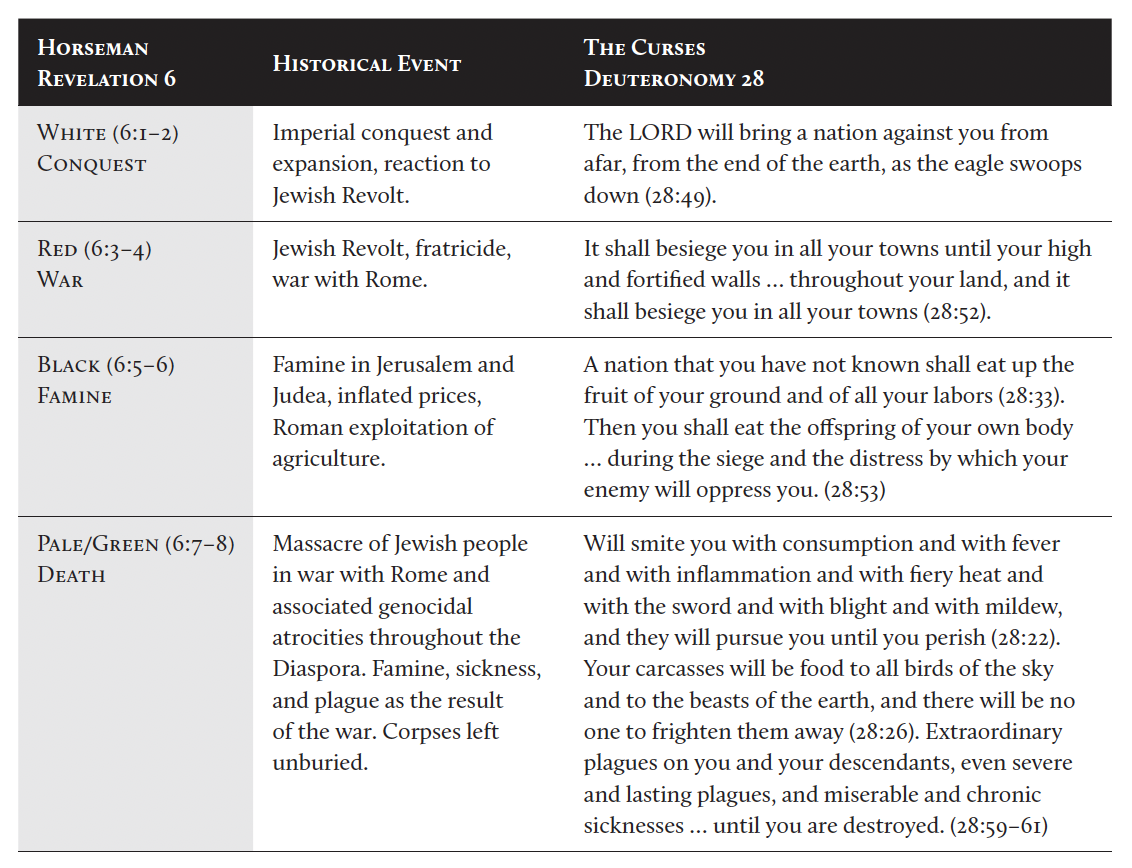
John's first-century readers would have interpreted the ride of the four horsemen in light of events that occurred in the recent decades leading up to their present moment in time: the time of Jacob's trouble. The vision encouraged them to stand fast in their convictions with hope that the times of tribulation they currently endured would quickly culminate with the opening of the remaining seals and the coming of the Messiah. If the curses in Deuteronomy had been fulfilled, the hour of redemption should be at hand.
Nearly two thousand years later, we can still read the unfolding of the tribulations and trials depicted in the book of Revelation as events that lie in store for the future. However, it is also possible to see their fulfillment (or partial fulfillment) in the past, in the first century, and particularly in the days of the Roman emperors Nero and Domitian.
References
This lesson is adapted from Daniel Lancaster's teachings in The End of Days, as presented by First Fruits of Zion for the Torah Club.
Conquest
Then I saw when the Lamb broke one of the seven seals, and I heard one of the four living creatures saying as with a voice of thunder, "Come." I looked, and behold, a white horse, and he who sat on it had a bow; and a crown was given to him, and he went out conquering and to conquer. (Revelation 6:1-2)
As the Lamb sunders the first seal, one of the four living creatures invites the first horseman to "come" from the heavenly realm above and enter the lower world. The four living creatures represent the created order of earth and the four directions; therefore, they issue the summons.
The white rider carries a bow, conquering and to conquer, and he wears the crown of a conqueror. He represents the conquests of the Roman Empire as they press their borders to the four directions, always hungry for more, always looking to dominate and conquer. The rider wears the crowns of Julius Caesar, Antony, and Pompey. He is Augustus, Tiberius, Caligula, and Claudius. Beneath the trampling hooves of the first horseman, the holy land of Israel falls under the control of the terrifying fourth beast from the book of Daniel. The Jewish people become vassals and property of the Roman Empire. The nation loses its independent sovereignty. This sets the stage for Rome's puppet king, Herod the Great, the so-called King of the Jews. Under Emperor Nero, Rome's legions marched once more against the Holy Land to reconquer it by taking it back from the Jewish revolutionaries.
References
This lesson is adapted from Daniel Lancaster's teachings in The End of Days, as presented by First Fruits of Zion for the Torah Club.
War
When He broke the second seal, I heard the second living creature saying, "Come." And another, a red horse, went out; and to him who sat on it, it was granted to take peace from the earth, and that men would slay one another; and a great sword was given to him. (Revelation 6:3-4)
On the trail of the spirit of conquest comes war, violence, and human suffering. The second rider is mounted upon a red horse to evoke the color of blood. He wields a great sword with which to execute violence, inciting the people on earth to slay one another, and he is granted authority to take peace from the earth.
In the days of the apostles, the second rider rode forth during the reign of Nero, shattering the Pax Romana (Peace of Rome). He went to work spilling blood. He spilled the blood of the disciples of Yeshua in the city of Rome in the grisly spectacles of Nero's circus and Nero's gardens on Vatican Hill. He spilled the blood of the Jewish people in Galilee during the Jewish Revolt under the Roman war machine. He spilled the blood of the population of Judea through fratricide when the Jewish Zealot factions turned on one another and against the people of Jerusalem before the Romans had even surrounded the city. During those days of great tribulation, as the Romans laid siege to Jerusalem, the blood of the slain ran from the holy city in an apocalyptic river. Titus surrounded the city with a wall of crosses adorned with crucified Jews captured trying to escape.
At the same time, back in Italy, a civil war erupted in Rome. Legion marched against legion, and the whole empire staggered and reeled under the sword of violence. The streets of Rome ran red with the blood of fratricide just as the streets of Jerusalem did. The Temple of Jupiter burned just as the Temple in Jerusalem did. All of this mayhem was the work of the rider on the red horse, an angelic spirit of judgment that unleashes the worst in human beings and turns us against one another.
References
This lesson is adapted from Daniel Lancaster's teachings in The End of Days, as presented by First Fruits of Zion for the Torah Club.
Famine
When He broke the third seal, I heard the third living creature saying, "Come." I looked, and behold, a black horse; and he who sat on it had a pair of scales in his hand. And I heard something like a voice in the center of the four living creatures saying, "A quart of wheat for a denarius, and three quarts of barley for a denarius; and do not damage the oil and the wine." (Revelation 6:5-6)
The black horse that rides forth at the summons of the third living creature is the angel of famine. Famine always follows war and violence. The horse is black to depict starvation, the blackening of the skin, the darkness of despair. He carries with him a pair of balance scales to symbolize rationing of food (cf. Leviticus 26:26). The living creatures limit the scale of the famine and, in keeping with Roman interests, preserve the agricultural production (olive orchards and vineyards) for Roman exploitation.
During the Jewish Revolt, famine killed a higher percentage of the population than the Romans did. The Zealot revolutionaries burned their own granaries to spite one another, leaving the city of Jerusalem in a state of starvation long before the formal siege began. The Jewish historian Josephus narrates the terrible stories of famine with clear allusion to the curses in the Torah (Deuteronomy 28:52-53). Within Jerusalem's walls, the price for a quart of wheat far exceeded a single denarius. The Talmud preserves several stories about the severe famine conditions during the war and the lean years that followed (b.Gittin 56).
Meanwhile, in Rome, the empire plunged into its own civil war. Political and military chaos led to a disruption in the Egyptian grain supply, leaving the people of Rome starving.
References
This lesson is adapted from Daniel Lancaster's teachings in The End of Days, as presented by First Fruits of Zion for the Torah Club.
Death
When the Lamb broke the fourth seal, I heard the voice of the fourth living creature saying, "Come." I looked, and behold, an ashen horse; and he who sat on it had the name Death; and Hades was following with him. Authority was given to them over a fourth of the earth, to kill with sword and with famine and with pestilence and by the wild beasts of the earth. (Revelation 6:7-8)
Following conquest, war, and famine, the Angel of Death rides forth on the pale horse. A better translation for the color of the horse might be a sickly green (chloros, χλωρός), the pallor of death. Death's colleague, Sheol (Hades), the insatiable realm of the dead, follows after the rider on the black horse to devour the victims. God grants them authority to devour a fourth of the holy land: those slain with the sword, with famine, with pestilence, and by the wild beasts. (Note that the Greek word translated as earth [ge, γῆ] in Revelation 6:7-8 can also be translated as "land.")
The apostolic generation witnessed Death and Sheol gorging themselves on the Jewish population both within the boundaries of the Holy Land and in cities throughout the Diaspora. Josephus describes the Romans finally conquering the last quarters of Jerusalem, only to discover streets and houses already full of corpses, dead from starvation. The four riders executed their judgments on the land of Israel and the Jewish people of that generation in fulfillment of the prophecy from Ezekiel:
When I send against them the deadly arrows of famine which were for the destruction of those whom I will send to destroy you, then I will also intensify the famine upon you and break the staff of bread. Moreover, I will send on you famine and wild beasts, and they will bereave you of children; plague and bloodshed also will pass through you, and I will bring the sword on you. I, the LORD, have spoken. (Ezekiel 5:16-17)
Jews died by the sword and by famine during the war with Rome; they died by pestilence in the destitute conditions of its aftermath; and the survivors died by wild beasts in the arenas and spectacles of their Roman captors.
Outside the land of Israel, in the Decapolis cities and across the empire, the unrest of those days triggered additional massacres against the Jews. Jewish population centers all over the world suffered pogroms. It's difficult to ascertain a precise number of how many Jewish people perished during those troubled years of tribulation, but it's no exaggeration to suggest that 25 percent of the world's Jewish population died. It was the time of Jacob's trouble. It was a "great tribulation" for the Jewish people, unprecedented from the beginning of the world until then. "Unless those days had been cut short, no life would have been saved; but for the sake of the elect those days will be cut short" (Matthew 24:2I-22). It's no wonder that the original readers of the book of Revelation anticipated the coming of the Messiah and the final redemption in their generation.
References
This lesson is adapted from Daniel Lancaster's teachings in The End of Days, as presented by First Fruits of Zion for the Torah Club.
Four Horses in London
When the Lamb broke the fifth seal, I saw underneath the altar the souls of those who had been slain because of the word of God, and because of the testimony which they had maintained. (Revelation 6:9)
In the next few lessons, we will continue to open the seven seals. With the opening of the fifth seal, the persecution against the Jewish people spills over to the disciples of Yeshua. Still enraged with the woman (Zion), the dragon goes "to make war with the rest of her children, who keep the commandments of God and hold to the testimony of Yeshua" (Revelation 12:17). We will learn that the first five seals have already been broken. They had already been broken even in the days of the apostles, as John recorded the vision of Revelation. Ever since then, the world has been waiting in a period of time called "a little while longer" (Revelation 6:I1). That period of waiting may be drawing to a close.
On Wednesday, April 24, 2024 (the second day of Passover, 5784), the world watched in amazement as four horses tore through the streets of London. Perplexed and amazed onlookers captured footage with their phones of a magnificent, completely white horse and equally magnificent, completely black horse, both saddled and in full tack but without riders, as they ran at full gallop down busy London streets. They plowed over pedestrians and charged into traffic. One of them smashed hard and head-on into a bus. Cuts and lacerations on the white horse's neck soaked its hooves and the coat of its front quarters red with blood for an even more visually striking and iconic effect.

2 of the 4 horses that broke free in central London underwent surgery, British Army says.
It turned out that the four riderless steeds were royal horses of the British Household Cavalry. The animals had been out exercising in London when the sound of a nearby demolition project spooked them. The four horses threw their riders and bolted through the streets of the city. Three of the riders were hospitalized for their injuries.
The four horses were named Vida, Trojan, Quaker, and Tennyson. The names seem portentous.
Vida, the white horse stained red with its own blood, is the Spanish and Portuguese word for "life," derived from the Latin word vita. The juxtaposition of life and blood evokes imagery we might associate with the horsemen of the apocalypse.
TROJAN refers to the Trojan horse of Homer's epic. Ominously, the United Kingdom's disastrous immigration policy has created a Trojan horse of refugees and asylum seekers from Muslim countries, leading to a critical demographic shift. Hundreds of thousands of Syrians, Pakistanis, Bangladeshis, Sudanese, Iranians, and Iraqis have entered the United Kingdom on asylum claims, more than two million in the last decade, nearly five million in the last two decades.
QUAKER refers to a persecuted religious society that originally started in London. They were said to quake under the inspiration of the Holy Spirit. The Quaker Act of 1662 made their faith illegal, leading to fines, imprisonment, and persecution for the sake of their religious convictions, akin to modern initiatives for the suppression of free speech and religious liberties.
TENNYSON refers to the British poet who wrote the epic poem titled The Charge of the Light Brigade, a true story of how 6oo British cavalrymen and their steeds were ordered to charge a Russian position during the Crimean War. Obedient to the orders, they charged directly into the line of fire of Russian artillery batteries, ending in a terrible massacre of horse and rider. Tennyson's poem opens with the memorable lines: Half a league, half a league, Half a league onward, All in the valley of Death.
The whole world witnessed the images of the riderless horses galloping through the streets of London. The BBC broadcast the images around the world. Originally, the BBC reported five royal horses running loose in London, but the number later turned out to be precisely four.
Yeshua told us not to wait for signs to indicate His arrival. Yeshua told us that we should require no sign other than the sign of Jonah. He told us that, if we are paying attention, we should be able to discern the hour as easily as one can see a storm brewing in the sky. If so, the gathering thunderheads of today's geopolitical and social realities, technological innovations, and spiritual revelations seem to indicate that the storm is about to break. Nevertheless, the four horses in London-Vida, Trojan, Quaker, and Ten-nyson-bring to mind the book of Revelation and the four horsemen of the apocalypse. Are the four horsemen preparing to ride out again?
References
This lesson is adapted from Daniel Lancaster's teachings in The End of Days, as presented by First Fruits of Zion for the Torah Club.