Crown of the Twelve Stars
What Was, Is, and Will Be
Therefore write the things which you have seen, and the things which are, and the things which will take place after these things. (Revelation I:19)
You might be thinking, “Why learn all this history? Aren’t we supposed to be learning about the future and the end times? That’s a fair question. The future is still coming. We'll get there. But according to the New Testament, the end of days began in the days of the apostles. The gospel message boldly declared, "The kingdom of heaven is near." That was almost two thousand years ago, but Yeshua's disciples absolutely believed they lived at the end of history. Were they wrong? If so, the New Testament is also wrong.
They were not wrong, and neither is the New Testament. They did live in the end of days. They did stand at the end of history. The Day of the LORD could have happened in their lifetimes. It was about to happen, and it nearly did happen. Yeshua was not wrong. The kingdom was near, and the events that befell his generation were all part of the program leading to the end of this current age and the beginning of the next. That generation witnessed signs and portents that indicated Bible prophecies about the final redemption were coming to pass in their day and age. Since then, it's as if the whole end-times program has been on pause, like an old VCR tape of an exciting movie left paused in the middle of an action scene. The story has been paused "until the fullness of the Gentiles has come in" (Romans II:25, Lesson 4), but currently every indication suggests that the end of days is resuming.
Therefore, we must understand the history of what happened in the days of the apostles leading up to the writing of the book of Revelation. To understand the whole story, you need to watch the movie from the beginning. The history provides us with a social, political, and religious context for decoding the cryptic book of Revelation. It also shows us what literally happened in the end of days, the last time the end of days was literally happening.
Our historical perspective on current events and the coming future is baked into the book of Revelation. As the angel of Yeshua introduces the revelation to John on Patmos, he tells the apostle to write about "the things which you have seen, and the things which are, and the things which will take place after these things." In other words, the book of Revelation is not just about the future. It's also about things that happened in the past, prior to John receiving the revelation. That's what is meant by the "things which you have seen." It's also about the current events that John and his readers were experiencing during the tribulation under Domitian around the year 95 CE. That's the "things which are." Finally, it's about the future yet to come. Things that are still going to happen. That's the "things which will take place after these things."
References
This lesson is adapted from Daniel Lancaster's teachings in The End of Days, as presented by First Fruits of Zion for the Torah Club.
Was, Is, And Is to Come
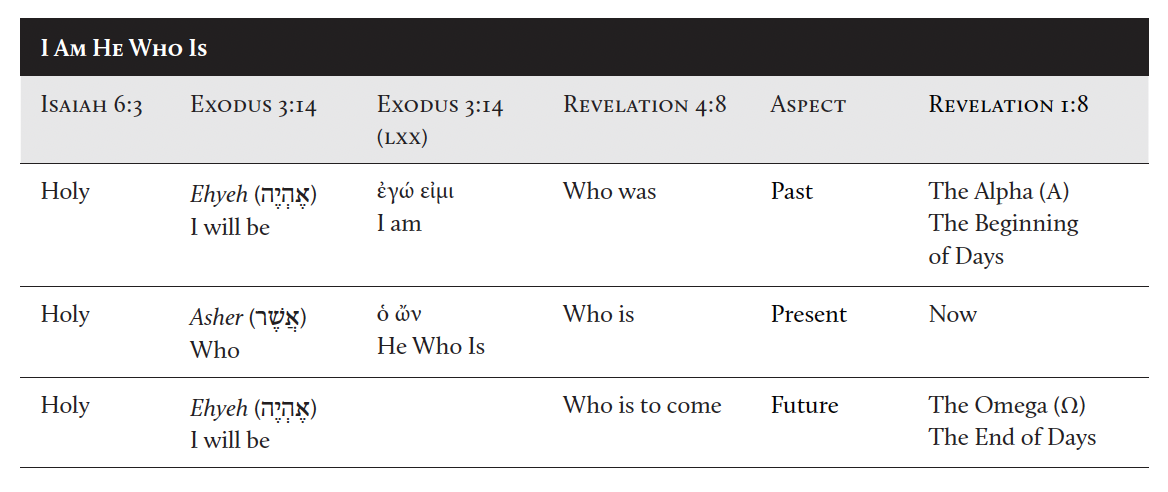
The four living creatures, each one of them having six wings, are full of eyes around and within; and day and night they do not cease to say, "Holy, Holy, Holy is the LORD God, the Almighty, who was and who is and who is to come." (Revelation 4:8)
Remarkably, this three-fold past-present-future approach to the story of the end of days corresponds with the name of God as glorified in the heavenly liturgies witnessed by John. The One who sits upon the throne is called "the Alpha and the Omega ... who is and who was and who is to come" (Revelation 1:4, 8). The angels around the throne do not cease from declaring the three-fold holiness of "the LORD God, the Almighty, who was and who is and who is to come."
The three-fold acclamation "holy, holy, holy" corresponds to the three Hebrew words of God's own self-disclosure to Moses at the burning bush. When Moses asked for God's name, He replied, "Ehyeh Asher Ehyeh (M nUt 1'ж)," meaning, "I Will Be As 1 Will Be."
In the Greek (LXX) version of the Torah, the name is translated as Ego Eimi O On (eyw siu o wv), which conveys the present-tense, "1 Am He Who Is" (Exodus 3:14). In both cases, the name of God communicates His transcendence outside of time. He is the eternal, timeless God at the beginning of time; He is the eternal, timeless God of the current moment, and He is the eternal, timeless God at the end of time.
The three-fold past-present-future explains our approach to understanding Revelation and the end of days. It's not a preterist interpretation (which locates the end of the age in the first century), nor is it an exclusively futurist interpretation (which denies the fulfillment of the prophecies in the first century). Instead, our approach to the book of Revelation considers things that happened prior to the revelation on Patmos, things which were happening at the time of the revelation on Patmos, and things "things which will take place after these things" (Revelation I:19).
In this lesson, we'll follow the history of the Jewish people in exile (past) and into the modern era (present) as we continue to prepare for learning about the redemption and the Day of the LORD (future). We will also revisit that prophecy from Revelation 12 about Lady Zion, who wears the crown of twelve stars and flees from the wrath of the dragon.
References
This lesson is adapted from Daniel Lancaster's teachings in The End of Days, as presented by First Fruits of Zion for the Torah Club.
Jacob’s Angels
Then Jacob sent messengers before him to his brother Esau in the land of Seir, the country of Edom. (Genesis 32:3)
Jacob's flight from Canaan, his twenty years living outside the promised land, and his eventual return to the land of his fathers, portended the exile of the Jewish people, their sojourn in the Diaspora, and their ultimate return to the land. It's an example of why the Talmud says, "The deeds of the fathers are portents for the sons." That means that the stories of Abraham, Isaac, and Jacob foreshadow the stories of their children, the Jewish people.
In the previous lesson, we explored one traditional explanation of Jacob's dream of the ladder. In that explanation, he saw angels ascending and descending upon him as he left the land of Canaan. The angels in the dream symbolized four empires that would oppress the children of Israel and carry them into exile. But that's not the only way to interpret the dream.
Another traditional interpretation explains the angels on the ladder as messengers that God sent to protect Jacob in exile and bring him safely back to the land of Canaan. Hence the promise, "Behold, I am with you and will keep you wherever you go, and will bring you back to this land; for 1 will not leave you until I have done what I have promised you" (Genesis 28:15).
Although Jacob did not always see God's angels watching over him, they protected and prospered him during his years in Aram. During his sojourn in exile, his family grew, and so did his wealth. When the time came, God's angels escorted Jacob back to Canaan. As he prepared to enter the land, he again encountered "the angels of God." They had come out to meet him and escort him home. He declared, "This is God's camp!" He named the place Mahanaim ("two camps") because he saw that the ordinarily invisible camp of God's angels had encamped around his family to protect them.
That's how the angels of God escorted Jacob and his family back to the land of Canaan, just as God had promised, "I will bring you back to this land":
Now as Jacob went on his way, the angels of God met him. Jacob said when he saw them, "This is God's camp." So he named that place Mahanaim. Then Jacob sent [angels] before him to his brother Esau. (Genesis 32:1-3)
The Hebrew word translated as "angels" (malachim, D'>$}p) can also be read as "messengers." Jacob sent messengers/angels (malachim) to Esau to announce his arrival. A few verses later, Jacob finds himself wrestling with an angel. Suffice it to say, there's a lot of angelic activity connected with Jacob's return to the promise land.
As mentioned above, the story of Jacob's flight from Canaan, his sojourn in the land of Aram, and his return to Canaan foreshadows the exile and the redemption of the Jewish people. Jacob's return from exile after a twenty-year absence from the promised land alludes to the final redemption when, at the end of the age, God will gather the exiles of Israel and return them to their ancient homeland. Just as God sent His angels to protect Jacob in exile and to escort him home again, He sends His angels to bring the exiles of Israel back to the land in the final redemption. Yeshua said, "When the Son of Man comes in His glory, and all the angels with Him .. He will send forth His angels with a great trumpet and they will gather together His elect from the four winds, from one end of the sky to the other" (Matthew 25:31, 24:31).
References
This lesson is adapted from Daniel Lancaster's teachings in The End of Days, as presented by First Fruits of Zion for the Torah Club.
Angels in Apocalypticism
In the Bible, angels serve primarily as God's messengers. That's what they are. Spiritual beings that God dispatches on errands. Angels make several appearances in the stories of Abraham, Isaac, and Jacob. Most of the time, they bring a message from heaven, but sometimes they have a different type of mission. For example, God sent two angels to investigate the sins of Sodom and Gomorrah, unleash God's wrath against those cities, and rescue Lot and his family.
In apocalyptic Jewish literature from the Second Temple Era (writings like Daniel, Zechariah, I Enoch, Jubilees, 2 Baruch, and 2 Ezra), angels take on larger and more complex roles. They are depicted as mediators of revela-tions, revealers of secrets, interpreters of dreams and visions, and heavenly tour guides. Angels act as warriors in the battle against the powers of evil, and archangels command heavenly armies. Angels sing in liturgical choirs. They serve in the heavenly Temple as priests officiating the worship of God, offering incense, and conducting ceremonial rites at the heavenly altar. They conduct the prayers of human beings into the presence of the Almighty, and then they carry His replies back to the petitioners.
Angels are especially involved in the end of days. They work as scribes and accountants, recording the deeds of human beings, reviewing heavenly ledgers, and conducting the heavenly tribunals. They are in charge of the heavenly books: the book of life, the book of death, and the book of deeds.
They put a mark on men destined for judgment, and they put a seal on those designated for preservation. They visit God's chastisements and burning wrath on the world of human beings, causing natural disasters, inspiring wars, releasing plagues, and visiting the earth with sorrow and death.
On the other hand, they act as agents of the redemption. They sound the heavenly trumpets, herald the coming of the Messiah, fight the enemies of God, and facilitate the resurrection of the dead. They steward over the redemption of the exiles of Israel and participate in the ingathering. Ulti-mately, angels usher in the Day of the LORD:
Behold, the Lord came with many thousands of His holy ones, to execute judgment upon all, and to convict all the ungodly of all their ungodly deeds which they have done in an ungodly way, and of all the harsh things which ungodly sinners have spoken against Him. (Jude 14-15; I Enoch 1:9)
Angels appear in a variety of forms, not always human-shaped, and not always winged. Angels might appear as winds, flames of fire, lamps, torches, stars, birds, animals, men, and otherwise mythical beasts. Since angels are spiritual beings, they can alter their guise in the eyes of human beings. The book of Revelation presents a wide array of angelic morphologies. Around the throne of God, fiery Seraphim angels from Isaiah 6 appear alongside the four-faced living creatures and wheel-angels from Ezekiel I, chanting out the praises of God.
The Bible has a variety of names for angels. They are called the sons of God, gods, princes, messengers, servants, stars, hosts, spirits (winds), and holy ones. Not all angels are good guys. The apocalypses have plenty of evil angels, such as the fallen "Watchers" who lusted after the daughters of men and said: "Come, let us choose wives from among them." Satan also has his own angels under his authority (Matthew 25:4I; Revelation 12:9). At the head of each of the seventy nations presides an angelic prince with spiritual authority over that nation (Daniel 10:20-21), but the Archangel Michael is the prince over Israel: "the great prince who stands guard over the sons of your people" (Daniel 12:1).
As we press further into the end of days and the book of Revelation, we can expect to see the angels stirring.
References
This lesson is adapted from Daniel Lancaster's teachings in The End of Days, as presented by First Fruits of Zion for the Torah Club.
Long Painful Exile
Then Jacob was left alone, and a man wrestled with him until daybreak. (Genesis 32:24)
While Jacob sojourned in the land of Aram, he suffered mistreatment and abuse at the hands of his uncle Laban and his cousins. Despite their unkindness and their attempts to impoverish him, Jacob prospered in exile. By the time God told him to return to the land of Canaan, he was the husband of four wives, father of eleven sons, and owner of an abundance of livestock. His wealth aroused jealousy from his uncle and his cousins, inspiring them to mistreat him further. They resented and feared him, but Laban did not want to see him return to Canaan. Laban intuitively knew that Jacob's presence brought a blessing to his household. He did everything he could to block Jacob from returning to Canaan.
In the end, Jacob had to flee from Laban and his sons. Even then, Laban and his sons set off in pursuit. Laban intended to kill Jacob and take back his daughters and flocks. Only God's divine intervention saved Jacob from the hand of his uncle.
The story of Israel's exile among the nations for the last two thousand years follows a similar plotline. While sojourning in exile, driven from nation to nation, the Jewish people have prospered despite adversity and targeted persecution. From the Middle Ages onward, the Jewish people endured centuries of hardship under Christian Europe. The proverbial "wander-ing Jew" refers to a chronic refugee problem as persecutions, pogroms, and anti-Jewish legislation have pushed the people from nation to nation. Forced expulsions occurred in England, France, Spain, Portugal, and the Papal states, displacing whole communities.
Along the way, Jews endured a litany of indignities, atrocities, and massacres inspired by theological anti-Semitism. Accused of being "Christ killers" and enemies of God responsible for the crime of deicide, Jewish people were treated with suspicion, hatred, and violence. Medieval passion plays cemented the image of Jews as the enemies of Christ and Christendom. It became a widespread custom to strike a Jew on Good Friday to avenge the crucifixion of Jesus.
Governments legislated harsh laws against Jews, restricting their move-ments, opportunities, and property rights. Jews were segregated into ghet-tos, barred from land ownership, and excluded from most trades. They were often pushed into moneylending careers, which were forbidden for Christians because of the prohibition on usury. The moneylending role exacerbated Gentile resentment and inspired the stereotype of Jews as greedy and money-loving.
Jews became the scapegoats for misfortunes. Jewish communities received the blame for the Black Death. They were falsely accused of poisoning wells. Blood libels falsely accused them of killing Christian children in evil rites and using their blood to make Passover matzah. Such conspiracy theories and outrageous allegations inspired repeated pogroms that wiped out and displaced villages and shtetls. The suffering became especially acute during the Crusades, when crusaders en route to fight in the Holy Land targeted Jewish communities along the way.
As the Middle Ages drew to a close and the Renaissance dawned, Spanish and Portuguese Inquisitions targeted conversos-Jews who had converted (often forcibly) to Christianity but were suspected of secretly retaining Jewish practices and beliefs. Jewish Christians were routinely arrested and tortured under those suspicions. At the same time, those who refused to convert to Christianity found themselves forcibly expelled from Portugal and Spain.
The Protestant Reformation did not improve matters for the Jews of Europe. Martin Luther called for the burning of synagogues, the closing of Jewish schools, and the confiscation of Jewish literature. He also recommended confiscating their wealth with the promise to return it to them if they would convert to Christianity.
In Eastern Europe, Ukraine, and Russia, waves of pogroms sanctioned by both the Orthodox clergy and the government periodically terrorized the Jewish populations. The pogroms heightened in frequency and intensity during the late nineteenth century. Meanwhile, Jews in Western European countries continued to find themselves marginalized despite their best efforts to shed Jewish identity and assimilate into the Gentile world.
It all came together in a demonic crescendo when the Nazis combined that long legacy of European Christian anti-Semitism with German nationalism and racial theories to author the Final Solution and the great tribulation of the Holocaust. Like an exclamation mark at the end of a long sentence of Jewish suffering, Nazi Germany and its collaborators systematically and efficiently murdered six million Jews. Had they not lost the war, they would have finished the Final Solution.
References
This lesson is adapted from Daniel Lancaster's teachings in The End of Days, as presented by First Fruits of Zion for the Torah Club.
Zionism and Israel
Your name shall no longer be Jacob, but Israel; for you have striven with God and with men and have prevailed. (Genesis 32:28)
The Bible unequivocally promises the ingathering of the Jewish people back to the land of Israel. It's the most frequently repeated prophecy in the Bible. The Messiah will "lift up a standard for the nations and assemble the banished ones of Israel, and will gather the dispersed of Judah from the four corners of the earth" (Isaiah II:12).
Through all the centuries of exile, the Jewish world waited for that promised redemption. Holding fast to the Bible's promises, the Jewish people longed for the coming of the Messiah and their return to the land of Abraham, Isaac, and Jacob. But the Messiah did not come.
In the Enlightenment Era of the late nineteenth century, Jewish thinkers and secularists abandoned hope in the coming of the Messiah and undertook the effort themselves. They called their movement Zionism. It refers to the ideology that the Jewish people should have their own sovereign nation rather than continue to live as a marginalized minority population within other nations. Naturally, most Zionists looked toward their ancestral land-the land of the Bible, a neglected tract of the Middle East owned by the Ottoman Empire. The founders of the movement framed Zionism as a secular initiative, but it was informed by the Bible's promises of a future return to the land of Israel. Bible prophecies fueled the secular dream.
Even before the establishment of Zionist initiatives, Jews fleeing poverty and persecution from Eastern Europe sought refuge in Ottoman Palestine.
Early Zionists began programs to buy parcels of land in Palestine. They encouraged settlers to start agricultural communities on the land they purchased. Jews began returning to the land in increasingly large numbers.
After World War 1, the British took possession of Palestine. The British Balfour Declaration of 1917 promised "a national home for the Jewish people" in Palestine, inviting more emigration. Increasing levels of anti-Jewish legislation during the lead-up to World War Il sent waves of displaced refugees seeking shelter in Palestine. They had nowhere else to go. Even the United States turned away Jewish refugees.
After World War II, Muslim nations throughout the Middle East turned against their Jewish populations. Ancient Jewish communities in countries like Iran, Iraq, Afghanistan, Morocco, Libya, and Syria were forcibly expelled or pressured to leave through threats and violence. In the wake of the Holo-caust, survivors in Europe looked toward Palestine hopefully, but the British reversed their promise of a national home for the Jewish people and closed Palestine's borders to Jewish emigration. In 1947, the British wanted out of the problem. They turned to the newly formed United Nations for direction. In view of the attempted genocide of the Jewish people and the ensuing refugee crisis, the United Nations agreed on the formation of a Jewish State in the Holy Land. The modern State of Israel was born. Since then, Jews have come home from all over the world to seek refuge in the new Jewish state.
In the late 1980s and early gos, when an Ethiopian civil war endangered ancient African Jewish communities, the State of Israel airlifted nearly the whole population of Ethiopian Jews out of danger and brought them home to the promised land. For most of the short history of the Soviet Union, Jews were kept locked behind the iron curtain, but as the regime lost its grip under glasnost and perestroika in the late 198os, vast numbers fled the tyranny of atheistic and anti-Semitic communism for life in Israel. Nearly one million Russian-speaking Jews found their way home.
Today, almost half of the world's surviving Jewish population lives in the land of Israel. It's not possible to take the Bible literally without admitting that the ingathering of the Jewish people, foretold by the biblical prophets, is underway in our modern era:
Do not fear, for I am with you; I will bring your offspring from the east, and gather you from the west. I will say to the north, "Give them up!" And to the south, "Do not hold them back." Bring My sons from afar and My daughters from the ends of the earth. (Isaiah 43:5-6)
References
This lesson is adapted from Daniel Lancaster's teachings in The End of Days, as presented by First Fruits of Zion for the Torah Club.
Facing Esau
Then Jacob lifted his eyes and looked, and behold, Esau was coming, and four hundred men with him. (Genesis 33:1)
Before he could return to the land, Jacob had to escape Laban and his sons. Then he had to wrestle an angel through the night. The next morning, he had to face Esau. Jacob hoped that his brother's anger had cooled over the last twenty years. On the contrary, Esau came out to meet him with four hundred armed men.
The confrontation with Esau contains hints about Israel's return to the promised land. In a previous lesson (Lesson 6), we learned that the rabbis considered Esau and his kingdom of Edom spiritually symbolic for the Roman Empire. Just as Esau's wrath forced Jacob to flee from Canaan, Rome's wrath forced the Jewish people into the long exile. That's not the literal meaning of the story of Jacob and Esau. It's more like a parable. But suppose we were to extend the parable into Jacob's return in Genesis 32-33. In that case, we might expect to see confrontation between the Jewish people and whatever world power now occupies the role of adversary as Israel returns from exile. (As we will see below, the Jewish people have faced unrelenting conflict from adversaries since their return to the promised land.)
In the story, Jacob wisely avoids conflict by bribing his brother with gifts and mollifying his wrath with humble gestures. Nevertheless, Jacob did not assume that his brother's good graces would last forever. When Esau urged him to return with him to his home on Mount Seir in the land of Edom, Jacob accepted the invitation and promised to come, but he did not go. The rabbis concluded that Jacob's promise to Esau will be fulfilled on the Day of the LORD, when the kingdom comes. Then the Messiah will take possession of the nations, including both Rome and Edom: "The deliverers will ascend Mount Zion to judge the mountain of Esau" (Genesis Rabbah 78:14; Rashi on Genesis 33:14).
References
This lesson is adapted from Daniel Lancaster's teachings in The End of Days, as presented by First Fruits of Zion for the Torah Club.
Trouble in the Land
You have brought trouble on me by making me odious among the inhabitants of the land, among the Canaanites and the Perizzites. (Genesis 34:30)
Jacob settled in the land at Shechem, but he had to contend with the Canaanites who already lived there. They raped his daughter. His sons retaliated. They slaughtered the men of Shechem. Jacob complained that their disproportionate retaliation incited the wrath of the inhabitants of the land; "They will gather together against me and attack me and I will be destroyed, I and my household."
Jacob fled to Bethel, where he had first seen the vision of the ladder, but his trials in the land were not yet at an end. On the road from Bethel to Hebron, he suffered the loss of his beloved wife, Rachel. She died during the travail of childbirth.
Likewise, every step of the way back has been a fight and a sorrow for the Jewish nation. Surrounded by enemies and targeted by unceasing hos-tilities, Israel has been locked in an existential battle for the survival of the Jewish people since its inception. During World War II, the Palestinian Arab population colluded with Hitler and adopted the goals of the Final Solution. The Nazis translated their propaganda against Jews into Arabic and distributed it widely throughout the Middle East (where it continues to circulate).
On the same day that the State of Israel declared its independence, seven Arab nations invaded, vowing to push the Jews into the sea. Israel had no army, only a poorly trained militia. Against overwhelming odds, the fledgling state prevailed in that war. God miraculously intervened to defend the tiny nation in the War of Independence (1948-1949), again in the Six-Day War (I967), again in the Yom Kippur War (1973), and to this day. The modern wars of the State of Israel unfold like the miracle stories of Old Testament victories. The state's continued existence over the last eighty years, despite all adversity and international hatred, defies natural explanations. To those with eyes to see, it should be obvious that God dispatches angels to fight on Israel's behalf. Even secular Israelis admit that anyone who denies the miracles in Israel is simply not being realistic.
References
This lesson is adapted from Daniel Lancaster's teachings in The End of Days, as presented by First Fruits of Zion for the Torah Club.
The Endless War
My men being few in number, they will gather together against me and attack me and I will be destroyed, 1 and my household. (Genesis 34:30)
The War for Independence displaced more than half a million Palestinian Arabs. Israel refused to allow the refugees to return after the war. In the Six-Day War, Israel took Sinai from Egypt, Judea and Samaria (aka the West Bank) from Jordan, and the Golan from Syria, but did not annex those ter-ritories. The unresolved status of Palestinian refugees and the unresolved status of Palestinian Arabs in Judea and Samaria has been a festering sore for the state, resistant to all remedies and subject to various infections.
Arab states in the Middle East conspired with the Soviet Union to eliminate the Jews from the Middle East. After their failures in the Six-Day War and the Yom Kippur War, the Soviet Union organized the Palestinian Liberation Organization (PLO) and coordinated an endless war of terrorism. The KGB also created propaganda initiatives in student movements and within the UN to demonize and condemn both Zionism and the State of Israel. In keeping with that long-standing policy, Palestinian leadership repeatedly refuses a two-state solution in favor of a never-ending war of terror and hatred against Israel. The Iranian revolution (also supported by the Soviets) brought Muslim fanaticism to political power and made the elimination of Israel the religious duty of Islamic Jihad (holy war). The goal of that Jihad is nothing short of the genocide of all Israeli Jews "from the river to the sea."
Long after the collapse of Nazi Germany and the Soviet Union, their anti-Jewish and anti-Israel propaganda continues to propagate and control world opinion. Meanwhile, the enemies of Israel continue to misuse Palestinian Arabs as unwitting pawns and trophy victims in a long game toward the demonization and destruction of the Jewish state. Palestinian terrorists are celebrated as heroic liberation fighters while the Israeli Defense Force is villainized and unfairly mischaracterized. The uN has made the hypocritical condemnation of Israel into its full-time mission while turning a blind eye to all other humanitarian crises and human rights violations in the world. No other state in the world endures such scrutiny and hatred.
The world's almost universal condemnation of the State of Israel and hatred for the Jewish people, which grows louder every day, also comes as the fulfillment of biblical prophecies about the end of days. It's yet another indication that the end times have resumed. The Bible says that, in the end of days, the nations will rally together against Israel and the Jewish people in the war of Gog and Magog (Ezekiel 38-39). We teeter on the edge of that war today.
References
This lesson is adapted from Daniel Lancaster's teachings in The End of Days, as presented by First Fruits of Zion for the Torah Club.
Not the Kingdom Yet
God said to him, "Your name is Jacob; you shall no longer be called Jacob, but Israel shall be your name." Thus He called him Israel. (Genesis 35:10)
The ingathering of the exiles of Israel back to the land after a two-thousand-year absence seems to be a clear token that the wheels of the end times are turning again. The rage of the nations against the presence of Jewish people in the land of Israel also seems to betoken a fulfillment of end-times prophecy.
Nevertheless, one should never mistake the modern State of Israel for the kingdom. When the kingdom of heaven comes, the government of Israel will fall under the authority of King Messiah. He will subdue the nations, and there will be peace on earth. The nations will not make war. All nations will be blessed through Abraham's seed. There will be no scarcity. Every person will sit under his own vine and fig tree. The house of the God of Jacob will be restored. Everyone will know the LORD. The people will walk according to God's commandments. The Torah will go out from Zion to all nations. So it's safe to say that we aren't there yet.
Unlike the future kingdom, the modern State of Israel is a nation like other nations on earth, deeply flawed, divided, rife with political corruption, and in pursuit of the things of this present age. Founded on the secular and progressive ideals of the Modern Era, the Jewish state is mostly irreligious. Only about half of Israelis identify as religious or Torah-observant at all. For many Israelis, Shabbat is simply a day off from work, not a day sanctified to God. Israeli secular culture emulates the sins and vices of other Western nations. Drug and alcohol addiction, pornography, sexual promiscuity, abor-tion, divorce, and all the failings of the modern world are also found in Israel.
Government corruption runs deep in the holy land. Criminal enterprises within Israel wield immense power in business and politics. National policies, both foreign and domestic, often go amiss. Religious Jews enjoy government benefits and exemptions from military service that inspire resentment from secular Jews, deeply dividing the society. Failure to adequately address the displaced Palestinian refugee population has left that population vulnerable to propaganda and radicalization. Aggressive settlement policies alternating with abrupt reversals on those policies communicate mixed messages that exacerbate frustrations on all sides. Eye-for-eye retaliations against terror fail to keep terrorism in check but continue to radicalize bel-ligerents. Homegrown terrorists in the form of radical Jewish nationalists carry out their own versions of an intifada against their Palestinian neigh-bors, further inflaming hatreds. By all measures, Israel is not the promised kingdom-not yet.
However, none of those deficiencies disqualifies the Jewish people in the land of Israel from God's purposes or covenantal promises. The covenant has not been cancelled by grace or replaced by a new one. The Jewish people have not been replaced by a new religion. The people of Israel are still the people of the book, the holy nation, and the chosen people, whether they want to be or not, whether they deserve to be or not. Israel's election is not based on merit; it's based on God's unbreakable covenant promises. It's possible to be in violation of the terms of the covenant and still be in the relationship. It's even possible that, without repentance, Israel might forfeit the redemption again and descend back into exile (God forbid) according to the terms of the covenant. It has happened before.
The modern State of Israel is a far cry from the utopian ideals of the coming kingdom, but the very existence of the state looks like a hopeful step in that direction. It can be seen as an indication that the end of days has resumed and the kingdom is, once again, at hand. The redemption is just around the corner. That's why the synagogue prayer for the welfare of the State of Israel (composed in 1948, shortly after the establishment of the state) refers to the nation as "the first blossoming of our redemption." It's a promise of what is to come.
References
This lesson is adapted from Daniel Lancaster's teachings in The End of Days, as presented by First Fruits of Zion for the Torah Club.
Son of Days
Rachel began to give birth and she suffered severe labor. (Genesis 35:16)
If the end times are resuming, that means the birth pains of the Messiah must also resume-until the baby is born. In previous lessons, we learned that Jewish eschatology anticipates a period of trouble and tribulation prior to the coming of the Messiah. That period of tribulation can be compared to the labor pains of a woman about to give birth. The so-called birth pains of Messiah (Chevlei Mashiach) feature prominently in the biblical prophets, in Jewish apocalypses, and in rabbinic literature.
We have also learned that the Prophet Jeremiah predicted a time of tribulation before the final redemption that he called "the time of Jacob's distress." In that day of trouble, the men of Israel suffer anguish, terror, and dread "as a woman in childbirth" (Jeremiah 30:5-7). "The time of Jacob's distress" that besets the people "as a woman in childbirth" seems reminiscent of the travail and death of Jacob's beloved wife, Rachel. With her dying breath, Rachel named the child that caused her so much pain Ben-oni ("1X*|]), "son of my trouble." Thus, she gave Jacob his twelfth and last son, completing the number of Israel.
Son of My Trouble alludes to the birth pangs of the Messiah and the tribulations that must come before the redemption. The name aptly describes the first coming of Yeshua, who was born in Bethlehem, near Rachel's tomb. He brought the sword of judgment to the nation (Matthew 10:34). The time of trouble that Yeshua predicted descended on the Jewish people as He predicted. The destruction of the Temple and Jerusalem came after His death, resurrection, and ascension. The great exile and all the calamity that has befallen the Jewish people for the last two thousand years began with that son of trouble: the Messiah.
Jacob changed the child's name to Benjamin (Benyamin), which might mean, "Son of the right hand," or, alternatively, "Son of Days." A legend in Testament of Benjamin says that Rachel fasted and prayed for twelve days before she was able to conceive Jacob's twelfth son and complete the number of Israel. Therefore, he was named "Son of Days."
Rachel remained barren for twelve years after she had given birth to Joseph. She beseeched the LORD with fasting for twelve days, and she conceived and gave birth to me (Benjamin). For my father loved Rachel dearly, and he prayed that he might see two sons born from her. Therefore I was named Benjamin, that is, a Son of Days. (Testament of Benjamin 1:4-6)
Son of Days alludes to the long wait for the Messiah, Israel's prayers for His coming, and His ultimate arrival on the Day of the LORD. Son of My Right Hand alludes to the Messiah's exalted position at the right hand of glory and His identity as the Son of God. The Psalms refer to the Messiah as "the man of Your right hand" (Psalm 80:17); "Sit at My right hand until I make Your enemies a footstool for Your feet" (Psalm IIO:I).
References
This lesson is adapted from Daniel Lancaster's teachings in The End of Days, as presented by First Fruits of Zion for the Torah Club.
Crown of Twelve Stars
The entire nation of Israel is called by the name Rachel. (Genesis Rabbah 82:10, on Jeremiah 31:15)
In one of Joseph's dreams, he sees himself and his eleven brothers as stars in the sky. He sees his father and mother as the sun and the moon (Genesis 37:9-10). The imagery from Joseph's dream adorns the woman in Revelation 12. She is "clothed with the sun, and the moon under her feet, and on her head a crown of twelve stars" (Revelation 12:1). The allusions to Rachel are intentional. The woman is depicted "being in labor and in pain to give birth" (Revelation 12:2).
She gives birth to the Messiah. The child brings her trouble in the form of persecution because it attracts the attention of the dragon, who wants to devour it. The child is taken away from her, alluding to Jeremiah's prophecy, "Rachel is weeping for her children; she refuses to be comforted for her children, because they are no more" (Jeremiah 3I:15). They have gone into exile. The Hebrew of Jeremiah 31:15 can also be read to say that Rachel weeps for her children because "He is no more," that is to say, the Messiah is no longer present with her. Instead, he has been "caught up to God and to His throne" (Revelation 12:5). The Messiah remains concealed from her at the right hand of the throne of glory, corresponding to the name Jacob gave the child: Benjamin, Son of the Right Hand.
The woman is forced to flee into the wilderness, symbolizing Israel's exile from the promised land. She is given "two wings of the great eagle" so she could fly into the wilderness, taking refuge in the wide Diaspora of the earth (Revelation 12:14). The dragon pursues her, spewing a flood of water from his mouth to sweep her away. The water spewing from the dragon's mouth represents Satan's attempt to snuff the Jewish people out of existence by turning the nations against Israel:
Alas, the uproar of many peoples who roar like the roaring of the seas, and the rumbling of nations who rush on like the rumbling of mighty waters! The nations rumble on like the rumbling of many waters. (Isaiah 17:12-13)
The waters fail because the people are scattered so widely across the earth. The dragon's efforts are exhausted: "The earth helped the woman, and the earth opened its mouth and drank up the river which the dragon poured out of his mouth" (Revelation 12:16, cf. Isaiah 17:12-14). Therefore, the dragon turns his attention to the other children of the woman.
As the end of days resumes, we can anticipate a second period of great travail before the Messiah's second coming. Angelic forces will once more ascend and descend. They will struggle against the powers of darkness and wrestle with human beings. They will unleash judgment and tribulation on the earth in the form of cataclysm and catastrophe.
In the coming days, the forces of Gog and Magog will rise up to drive the Jewish people from the holy land. A World Deceiver will lead them, acting as the agent of the dragon in his endless war against the Jewish people and the disciples of Yeshua. According to the book of Revelation, all these troubles remain yet to come for the woman and her children.
Nevertheless, the joy of Yeshua's appearing in glory with His Father's angels will erase the memory of those dark days of trouble:
Whenever a woman is in labor she has pain, because her hour has come; but when she gives birth to the child, she no longer remembers the anguish because of the joy that a child has been born into the world. Therefore you too have grief now; but I will see you again, and your heart will rejoice, and no one will take your joy away from you. (John 16:21-22)
When He returns, the Jewish people will recognize their Son of Trouble as the Son of the Right Hand, the one seated at the right hand of the Father. He is the Son of Days for whom Israel has waited and prayed for so many years. He is the Messiah who was, and is, and is to come.
References
This lesson is adapted from Daniel Lancaster's teachings in The End of Days, as presented by First Fruits of Zion for the Torah Club.