Beginning of the Birth Pains
Judgment Begins With the House of God
The time of the judgment begins with the house of God, and if it starts with us, how will it end for those who disobey the good news of God? (I Peter 4:17, my translation)
The Apostle Peter says that the day of judgment “begins with the house of God.” This means it starts with Israel, i.e., the household of God and it starts with the Temple, i.e., the house of God. If so, the end of days must have begun with the destruction of Jerusalem and the house of God in 70 CE. That matches what the Prophet Daniel predicted. He said that, after the death of the Messiah, the fall of Jerusalem, and the destruction of the Temple, the "end will come with a flood; even to the end there will be war; desolations are determined" (Daniel 9:26).
Two thousand years after the Romans destroyed God's house in Jerusalem, the house of God still takes center stage in world events. Islam is concerned with control of the "the holy place" (Matthew 24:15), where Allah has taken "his seat in temple of God" and is exalted "above every so-called god or object of worship" (2 Thessalonians 2:4). When Hamas launched its war against Israel on October 7, 2023, spokesmen for the terrorist organization named the attack the Al-Aqsa Flood, referring to the Al-Asqa Mosque, which stands on top of the Temple Mount in Jerusalem. The terrorists explained that they attacked Israel in response to alleged Israeli incursions into the mosque. They said they needed to fight the Jews to stop the rebuilding of the Temple. The name Al-Aqsa Flood evokes Daniel's dire prophecy, "its end will come with a flood" (Daniel 9:26).
The massacre of October 7, 2023, opened a bloodletting that has spilled over to the rest of the world. Inspired by the brazenness of the Hamas terrorists who brutalized, raped, and murdered their way through Israel's civilian population along the Gaza border, Islamic terrorists in Syria, Nigeria, Sudan, and the Democratic Republic of Congo have carried out similar atrocities and brazen massacres against non-Jews. Whole communities have been slaughtered in Syria. Whole villages have been killed in Nigeria. Whole congregations of Christians have been beheaded in their churches in the DRC.
It looks like Islam is auditioning for the role of the chief villain in the unfolding drama of the end of days. Starting with the Jews, the Muslim faith requires the elimination of infidels either through forced conversion or extermination. The eschatology of Islam drives discipleship to Muhammad. Muslim eschatology encourages the faithful to make war against all non-Muslims as the path toward world peace. That's why Islam is euphemistically called "the religion of peace." Islam looks forward to a caliphate—a literal kingdom of Allah on earth-under the sword of shariah law. If the hope for a coming kingdom sounds similar to what we believe, that's because it is derived from a distorted reading of the same biblical passages that promise the coming end of the age and the kingdom of God. Muslim eschatology perverts the apocalyptic message of Jewish prophecy.
Islam wages war with Israel, with the Jewish people, with Christianity, with Christians, and with the entire Western world. That makes Islam today's top contender for the role of the Beast, as described in the book of Revelation. But other contenders have played the role before. During the days of the New Testament, when the book of Revelation was written, Islam did not yet exist. The New Testament predates Muhammad by nearly 700 years. During the New Testament Era, Rome was the Beast. The Roman Empire was the kingdom of darkness and the kingdom of this world. The Roman Empire was the center of Jewish concern. Rome played the role of chief villain in Jewish apocalypses from the late Second Temple Era into the Middle Ages.
Two thousand years after Rome destroyed the Temple, the same spiritual forces continue to wrestle. It's as if Isaac and Ishmael are still competing for Abraham's blessing. It's as if Jacob and Esau are still wrestling for Isaac's blessing.
References
This lesson is adapted from Daniel Lancaster's teachings in The End of Days, as presented by First Fruits of Zion for the Torah Club.
Edom and Rome
Two nations are in your womb; two peoples will be separated from your body; one people shall be stronger than the other, and the older shall serve the younger. (Genesis 25:23).
Isaac's wife, Rebekah, was barren for twenty years. A legend says Isaac brought her to Mount Moriah, where he himself had once been bound. He prayed for her there. God answered, and she conceived, but her pregnancy brought extraordinary pain. Unaware she carried twins, Rebekah cried, "Why am I this way?" The LORD replied with a short oracle explaining that she carried twins competing for supremacy. The twins represented two peoples, one stronger than the other, but their roles would ultimately be reversed, "and the older shall serve the younger."
The babies, Jacob and Esau, became forefathers of two nations destined for conflict: Israel and Edom. The neighboring nations inherited the enmity of the brothers. Hostilities began in the wilderness when the Amalekites (an Edomite tribe) attacked Israel (Exodus 18). Rivalry continued through the monarchy, exile, and beyond. The Edomites participated in Jerusalem's fall to Babylon, prompting prophetic rebukes of the book of Obadiah.
In the Apostolic Era, the rabbis began to refer to Rome with the code-word Edom. During those dangerous years, criticism of Rome could lead to imprisonment, trial, and execution. To avoid arrest and execution, the rabbis spoke in cryptic symbolic language where they understood Edom as a cipher for Rome. They derived the terminology from Psalm 137:7, which mentions the Edomites shouting for the destruction of Jerusalem:
Remember, O LORD, against the sons of Edom the day of Jerusalem, who said, "Tear it down, tear it down to its very foundation." (Psalm 137:7)
The Roman destruction of Jerusalem created a natural, homiletic bridge between Rome (with her penchant for red standards and uniforms) and the children of Esau. The stories about Jacob and Esau became fraught with symbolic meaning about the relationship between the Jewish people and the Roman Empire.
The apostles adopted their own code language for speaking about Rome. Drawing a connection from the same psalm, they began referring to the Roman Empire as Babylon and "daughter of Babylon":
O daughter of Babylon, you devastated one, how blessed will be the one who repays you with the recompense with which you have repaid us. (Psalm 137:8)
References
This lesson is adapted from Daniel Lancaster's teachings in The End of Days, as presented by First Fruits of Zion for the Torah Club.
The Fourth Beast
Daniel said, "I was looking in my vision by night, and behold, the four winds of heaven were stirring up the great sea. And four great beasts were coming up from the sea, different from one another." (Daniel 7:2-3)
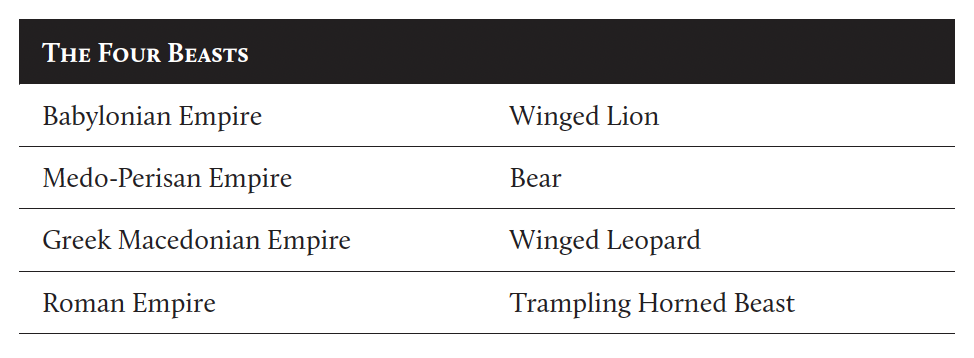
Apocalyptic literature uses various types of animals to symbolize the nations. Daniel depicts four subsequent world empires as four types of beasts coming up out of the sea (Daniel 7). The first beast was a winged lion, symbolizing the Babylonian Empire of Nebuchadnezzar that conquered Jerusalem and destroyed the Temple in 586 BCE. Nebuchadnezzar also carried Daniel and his friends into captivity in Babylon.
The second beast was a great bear with three ribs hanging from its maw, eating its fill of flesh. It symbolized the Medo-Persian Empire that conquered Babylon, Lydia, and Egypt. This was the empire of Darius that took possession of Daniel and the Judean captives.
The third beast was a four-winged leopard with four heads. It symbolized the Greek Macedonian Empire under the conquests of Alexander the Great. The four heads symbolized the four generals who divided the empire after Alexander's death.
Then Daniel sees the fourth beast:
After this I kept looking in the night visions, and behold, a fourth beast, dreadful and terrifying and extremely strong; and it had large iron teeth. (Daniel 7:7)
Who is the fourth beast? Daniel's vision foresaw the dreadful Roman Empire:
It devoured and crushed and trampled down the remainder with its feet; and it was different from all the beasts that were before it, and it had ten horns. (Daniel 7:7)
The whole Mediterranean suffered under the trampling feet of the dreadful iron-toothed beast. The Roman Empire extended into Europe, to Spain, to Britain, to Cyrene, to Egypt, all the way to the border with Parthia, and it ruled over the Jewish people. Instead of the Son of David ruling in Jerusalem, Roman governors administered Judea as a Roman Province. Herodian kings served as puppets for Rome, handling the Jews on behalf of the Caesars. The idolatrous Gentile cities of the Decapolis brought the power of Greek gods and Roman flags and standards within the borders of the Holy Land. The Beast controlled the Temple Mount and the priesthood, and, ultimately, the Beast trampled Jerusalem under its feet, bringing an end to the daily sacrifices.
References
This lesson is adapted from Daniel Lancaster's teachings in The End of Days, as presented by First Fruits of Zion for the Torah Club.
The Red Hairy Beast
Now the first came forth red, all over like a hairy garment; and they named him Esau. (Genesis 25:25)
What kind of animal is the fourth beast? Unlike the lion, bear, and leopard of the earlier visions, Daniel doesn't compare the fourth beast to any known animal. That's deliberate. The uncertainty highlights the fourth beast's unnatural and monstrous nature. Unlike any of the previous beasts, it has ten horns and unnatural teeth of iron. It tramples underfoot all that remains of the previous beasts. Daniel describes it as "dreadful and terrifying and extremely strong" (Daniel 7:7). The book of Revelation described it as a phantasmagorical, ten-horned, seven-headed chimera possessing elements of the previous three beasts, "like a leopard, and his feet were like those of a bear, and his mouth like the mouth of the lion" (Revelation 13:2). In contrast to that chimerical mashup, the rabbis simply pictured the fourth beast as a big wild pig.
Rabbinic literature depicts the beast of Rome as the pig, particularly the wild boar, a type of hairy tusked pig native to the land of Israel. What's more, the ruddy tint of the pig's skin and its hairy coat evoked associations with Esau. When discussing the symbolic meaning of the dietary laws, the rabbis explained that the swine uniquely symbolizes Rome because of its hypocrisy. From all external appearances, the pig seems to be a clean animal, but it is not:
The pig, for though it divides the hoof, thus making a split hoof, it does not chew cud, it is unclean to you. (Leviticus II:7)
When the swine is lying down it puts out its divided hoofs, as if to say, "I am clean." Likewise, the wicked state robs and oppresses yet pretends to be executing justice. (Genesis Rabbah)
The Torah's dietary laws required animals fit for food to have a divided hoof and to ruminate. A pig's split hoof makes it look like it's permitted for food, but the pig does not ruminate. Similarly, the Roman Empire appeared virtuous in its administration, but in reality, Roman governors and officials committed violence and robbery under the guise of establishing justice.
It's worth noting that the New Testament also associates Rome with the pig. Yeshua warned His generation about granting Rome authority over the Temple and the priesthood (which happened in those days) when He said, "Do not throw your pearls before swine, or they will trample them under their feet, and turn and tear you to pieces" (Matthew 7:6). Wild boars are dangerous animals, well-known for charging and goring with their tusks. They trample victims under their hooves. Those trampling hooves also damage vineyards and agricultural land, making them hated and feared by farmers in Israel to this day. Exactly as Yeshua predicted, Rome turned against the Temple and the holy city and trampled it underfoot (Cf. Revelation II:2).
References
This lesson is adapted from Daniel Lancaster's teachings in The End of Days, as presented by First Fruits of Zion for the Torah Club.
This Age and the Age to Come
Afterward his brother came forth with his hand holding on to Esau's heel, so his name was called Jacob; and Isaac was sixty years old when she gave birth to them. (Genesis 25:26)
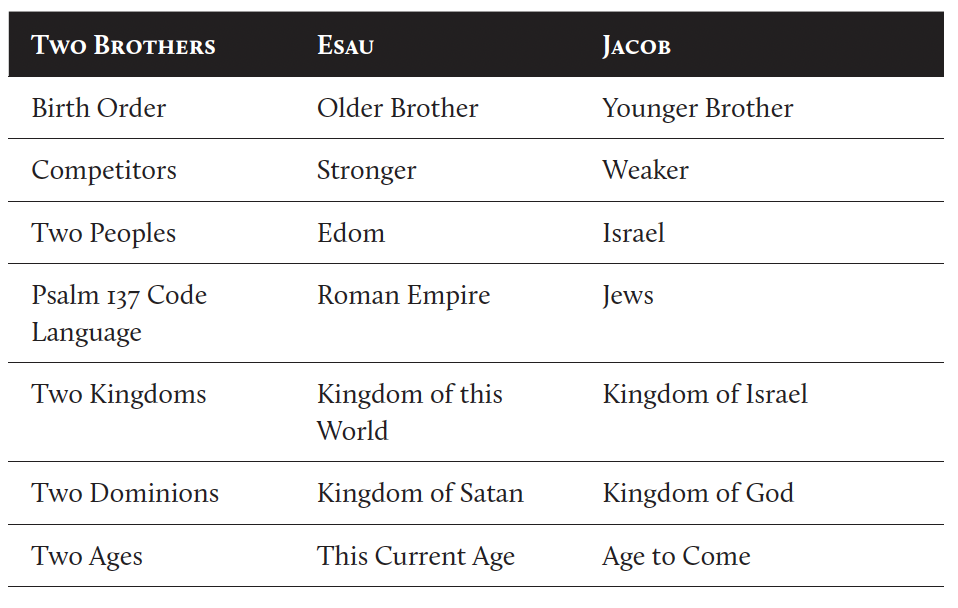
In the teaching of the rabbis, the wrestling match between Jacob and Esau became a metaphor for the struggle between the Jewish people and the Roman Empire. That struggle persisted even after the destruction of the Temple. While Rome dominated this current age, the future age belonged to Israel.
The words, "the older will serve the younger," were interpreted in reference to the two ages: This current age is the older one. It will yield in servitude to the age to come. In the future Messianic Era, "deliverers will ascend Mount Zion to judge the mountain of Esau, and the kingdom will be the LORD's" (Obadiah 21).
The apocryphal book of 4 Ezra, a first-century apocalypse written around the same time as the book of Revelation, compares the birth of Jacob and Esau to the transition from this current age to the age to come. Jacob symbolizes the coming age, but Esau symbolizes this current age. That's why Esau is born first. Jacob enters the world clutching the heel of Esau, signifying that the age to come follows immediately after this current age:
"How will the eras be divided? When will the first age end and the age to follow begin?" He said to me,"... Jacob's hand clutched Esau's heel from the beginning. Esau is the end of this age, but Jacob is the beginning of the age that follows. For the beginning of a man is his hand, and the end of a man is his heel. Between the heel [of Esau] and hand [of Jacob], look for nothing else, Ezra!" (4 Ezra 6:7-9)
The following chart shows the evolution of the Jacob-and-Esau symbolism as it developed into an antithesis between this current age and the age to come.
References
This lesson is adapted from Daniel Lancaster's teachings in The End of Days, as presented by First Fruits of Zion for the Torah Club.
A Three-Headed Eagle and the Vine
I kept looking in the night visions, and behold, with the clouds of heaven one like a Son of Man was coming, and He came up to the Ancient of Days and was presented before Him. (Daniel 7:13)
At the conclusion of the vision of the four beasts, the Prophet Daniel sees the day of judgment. The Ancient of Days takes His seat on the throne of judgment. The books of judgment are opened. The fourth beast is slain. Its body is thrown into the flames. The Messiah comes "with the clouds of heaven," in appearance "like a Son of Man" (Daniel 7:13). He receives authority to rule over "all the peoples, nations and men of every language" in an everlasting kingdom which will not pass away or be destroyed as the empires of the four beasts were.
The important thing to notice is the sequence of events. The fourth beast is followed by the day of judgment, the end of the age, and the beginning of the age to come. The Messiah defeats the fourth beast and replaces its kingdom with the Messianic Kingdom of God. Apocalyptic literature further illustrates the transition with embellishments on Daniel's bestiary.
For example, in the apocryphal book of 4 Ezra, Ezra the scribe sees a vision of a great three-headed eagle that rises over the whole earth and takes power over the entire world (4 Ezra 11). To his surprise, he sees the wings of the eagle competing with one another to control the bird. Smaller upstart wings keep sprouting out of the body. Ultimately, a lion rises from a forest. It roars at the eagle and rebukes it for its corruption, its wickedness, and its cruel despotism. The lion declares an end to the eagle's dominion.
Don't worry if the symbolism seems too cryptic. The next chapter offers an interpretation. The eagle represents the fourth beast from the book of Daniel. The competing wings that keep sprouting from the eagle represent various factions and leaders vying for power. The lion represents "the Messiah whom the Most High has kept until the end of days, who will arise from the seed of David ... He will denounce them for their ungodliness and for their wickedness, and will present before them their corrupt deeds" (2 Esdras 12:32-33). The leadership of that evil government will be forced to stand trial before the judgment seat of the Messiah. He will sentence them to destruction, but He will show mercy to the remnant of the Jewish people and preserve them "until the end comes, the day of judgment" (4 Ezra 12:34).
Here's another example from apocalyptic literature dramatizing the same events. In the apocryphal visions of 2 Baruch, Baruch, the scribe of Jeremiah, has a prophetic dream in which he sees a forest surrounded by mountains. A lowly vine and peacefully flowing fountain arise in the midst of the forest. Nourished by the water of the fountain, the vine climbs the trees of the forest and spreads its canopy until it dominates both the forest and the mountains. Finally, only a single mighty cedar remains. The vine opens its mouth and rebukes the cedar for its corruption, deceit, and wickedness: "You kept conquering that which was not yours... and you kept extending your power over those both far and near ... but now your time is over and your hour is come" (2 Baruch 36:8-9).
The vision is explained to Baruch. The great forest is the fourth beast of Daniel's vision:
A fourth kingdom will arise, more powerful, cruel, and evil than any that came before it. It will rule for many years as a forest in a plain ... and will exalt itself higher than the cedars of Lebanon. It will conceal truth, and all who are polluted with iniquity will take shelter in it, as evil beasts take shelter and creep in the forest. (2 Baruch 39)
The vine and the fountain that overcome the forest is the kingdom of the Messiah. The lofty cedar left standing in the forest is the last emperor:
The last leader of that time will be left alive... he will be bound, and they will take him up to Mount Zion, and My Messiah will convict him of all his crimes ... he will put him to death, and protect the rest of My people which shall be found in the place which I have chosen. His kingdom will endure forever, until the age of decay is at an end, until the times are fulfilled. This is your vision, and this is its interpretation. (2 Baruch 40)
Here's the point: The Jewish apocalyptic imagination looked forward to a confrontation between the Messiah and the fourth beast of Daniel's visions.
References
This lesson is adapted from Daniel Lancaster's teachings in The End of Days, as presented by First Fruits of Zion for the Torah Club.
The Third Temptation
The devil took Him to a very high mountain and showed Him all the kingdoms of the world and their glory. (Matthew 4:8)
Like Jacob wrestling Esau for dominion, the Messiah is destined to wrest dominion away from the kingdom of the fourth beast. Daniel's prophecy of the four beasts indicates that the end of the age culminates in a struggle between Rome and the Son of Man. The apocalyptic dramatizations from 4 Ezra and 2 Baruch make that interpretation explicit. The Messiah is the Son of Man who will prevail over the fourth beast and take possession of all the kingdoms of the world.
That destiny explains the third temptation during Yeshua's forty days in the wilderness. Satan offers to help Yeshua fulfill His messianic purpose by granting Him authority over "all the kingdoms of the world":
He led Him up and showed Him all the kingdoms of the world in a moment of time. And the devil said to Him, "I will give You all this domain and its glory; for it has been handed over to me, and I give it to whomever I wish. Therefore if You worship before me, it shall all be Yours." (Luke 4:5-7)
In his Hebrew commentary on the New Testament, Rabbi Yechiel Tzvi Lichtenstein explains what is going on behind this scene:
Each nation is ruled by an angelic prince, as explained in Daniel (I0:20), and Satan was the prince of Rome, as it says in Revelation 13:2, "The dragon (which is Satan) gave the beast his power, his throne, and great authority." At that time, Rome ruled over all kingdoms, installing and deposing kings. (Lichtenstein, Commentary on the New Testament, Matthew 4:9)
Thus, Satan offered Yeshua the reins to the Roman Empire and all the kingdoms of the world if only He would ascribe him worship and obeisance. The third temptation offered Yeshua a shortcut to fulfill His mission. Satan offered to install Him as the next Roman emperor.
Let's make sure we get the picture here. Take a good look at the offer on the table.
The apocalyptic worldview stages a confrontation between the kingdom of darkness (ruling over this current age) and the kingdom of God (ruling over the age to come). The Roman Empire under the power of Caesar represents the kingdom of darkness as the physical manifestation of Satan's power in this present age. The future kingdom of God under the power of Messiah, the son of David, represents the kingdom of light as the physical manifestation of God's power in the age to come. To get us through that transition, the Messiah must defeat Rome (the fourth beast) and replace its kingdom with His rule over the world and thereby usher in the age to come. In short, the battle for the end of the age is a battle between the Messiah and Rome.
References
This lesson is adapted from Daniel Lancaster's teachings in The End of Days, as presented by First Fruits of Zion for the Torah Club.
My Name is Legion
He was asking him, "What is your name?" And he said to Him, "My name is Legion; for we are many." (Mark 5:9)
The story of Yeshua driving the demons into the swine reads like another apocalyptic dramatization of the confrontation between Messiah and Rome. The demoniac in the story is a Gentile, and the entire incident takes place in a Gentile-occupied piece of the Holy Land near a city of the Decapolis on Lake Galilee. An unclean man possessed by unclean spirits directly challenges Yeshua, "What business do we have with each other, Yeshua, Son of the Most High God? I implore You by God, do not torment me!" (Mark 5:7).
The demon inhabiting the man identifies itself by the name Legion, "My name is Legion; for we are many." How many? A Roman legion ranged from 4,000 to 6,000 men. The legions of the Roman army were the might, power, and strength of the empire. In that regard, the evil spirit identifies itself as the power of Rome.
The demons feared Yeshua might send them-prematurely-into the place of their punishment: "They were imploring Him not to command them to go away into the abyss" (Luke 8:31). They feared that the hour of redemption had come early and that the Messiah had come to chain them and seal them in the abyss (e.g., 1 Enoch 55:4, Cf. Jubilees 10:5-7). They "began to implore Him earnestly not to send them out of the country" because Rome would not willingly relinquish any conquered territories (Mark 5:10).
It so happened that a herd of two thousand swine grazed nearby-the very animals that the rabbis assigned to symbolize the fourth beast and the Roman Empire. Yeshua sent the legion of demons into the herd. The swine went into a panic. Yeshua's disciples witnessed a horrible cacophony of screaming animals and thundering hooves as the enormous stampede crashed headlong downhill. Like some sort of apocalyptic nightmare, the pigs charged across the shore and threw themselves into the lake, roiling up the waters and drowning themselves amidst a horrible racket of churning froth and terrified squealing. The entire thing went on for several minutes until the last pig had drowned itself in the lake. The disciples must have felt that they had witnessed an apocalyptic vision brought to life before their eyes. Because that's what it was.
This story is more than just a story. The legion occupying the demonized man symbolized the Roman occupation of the land. The expulsion of the demons and the destruction of the swine herd hint toward the toppling of Rome and the liberation of the land under the authority of King Messiah. That same story accounts for the primary narrative of the book of Revelation, which culminates with Satan drowning in the Lake of Fire.
References
This lesson is adapted from Daniel Lancaster's teachings in The End of Days, as presented by First Fruits of Zion for the Torah Club.
The Birth Pangs and the Messiah
All these things are merely the beginning of birth pangs. (Matthew 24:8)
On account of the two children wrestling in her womb, Rebekah experienced enormous discomfort as the hour of delivery drew near. Jewish tradition teaches that before the coming of the Messiah and the final redemption, the world will go through a period of suffering and upheaval called "the birth pangs of the Messiah" (Chevlei Mashiach, mn "2ạn). Just as a woman must endure labor pains before experiencing the joy of a child being born, the world must endure days of trouble prior to the end of the age and the coming of the Messiah.
Prophecies in Hosea, Joel, Zechariah, and Daniel predict just such a time of great distress before the final redemption. Prophecies from Isaiah, Jeremiah, and Micah compare that time of distress to the travails of a woman in labor:
Wail, for the day of the LORD is near! It will come as destruction from the Almighty. Therefore all hands will fall limp, and every man's heart will melt. They will be terrified, pains and anguish will take hold of them; they will writhe like a woman in labor, they will look at one another in astonishment, their faces aflame. Behold, the day of the LORD is coming. (Isaiah 13:6-9)
Several apocalyptic texts, like 2 Baruch, 4 Esdras, and the book of Jubilees, expand this theme, describing cosmic signs, wars, plagues, and moral collapse before the end. Rabbinic literature echoes this belief. The rabbis taught that, in the generation before Messiah comes, the world will experience war, famine, earthquakes, disease, and natural disasters. The natural order itself will seem to unravel: The earth will fail to produce, the stars and heavens will be disturbed, animals will act against their nature, and even human childbirth will falter.
Various traditions describe stages of tribulation that would come before the Messiah's arrival, including disasters like famine, war, pestilence, wild beasts, earthquakes, and cosmic upheavals. The rabbis also painted vivid pictures of a moral decline that will characterize the last generation. They spoke of schools turning into brothels, the righteous reduced to beggars, and the younger generation rising up against the older. We will explore many of these texts in greater detail in the coming lessons.
The important thing to notice, for now, is that Yeshua did not introduce the idea of the time of the birth pangs. When He told His disciples, "All these things are merely the beginning of birth pangs," He referred to a well-known concept in Jewish eschatology (Matthew 24:8).
References
This lesson is adapted from Daniel Lancaster's teachings in The End of Days, as presented by First Fruits of Zion for the Torah Club.
Beginning of the Birth Pangs
You will be hearing of wars and rumors of wars. See that you are not frightened, for those things must take place, but that is not yet the end. For nation will rise against nation, and kingdom against kingdom, and in various places there will be famines and earthquakes. But all these things are merely the beginning of birth pangs. (Matthew 24:6-8)
The confrontation between the Messiah and Rome did not play out the way we might have expected. He did not drive the Romans from the Holy Land. He did not topple the empire. He confronted the power of Rome by surrendering Himself to suffer death on a Roman execution stake. He interpreted His coming death as a fulfillment of the prophecy in Daniel 9 and a precursor to the fall of Jerusalem, the destruction of the Temple, and the end of the age:
The Messiah will be cut off and have nothing, and the people of the prince who is to come will destroy the city and the sanctuary. And its end will come with a flood; even to the end there will be war; desolations are determined. (Daniel 9:26)
The death of the Messiah set in motion a process that would culminate in the destruction of Jerusalem and the Temple. Yeshua foresaw the Romans coming to destroy the city and the Temple as clearly as Jeremiah foresaw the Babylonians coming in his day. He warned His disciples, "Truly I say to you, not one stone here will be left upon another, which will not be torn down" (Matthew 24:2). Then the end would come like a flood.
Yeshua's crucifixion at the hands of Rome came as a harbinger of that calamity. His death signified the beginning of the birth pangs (John 16:21-22).
He may have correlated His death with the prophecy from Micah that describes Zion in the travail of birth pains before going into exile:
Now, why do you cry out loudly? Is there no king among you, or has your counselor perished, that agony has gripped you like a woman in childbirth? Writhe and labor to give birth, Daughter of Zion, like a woman in childbirth; for now you will go out of the city, dwell in the field, and go to Babylon. (Micah 4:9-10)
Yeshua warned the weeping women of Jerusalem who followed His cross, "Stop weeping for Me, but weep for yourselves and for your children .. If they do these things when the tree is green, what will happen when it is dry?" (Luke 23:28, 31). He could see everything headed toward an inevitable collision between the kingdom of God and the kingdom of Satan. The Messiah, Jerusalem, and the Holy Temple were all collateral damage in that confrontation before the hour of redemption arrived. All these travails and sorrows befell His generation:
The beginning of sorrows, when there shall be much lamentation; the beginning of famine, when many shall perish, the beginning of wars, when the powers shall be terrified; the beginning of calamities, when all shall tremble ... Behold, famine and plague, tribulation and anguish. (4 Ezra 16:18-19)
Behold, the calamities draw near and are not delayed. Just as a woman with child, in the ninth month, when the time of her delivery draws near, has great pains about her womb for two or three hours beforehand, and when the child comes forth from the womb, there will not be a moment's delay, so the calamities will not delay in coming forth upon the earth, and the world will groan, and pains will seize it on every side. (4 Ezra 16:37-39)
References
This lesson is adapted from Daniel Lancaster's teachings in The End of Days, as presented by First Fruits of Zion for the Torah Club.
Good News and Bad News
If Yeshua was the Messiah and the kingdom was at hand (as He proclaimed), it seems like He should have driven the Roman legions into the sea just like that herd of swine He sent charging into Lake Galilee. That's not what happened. Instead, just one generation after His death and resurrection, the legions marched through the Holy Land, setting it ablaze. They conquered the holy city and demolished it, blaspheming the house of God. They left not one stone upon another. They enslaved the survivors. They sent the men to grisly deaths in the arenas and the women and children to lives of misery in the brothels. Moreover, the Roman authorities hunted down and killed disciples of Yeshua. They pursued them, arrested them, tried them like dangerous criminals, and put them to death. They also persecuted the Jewish people abroad ruthlessly. The whole Jewish world plunged into a dark time of suffering and exile, which persists until this very day.
What kind of good news was it that the Messiah brought? History had reached a fork in the road, at which it could go left or right.
The gospel message our Master proclaimed was conditional. The good news was simultaneously bad news. It was good news so long as the nation repented. Yeshua attempted to hasten the day of redemption by bringing the generation to repentance. If Israel repented, they could attain the kingdom, but if not, the stroke of judgment was sure to fall on the nation. Yeshua made it clear that His generation teetered on the brink. If they fell one way, they would topple into disaster, but if they tipped the other way, they would land in the kingdom. The nation tottered, teetered, tipped, and toppled into the disaster of exile:
If the Jews at that time had recognized Yeshua as their Messiah and Redeemer, the events depicted in the book of Revelation regarding the fall of Rome and the second coming of the Messiah would have been fulfilled during the war with the Romans. In truth, it all would have occurred in one generation. (Lichtenstein, Commentary on the New Testament, note on Matthew 3:2)
References
This lesson is adapted from Daniel Lancaster's teachings in The End of Days, as presented by First Fruits of Zion for the Torah Club.
Lady Zion Clothed with the Sun and the Moon
A great sign appeared in heaven: a woman clothed with the sun, and the moon under her feet, and on her head a crown of twelve stars. (Revelation 12:1)
From a purely human perspective, it looks like Satan won a stunning victory in the first century from which the house of God has not yet recovered. The vision of the woman clothed with the sun and moon offers us a behind-the-scenes apocalyptic perspective to explain how things actually played out in the heavenlies (Revelation 12). Contrary to appearances, the calamities that befell the nation in those days were merely the birth pains of the Messiah. The final redemption is still coming. Satan is defeated and thrown down from heaven, but until the final redemption, he carries out his wrath on earth against the people of God.
Before proceeding further in this lesson, take the time to read through the entirety of Revelation 12. Without trying to interpret its symbolism in reference to current world events and situations, think about how the vision might have been understood by people living in the days of the Apostle John, near the end of the first century. How would the original readers of the vision have interpreted the symbolism?
References
This lesson is adapted from Daniel Lancaster's teachings in The End of Days, as presented by First Fruits of Zion for the Torah Club.
The Dragon
Then another sign appeared in heaven: and behold, a great red dragon having seven heads and ten horns, and on his heads were seven diadems. (Revelation 12:3)
Revelation 12 presents a dramatic vision of a woman clothed with the sun, standing above the moon, crowned with twelve stars. "Clothed with the sun" implies heavenly radiance (Revelation 1:16, I0:1). The moon under her feet indicates dominion over the darkness of night (Genesis I:16). The crown of twelve stars alludes to the twelve tribes of Israel. The woman is Lady Zion as personified in the prophecies of Isaiah (e.g., Isaiah 52, 54, 60). She symbolizes the entire nation of Israel, the Jewish people. Her pregnancy symbolizes the coming of the Messiah. Her child is the Messiah. Her birth pains allude to "the birth pains of Messiah," that is, the time of travail and tribulation that the prophets predicted will come prior to the redemption. As the vision commences, Zion is about to bring forth the Messiah.
The "great red dragon, with seven heads and ten horns, and on his heads seven diadems" is identified as Satan, the villain of the vision and the spiritual force empowering the beast of Rome (Revelation 12:9, I3:1-2). The beast also has seven heads, which are identified as "seven mountains on which [Rome] sits, and they are seven kings" (Revelation 17:9-10). Rome was called "the city built on seven hills." Therefore, the heads symbolize seven Roman kings, probably starting with Augustus, the first emperor of Rome. If so, the seven heads include Augustus, Tiberius, Gaius Caligula, Claudius, Nero, Vespasian, and Titus, the seven emperors to rule Rome from the birth of the Messiah up until Domitian, the current emperor during John's imprisonment on Patmos.
The seven heads of the dragon span the life of Yeshua and the generation of the Apostolic Era. (The list excludes the three contestants of 69 CE.)
AUGUSTUS: 27 BCE-I4 CE. During the reign of Augustus, Yeshua was born. Augustus appointed Herod the Great as "king of the Jews." Herod tried to kill the infant Messiah.
TIBERIUS: 14-37 CE. Yeshua entered adulthood under Tiberius. A Roman governor put Yeshua to death under the authority of Tiberius. Tiberius appointed Annas, Caiaphas, and Pontius Pilate, the three men most responsible for the execution of Yeshua.
GAIUS CALIGULA: 37-4I CE. During the early Apostolic Era, Gaius attempted to force the Jewish people to erect in the Temple in Jerusalem an idolatrous image of himself as the Roman god Jupiter, making himself a chief candidate for the antichrist. He sent Roman legions to carry out his decree, nearly starting the war of Gog and Magog before Paul had even started his ministry.
CLAUDIUS: 41-54 CE. During the Apostolic Era, Claudius expelled the Jews of Rome for agitation in Rome in the name of Christ. The anti-Jewish legislation contributed to anti-Semitism and trouble for believers.
NERO: 54-68 CE. Nero was the first emperor to specifically target the disciples of Yeshua with state-sponsored persecution. After the fire of Rome, he carried out such savageries against Yeshua's disciples that the early believers widely believed him to be the antichrist. He also dispatched Rome's legions against Judea and Galilee to put down the Jewish Revolt.
VESPASIAN: 68-79 CE. Vespasian was the general who led Nero's legions against the Jewish people in the Jewish War. He devastated Galilee and Judea. As emperor, he imposed harsh measures against the Jewish people, an exorbitant Jewish tax, and specifically instituted a campaign to hunt down survivors of the house of David.
TITUS: 79-81 CE. Titus, the son of Vespasian, conquered Jerusalem, entered the holy of holies, and burned the Temple. His soldiers did not leave one stone upon another. He committed countless atrocities against the Jewish people and initiated the current exile.
The above summary of the seven heads provides the background history from just before the birth of Yeshua up until John received the vision. Tradition holds that the Apostle John saw the vision while imprisoned on the island of Patmos during the reign of the subsequent emperor, Domitian, the younger brother of Titus.
References
This lesson is adapted from Daniel Lancaster's teachings in The End of Days, as presented by First Fruits of Zion for the Torah Club.
Wrath of the Dragon
His tail swept away a third of the stars of heaven and threw them to the earth. And the dragon stood before the woman who was about to give birth, so that when she gave birth he might devour her child. (Revelation 12:4)
The dragon's tail sweeps a "third of the stars of heaven" down to earth, indicating Roman conquests of the nations prior to the birth of the Messiah-the child of the woman. The male child is the Messiah, the one destined "to rule all the nations with a rod of iron" (Psalm 2, 110). The dragon positions itself to devour the Messiah by taking possession of the land of Israel and installing Herod the Great as King of the Jews. Herod attempts to kill the child of the woman on the dragon's behalf.
The dragon ultimately succeeds by crucifying the Messiah on a Roman cross under the authority of the Roman governor, Pontius Pilate, but "her child was caught up to God and to his throne" (Revelation 12:5). This surprise twist in the plotline refers to the ascension of the resurrected Yeshua. Rather than slay the dragon or bind it in chains as the Messiah is expected to do, He slips away to the heavenly realm. The vision continues by depicting a war in heaven, which leads to the wrath of the dragon against the Jewish people:
When the dragon saw that he was thrown down to the earth, he persecuted the woman who gave birth to the male child. (Revelation 12:13)
Under Nero's armies, the Roman legions march on Galilee and Judea, sack Jerusalem, destroy the Temple, and massacre the population. After the fall of Jerusalem, the Jewish people go into exile among the nations where the dragon's genocidal efforts against the woman are exhausted and absorbed (Revelation 12:16). Still enraged with the woman, the dragon turns its attention "to make war with the rest of her children, who keep the commandments of God and hold to the testimony of Yeshua," i.e., the disciples of Yeshua under Roman persecution at the time of the writing of the book of Revelation (Revelation 12:17).
The prophecy gives us a glimpse behind the veil. That's what an apocalypse like the book of Revelation is supposed to do. It's supposed to lift the veil and show us what is happening in the spiritual realm behind the scenes playing out in this world.
Yeshua referred to this entire sweep of history, from His own time up until the destruction of the Temple and the tribulation that followed, as the birth pains of the Messiah. He told His disciples to anticipate the coming of the Son of Man immediately after the tribulation of those days. The visionary review of first-century history brings the reader up to the point in history where the book of Revelation begins. It's the same point at which we still wait today, nearly two thousand years later. We are still in the era that the vision refers to as the wrath of the dragon.
If so, according to this two-thousand-year-old apocalyptic vision, we can expect to see two things happening until the final redemption: a Satanic war against the Jewish people and a Satanic war against the disciples of Yeshua. Even so, come quickly, Master.
References
This lesson is adapted from Daniel Lancaster's teachings in The End of Days, as presented by First Fruits of Zion for the Torah Club.