Signs of the Times
Sarah’s Tomb
Abraham buried Sarah his wife in the cave of the field at Machpelah facing Mamre (that is, Hebron) in the land of Canaan. (Genesis 23:19)
Though God had promised to give the whole land of Canan to Abraham’s progeny, Abraham himself did not even own a piece of land on which to bury his wife. He negotiated with the local Canaanites to buy a field in which a suitable burial cave was found. He and his descendants, Isaac and Jacob, were ultimately entombed in the same cave. The tomb of Abraham, located at Hebron, is called Machpelah. The Jewish people still honor it as a holy site today.
Jewish tradition associates the cave of Machpelah with the garden of Eden, the resurrection from the dead, and eternal life. The rabbis believed that Abraham chose the cave as a burial place because he identified "the field" containing the cave as a portal to Eden. Legend says that the resurrection of the righteous will begin with those who sleep in the Machpelah tomb:
In that hour, Messiah goes up and brings glad tidings to those who sleep in Machpelah, and says to them: "Abraham, Isaac and Jacob, rise! Enough have you slept!" And they reply and say: "Who is this who removes the dust from over us?" And he says to them: "I am the Messiah of the LORD. Salvation is near, the hour is near." (Pirkei Mashiach, Beit HaMidrash 3:73-74)
References
This lesson is adapted from Daniel Lancaster's teachings in The End of Days, as presented by First Fruits of Zion for the Torah Club.
Travail and Childbirth
Yeshua came out from the temple and was going away when His disciples came up to point out the temple buildings to Him. And He said to them, "Do you not see all these things? Truly I say to you, not one stone here will be left upon another, which will not be torn down." As He was sitting on the Mount of Olives, the disciples came to Him privately, saying, "Tell us, when will these things happen, and what will be the sign of Your coming, and of the end of the age?" (Matthew 24:1-3)
Forty years prior to the siege of Jerusalem, the destruction of the Temple, and the great tribulations of the Jewish nation, Yeshua predicted it all. His predictions came to pass with remarkable accuracy, fulfilling His words, "Beware, I have told you everything in advance" (Mark 13:23).
Matthew 24 organizes those predictions into a broad outline of things that were to happen before the destruction of Jerusalem, followed by things that were to happen afterwards. A straightforward reading of the chapter makes it sound as if Yeshua expected the Day of the LORD to commence "immediately" after the destruction of the city and the distress of those days.
The story starts in the Temple. As Yeshua left the Temple courts that day, His disciples commented on the latest improvements to the facility. A massive construction project was underway. Half a century earlier, King Herod the Great initiated a complete renovation and rebuilding of the Temple. The project continued long after Herod's death. In the year that Yeshua died, reconstruction was still decades away from completion, but the massive scale of the work was now clearly visible. The disciples pointed out the enormous structures. Yeshua replied, "Do you not see all these things? Truly I say to you, not one stone here will be left upon another, which will not be torn down."
Later that same day, Yeshua took a seat on the Mount of Olives, east of the city. The elevation commanded a scenic view of the Holy Temple. They could see the House of God in all its splendor spread out before them.
The disciples posed two questions:
When will the destruction of the Temple happen?
What will be the sign of your coming and the end of the age?
He told them that it would not happen right away. They could anticipate some delay during which false prophets and false messiahs would arise and make audacious claims about the end of the world. The predictions of the false prophets might initially seem to find confirmation in wars, rumors of wars, and the occurrence of natural disasters like earthquakes or famines in various places. He told His disciples not to let such things discomfit them. They should not assume that wars and natural disasters betokened the end. Instead, "these things are merely the beginning of birth pangs" (Matthew 24:8). Things would get a lot worse for the Jewish people before the real end. He described the coming of "a great tribulation, such as has not occurred since the beginning of the world until now" (Matthew 24:21).
Yeshua accurately predicted the terrible, traumatic massacres of the Jewish people that occurred in Galilee, Judea, Perea, Syria, and throughout the Diaspora during the First Jewish Revolt (circa 66-73 CE). The Jewish historian Josephus lived through that great tribulation. He dutifully chronicled the details in his epic book, Jewish War. Around one million Jews were slaughtered during those years of terror. Additional massacres of Jewish communities ensued thereafter. Rome killed another half-million during the Second Jewish Revolt early in the second century. By the time it was all over, one-fourth of the Jewish population of the world was dead.
During those tragic years of travail, the nation experienced not merely "the beginning of the birth pains" but the hard labor a mother endures before delivery of a baby (John 16:20-22). So where is the baby? That is to say, why didn't the birth pangs bring the Messiah and the redemption?
Is there no king among you, or has your counselor perished, that agony has gripped you like a woman in childbirth? Writhe and labor to give birth, Daughter of Zion, like a woman in childbirth; or now you will go out of the city, dwell in the field, and go to Babylon. (Micah 4:9-10)
As the pregnant woman approaches the time to give birth, she writhes and cries out in her labor pains, thus were we before You, O LORD. We were pregnant, we writhed in labor, we gave birth, as it seems, only to wind. We could not accomplish deliverance for the earth, nor were inhabitants of the world born. (Isaiah 26:17-18)
The Prophet Hosea complains, "The pangs of childbirth come for him, but he is an unwise son, for at the right time he does not present himself at the opening of the womb" (Hosea I3:13).
References
This lesson is adapted from Daniel Lancaster's teachings in The End of Days, as presented by First Fruits of Zion for the Torah Club.
The End Comes Like a Flood
Then after the sixty-two weeks the Messiah will be cut off and have nothing, and the people of the prince who is to come will destroy the city and the sanctuary. And its end will come with a flood; even to the end there will be war; desolations are determined. (Daniel 9:26)
Sitting there on the Mount of Olives, overlooking the city some forty years before the fall of Jerusalem, Yeshua warned His disciples that, as the birth pangs continued, the Jewish people would undergo a terrible time of tribulation and persecution. He said, "They will deliver you to tribulation, and will kill you, and you will be hated by all nations because of My name" (Matthew 24:9). These things befell the Jewish people and His disciples just as He predicted. They underwent "a great tribulation" such as had not occurred since the beginning of the world until then (Matthew 24:21, see Chronicles of Apostles for a detailed narrative of those troubled years).
Yeshua alluded to prophecies in the book of Daniel as He described the events destined to befall the nation. He specifically referenced the destruction of Jerusalem and the Temple (Daniel 9:26), the installation of an idolatrous image in the holy place, which is the raising of the so-called abomination of desolation (Daniel II:31), and "a time of distress such as never occurred" (Daniel 12:1).
The sequence of events plays out in Daniel 9 like this. First, the Anointed One (i.e., the Messiah) is "cut off." Then an invading nation under the command of "the prince who is to come" destroys both the city and the Temple in a time of war and desolation. The prince establishes an agreement with the Jewish people, but after three and a half years (i.e., half a week), he installs an abomination that makes desolate the place of the Temple (Daniel 9:27):
When you see the abomination of desolation which was spoken of through Daniel the prophet, standing in the holy place (let the reader understand), then those who are in Judea must flee to the mountains. (Matthew 24:15-I6)
That's pretty much how things played out at the end of the first century. Some of the specific details don't match precisely, and there's no point trying to force them to fit when they don't. But Daniel's predictions run astonishingly close to the actual events as they transpired. The Messiah was killed. Forty years later, the city and the Temple were destroyed by Titus, the prince of Rome. The believers fled to the mountains of Perea and took shelter in the city of Pella. The Romans placed a shrine to Jupiter on the Temple Mount. During those years, the Jewish nation underwent a great tribulation.
References
This lesson is adapted from Daniel Lancaster's teachings in The End of Days, as presented by First Fruits of Zion for the Torah Club.
Immediately After the Tribulation
There will be a time of distress such as never occurred since there was a nation until that time. (Daniel 12:1)
Yeshua alluded to another important prophecy from the book of Daniel (12:1-3). The prophecy describes the Jewish people undergoing a time of unprecedented tribulation to be followed immediately by the final redemption and the resurrection of the dead:
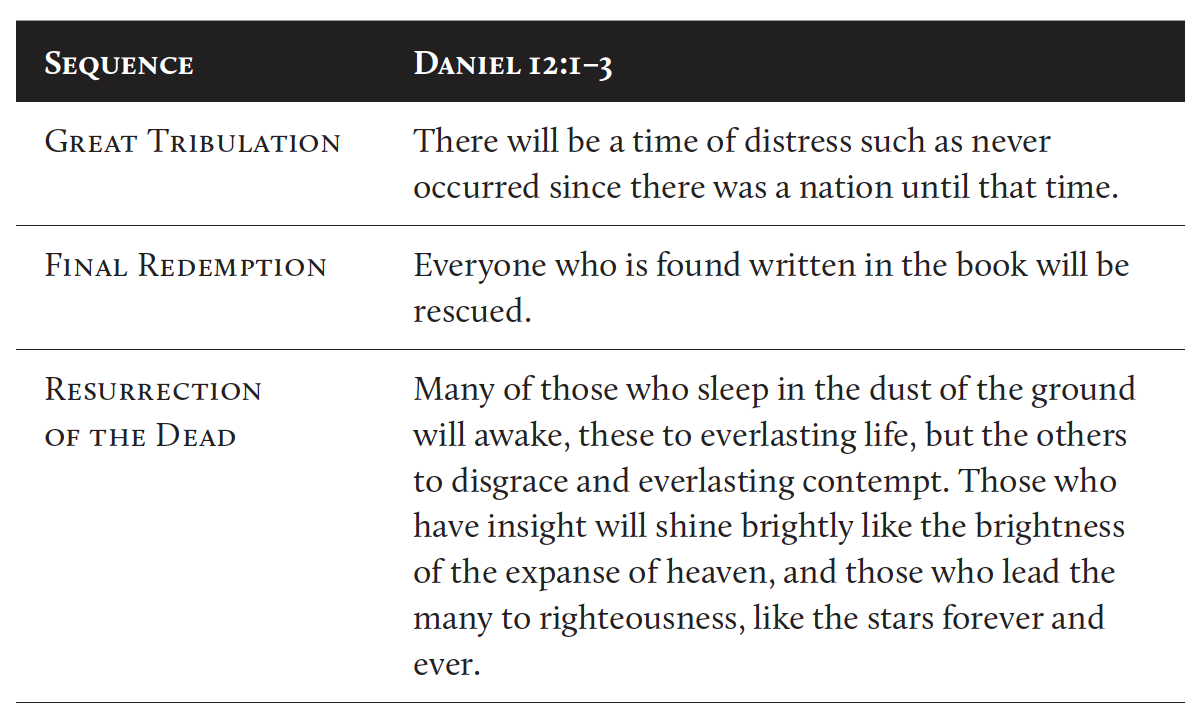
In keeping with Daniel's sequence of tribulation to be followed by the resurrection, Yeshua explained that "immediately after the tribulation of those days" the Messiah will come to usher in the final redemption and the resurrection (Matthew 24:29).
Here's how it was to happen: An abrupt reversal was to occur. The sun and the moon were to darken, the stars were to fall, and the sign of the Messiah was to appear in the sky. The nations would mourn as they saw the Jewish Messiah descending "with power and great glory," accompanied by the fanfare of the shofar. They would realize that their destruction was at hand.
The Jewish people, however, were to be gathered together "from the four winds, from one end of the sky to the other" (Matthew 24:3I). The exiles would be gathered back to the Holy Land, just as the prophets so frequently predicted. What's more, the ingathering of the Jewish people is closely associated with the resurrection of the dead (Ezekiel 37:12-13). The shofar of the Messiah was to rouse the sleepers from their graves.
Taken altogether, the prophecies of Daniel and the predictions of Yeshua indicate that the Messiah should have come after the destruction of Jerusalem in 70 CE, "immediately after the tribulation of those days." Yeshua conceded that He did not know the precise timing of the final redemption. He said, "Of that day and hour no one knows, not even the angels of heaven, nor the Son, but the Father alone" (Matthew 24:36). Nevertheless, He certainly implied that the day and hour was going to happen soon and within the lifetimes of His disciples. They were to expect His arrival immediately after the tribulation of those days.
References
This lesson is adapted from Daniel Lancaster's teachings in The End of Days, as presented by First Fruits of Zion for the Torah Club.
Imminence
But immediately after the tribulation of those days. (Matthew 24:29)
Yeshua's good-news message, "the kingdom of heaven is near," stated that the end of the age is at hand. Just how close at hand was it in the days of Yeshua? Really close. He told the disciples, "Truly I say to you, there are some of those who are standing here who will not taste death until they see the Son of Man coming in His kingdom" (Matthew 16:28). He said, "You will not finish going through the cities of Israel until the Son of Man comes" (Matthew 10:23). He said, "Truly I say to you, this generation will not pass away until all these things take place" (Matthew 24:34). He said, "A little while, and you will no longer see Me; and again a little while, and you will see Me" (John 16:16).
Therefore, the apostles believed that the Messiah was about to come. They firmly believed that they lived in the last days, and they declared, "In these last days," God spoke "to us in His Son" (Hebrews I:2). They considered their generation to be those "upon whom the ends of the ages have come" (I Corinthians 10:11).
Peter warned the Jewish people gathered to celebrate Shavu'ot in Jerusalem to repent in order to escape the wrath about to be visited upon them because he believed it was about to be unleashed on their generation: "Be saved from this perverse generation!" (Acts 2:40). But he also believed that the Messiah was about to come rescue those who repented in His name so that, "everyone who calls on the name of the Lord will be saved" (Acts 2:21).
The apostles expected Yeshua to return within their lifetime. Paul said, "We who are alive and remain until the coming of the [Master]" (I Thessalonians 4:15), "we will not all sleep, but we will all be changed ….. at the last trumpet (I Corinthians 15:5I-52). He was so persuaded that the hour was at hand that, "in view of the present distress," he cautioned his disciples against starting families (I Corinthians 7:26). He counseled those who did have families to hold them loosely without making long-term plans: "The time has been shortened, so that from now on those who have wives should be as though they had none" (I Corinthians 7:29). He urged his readers in Rome to recognize, "that it is already the hour for you to awaken from sleep; for now salvation is nearer to us than when we believed. The night is almost gone, and the day is near" (Romans I3:II-12). Many other passages could be cited to demonstrate that Paul held to an imminent eschatology.
Imminent Eschatology = The belief or expectation that the end of the age, the coming of the Messiah, the final judgment, and the establishment of the kingdom is about to happen very soon, within the near future or even within the current generation.
Even to the end of the first century, seventy years after the death and resurrection of Yeshua, John's disciples held on to the hope that John would not die before the coming of the Master. They remembered that Yeshua had said, "If I want him to remain until I come, what is that to you?" (John 21:22). They took it to mean that the Messiah would appear before the death of the beloved disciple.
John died and disappointed their hopes. But he left behind the book of Revelation, which opens with a description of "things which must soon take place" (Revelation I:1) and closes with the emphatic statements, "Behold, I am coming quickly ... the time is near ... Yes, I am coming quickly" (Revelation 22:7, 10, 20).
Despite these assurances, He did not come quickly.
References
This lesson is adapted from Daniel Lancaster's teachings in The End of Days, as presented by First Fruits of Zion for the Torah Club.
A Change in Plan
If that nation against which I have spoken turns from its evil, I will relent concerning the calamity I planned to bring on it. (Jeremiah 18:8)
Nearly two thousand years later, some Bible teachers dismiss the imminent eschatology taught by the apostles. Since things didn't pan out the way the apostles anticipated, there's a little bit of embarrassment over their expectation of the second coming within their generation, so it gets brushed under the rug. Other teachers and theologians re-interpret the words of Yeshua and the apostles to steer away from any hint of Jewish apocalypticism. They prefer to spiritualize the hope of the coming kingdom as symbolic code language for the dawn of the church age (i.e., realized eschatology). Neither of these solutions deals honestly with the text of the New Testament.
Realized Eschatology = The belief that the end-time promises-such as the kingdom of God-have already been fulfilled spiritually in the present age rather than awaiting a future, literal fulfillment.
If we are honest readers, we need to admit that the writers of the New Testament absolutely expected the Messiah to return within their lifetimes and establish a literal kingdom on earth. We also need to admit that the Messiah did not return within their lifetimes or establish a literal kingdom on earth. Does that mean the Bible is wrong?
The Bible is not wrong. It accurately records the expectations of Yeshua and the apostles from their vantage point in history. Since then, however, the timing of events has shifted. The plan changed, so to speak.
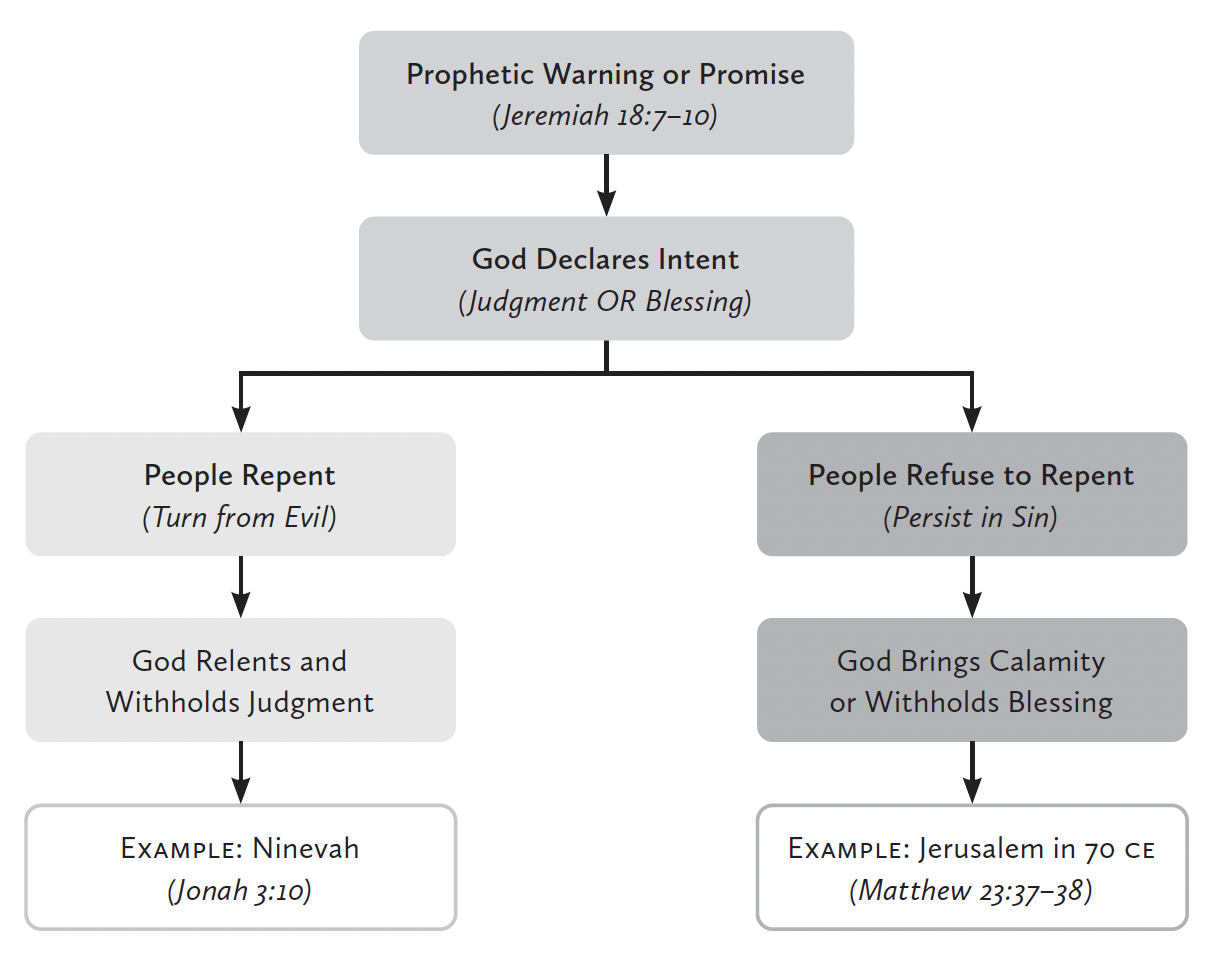
In previous lessons, we learned that God has concealed the timing of the redemption and refuses to disclose it. In the meantime, He retains the prerogative to shorten the days until the end of the age or extend them. In the story of Jonah and the people of Nineveh, the LORD declares that He reserves the right to extend mercy and compassion even to the point of reversing His own decree (Jonah 4:I1):
When God saw their deeds, that they turned from their wicked way, then God relented concerning the calamity which He had declared He would bring upon them. And He did not do it. (Jonah 3:10)
Bible prophecy is always contingent on the human response. Repentance can avert a harsh punishment, but persistence in sin can forfeit redemption. This principle is explicitly spelled out in Jeremiah:
At one moment I might speak concerning a nation or concerning a kingdom to uproot, to pull down, or to destroy it; if that nation against which I have spoken turns from its evil, I will relent concerning the calamity I planned to bring on it. Or at another moment I might speak concerning a nation or concerning a kingdom to build up or to plant it; if it does evil in My sight by not obeying My voice, then I will think better of the good with which I had promised to bless it. (Jeremiah 18:7-10)
If the Jewish people had repented under the teaching of Yeshua, the LORD would have relented "concerning the calamity" He planned to bring on Israel. The people of His generation could have proclaimed Yeshua as King Messiah and ushered in the Messianic Era without undergoing the trauma of the fall of Jerusalem and the destruction of the Temple. That was the gist of Yeshua's good-news message. By the time He delivered His discourse on the Mount of Olives, however, He knew that was not going to happen. Instead, the plan had already changed. Since the nation had not repented, the end of days was going to roll forward as Daniel predicted. Still, Yeshua held out the promise that, after the coming time of distress, the redemption would come quickly.
References
This lesson is adapted from Daniel Lancaster's teachings in The End of Days, as presented by First Fruits of Zion for the Torah Club.
Extending Mercy to the Nations
God has granted to the Gentiles also the repentance that leads to life. (Acts II:18)
The Day of the LORD brings a day of judgment on humanity. Yeshua taught that, if the Jewish people repented, they could bring the kingdom and avoid the great tribulation of the Day of the LORD. If the nation did not sufficiently repent, the coming of the Day of the LORD would sweep them into a time of punishment and judgment along with the Gentile nations. In either case, the nations were doomed to perish under the wrath of the Day of the LORD.
The Jewish people as a whole did not heed the message proclaimed by Yeshua and His disciples. It looked like the day of judgment was going to befall both Israel and the nations.
Then something unanticipated happened. People from the nations repented. The apostles were surprised at the new development. They declared, "God has granted to the Gentiles also the repentance that leads to life." As a result of that repentance, God forestalled the final judgment and redemption in order to extend mercy to the Gentiles, granting the world time to repent.
That's been underway ever since the days of the apostles. Paul explains that the revelation of the Messiah has been withheld from Israel "until the fullness of the Gentiles has come in" (Romans I1:25, cf. Romans 15:9, II:II; Luke 24:47). That's why Paul brought the message of repentance "even to the Gentiles, that they should repent and turn to God, performing deeds appropriate to repentance" (Acts 26:20).
The repentance of the nations, turning to the God of Israel, put the brakes on the Bible prophecy timeline. God's mercy on the nations stalled the final redemption and continues to do so until this hour. Simon Peter explains, "The Lord is not slow about His promise, as some count slowness, but is patient toward you, not wishing for any to perish but for all to come to repentance" (2 Peter 3:9).
Was the New Testament wrong about the timing of the coming of the Messiah? Not exactly. Bible prophecies about the end of days are best understood as potential paths that the course of history might take. They do not provide us with a hard-and-fast, defined sequence of events that must proceed in a certain order at a certain time. God reserves the divine prerogative to exercise mercy or to execute judgment depending on how we respond to Him.
For most of the last two thousand years, the teaching of Yeshua and the apostles has been making steady progress throughout the world. People from the nations continue to repent under the authority of King Messiah to this day:
This gospel of the kingdom shall be preached in the whole world as a testimony to all the nations, and then the end will come. (Matthew 24:14)
This explains why the redemption has been delayed until this day. "Or do you think lightly of the riches of His kindness and tolerance and patience, not knowing that the kindness of God leads you to repentance?" (Romans 2:4).
Remember, God told Abraham that He was willing to spare Sodom and Gomorrah for the sake of ten righteous Gentiles. The message of the gospel has yielded a harvest of tens of thousands upon thousands among the nations.
References
This lesson is adapted from Daniel Lancaster's teachings in The End of Days, as presented by First Fruits of Zion for the Torah Club.
Sign of Jonah
As the crowds were increasing, He began to say, "This generation is a wicked generation; it seeks for a sign, and yet no sign will be given to it but the sign of Jonah. For just as Jonah became a sign to the Ninevites, so will the Son of Man be to this generation." (Luke II:29-30)
The apostles believed that they lived in the last days. What made them so certain? Did they have a sign?
"Indeed Jews ask for signs" (I Corinthians I:22). That's because the apocalyptic Jewish worldview anticipates miraculous signs from heaven to herald the Messiah and the end of the age. For example, Isaiah says, "The stars of heaven and their constellations will not flash forth their light; the sun will be dark when it rises and the moon will not shed its light" (Isaiah 13:10, cf. Isaiah 24:23, 50:3). The Prophet Joel amplifies the phenomena:
The heavens tremble, the sun and the moon grow dark and the stars lose their brightness .. I will display wonders in the sky and on the earth, blood, fire and columns of smoke. The sun will be turned into darkness and the moon into blood before the great and awesome day of the LORD comes. (Joel 2:10, 30-31)
Similar passages from the prophets describe astronomical events that will presage the Day of the LORD, and that tradition continues in the apocalyptic literature with signs in the sky, supernatural anomalies, and sequences of omens.
Once, it happened that some of the teachers of the Torah and religious authorities asked Yeshua for a sign to validate His warnings about the nearness of the kingdom. They said, "Teacher, we want to see a sign from You" (Matthew 12:38). "They asked Him to show them a sign from heaven" (Matthew 16:1). Yeshua replied that they should be able to determine the validity of His message without the beneht of a supernatural sign:
When it is evening, you say, "It will be fair weather, for the sky is red." And in the morning, "There will be a storm today, for the sky is red and threatening." Do you know how to discern the appearance of the sky, but cannot discern the signs of the times? (Matthew 16:2-3)
That means that they should have been able to observe the current state of affairs in the world and realize that the Day of the LORD was at hand. It should have been obvious to them. They should not have required a miraculous sign to persuade them to repent.
Yeshua chastised them for their reluctance to heed His warning, "An evil and adulterous generation seeks after a sign; and a sign will not be given it, except the sign of Jonah" (Matthew 16:4). So, what's the sign of Jonah?
The "sign of Jonah" meant that there would be no sign. Jonah offered the Ninevites no signs whatsoever. Like Jonah, Yeshua simply declared His message about the impending doom that hung over the nation if they did not repent. In that respect, the sign of Jonah was not but the prophet himself. Likewise, Yeshua offered His generation no signs aside from His own message and testimony. He said, "For just as Jonah became a sign to the Ninevites, so will the Son of Man be to this generation" (Luke II:30). Yes, He did miracles, but so did other prophets and holy men. Yeshua offered no definitive "sign from heaven" that might validate His warnings about the end of days.
Unlike the people of Nineveh who heeded the message of the prophet in their midst without the benefit of a sign, the wicked and adulterous generation insisted on seeing a miraculous sign from heaven before they would listen. Yeshua rebuked them, "The men of Nineveh will stand up with this generation at the judgment and condemn it, because they repented at the preaching of Jonah; and behold, something greater than Jonah is here" (Luke II:32). Yeshua offered "something greater" than Jonah. He offered the potential of bringing the Messianic Era.
References
This lesson is adapted from Daniel Lancaster's teachings in The End of Days, as presented by First Fruits of Zion for the Torah Club.
The Resurrection as the Sign of Jonah
An evil and adulterous generation craves for a sign; and yet no sign will be given to it but the sign of Jonah the prophet; for just as Jonah was three days and three nights in the belly of the sea monster, so will the Son of Man be three days and three nights in the heart of the earth. (Matthew 12:39-40)
In the context of Matthew 16 and Luke 11, "the sign of Jonah" is no sign at all except for the call to repent. However, Matthew 12 offers an alternate way to interpret the sign of Jonah. In that chapter, Matthew re-interprets the sign of Jonah as a cryptic reference to the resurrection of Yeshua. Just as Jonah was three days in the fish, the Son of Man will be three days in the earth.
Among the early believers, Jonah became a symbol of the resurrection of Yeshua. Not just because of the three days he spent in the fish, either. Jewish tradition identified Jonah as the son of the Shulammite whom Elisha resurrected. The prayer Jonah uttered from the belly of the fish has a lot of death-and-resurrection imagery too:
I cried for help from the depth of Sheol... Water encompassed me to the point of death. The great deep engulfed me, weeds were wrapped around my head. I descended to the roots of the mountains. The earth with its bars was around me forever, but You have brought up my life from the pit, O LORD my God. (Jonah 2:2, 5-6)
Nevertheless, scholars believe the resurrection explanation of the sign of Jonah is a departure from Yeshua's original intention. The death-and-resurrection analogy appears only in Matthew 12, but not in the parallels in Matthew 16 and Luke I1. Moreover, in one of our manuscripts of Matthew, an early scribe copying the Greek text onto parchment left a scribal note at Matthew 12:40, cautioning us, "The Jewish Gospel does not have the words, 'Three days and three nights." The three days and three nights that Jonah spent in the fish do not map neatly onto the resurrection narrative. The apostles insist that Yeshua rose on the third day, not the fourth.
Despite those caveats, the apostolic community found the parallel between the story of Jonah's three days in the fish and Yeshua's death compelling enough to re-interpret the saying in light of the resurrection. They saw the resurrection of Yeshua as the sign of Jonah and the definitive sign that the end of the age had come.
References
This lesson is adapted from Daniel Lancaster's teachings in The End of Days, as presented by First Fruits of Zion for the Torah Club.
Why the Resurrection is the Definitive Sign
Many of those who sleep in the dust of the ground will awake, these to everlasting life, but the others to disgrace and everlasting contempt. (Daniel 12:2)
The keynote miracle of the end times and definitive sign of the Day of the LORD is the resurrection of the dead. The end-times resurrection of the dead does not merely resuscitate the dead back into the mortal state for a few additional years of life; it completely transforms the dead from the perishing mortal state into a new, undying human existence. If such an implausible thing were to happen, it would surely indicate that the end of days is close at hand.
The Prophet Ezekiel's vision of the valley of dry bones tethers the messianic ingathering of Israel's exiles with the resurrection of the dead: "Behold, I will open your graves and cause you to come up out of your graves, My people; and I will bring you into the land of Israel" (Ezekiel 37:12).
The Book of Daniel places the resurrection immediately after the time of unprecedented distress and tribulation: "Many of those who sleep in the dust of the ground will awake, these to everlasting life, but the others to disgrace and everlasting contempt." According to Daniel, the resurrected righteous will endure forever, never to die again:
Those who have insight will shine brightly like the brightness of the expanse of heaven, and those who lead the many to righteousness, like the stars forever and ever. (Daniel 12:2-3)
Jewish apocalypticism heightened the hope of the resurrection of the dead. By the time of the apostles, faith in the future resurrection had become a defining hallmark of Pharisaic theology. Therefore, when Yeshua rose from the dead, His disciples quite naturally interpreted the event as the first instance in the end-times resurrection! They had no reason to suspect that it would be a long while before the rest of those asleep in the dust would awaken to everlasting life (or everlasting contempt). They considered Yeshua's resurrection a catalyst that would initiate the process: "Messiah has been raised from the dead, the first fruits of those who are asleep" (I Corinthians 15:20). His resurrection provided a clear sign that the end of the age had come upon them. They had all the evidence they needed. To the apostles, the resurrection of Yeshua was the sign of Jonah.
References
This lesson is adapted from Daniel Lancaster's teachings in The End of Days, as presented by First Fruits of Zion for the Torah Club.
The Last Generation
He has fixed a day in which He will judge the world in righteousness through a Man whom He has appointed, having furnished proof to all men by raising Him from the dead. (Acts 17:31)
The apostles believed that they were the last generation before the kingdom. They believed that the resurrection of Yeshua heralded the end of days and the imminent arrival of the Day of the LORD when all the dead would rise. Inspired by that solid hope, they offered the Jewish people eyewitness testimony for the resurrection of Yeshua and proclaimed His message, "The kingdom of heaven is at hand."
Paul took the message to the Gentiles. In the city of Athens, he explained to the Athenians gathered in the Areopagus that "God is now declaring to men that all people everywhere should repent, because He has fixed a day in which He will judge the world in righteousness through a Man whom He has appointed, having furnished proof to all men by raising Him from the dead" (Acts 17:30-31, emphasis added). The proof of the message about the nearness of the Day of the LORD was the resurrection of Yeshua.
The apostles were not wrong. The resurrection of Yeshua does prove the apocalyptic expectation of a new age about to commence. God is calling on all of humanity to "repent and turn to God, performing deeds appropriate to repentance" before the day of wrath (Acts 26:20), and the resurrection of Yeshua proves it.
The entire New Testament lives and breathes that messianic and apocalyptic fervor. Every page of it is colored with the conviction that the end is near, very near, right at the door, and about to happen. The early believers in Yeshua absolutely believed that they lived in the last generation before the Day of the LORD. They confidently expected to soon welcome the Messiah. For that reason, they cared little for the things of this world. Prestige, wealth, and success meant little to them. They did not cling to the temporary things of this current age because they knew that this current age was about to pass away. They did not hesitate to lay down their lives for their convictions because they firmly believed that, in only a short while, they would be resurrected to enter the kingdom and the World to Come.
Nearly two thousand years later, New Testament readers approach the text with a far more sober-minded perspective. We have learned to feel skeptical when people talk about the end times. After all, every generation since the first century ardently believed that they were the last generation before Messiah, but they were all wrong. The Messiah has not come. Why would things be different now? If someone claims that the Messiah is about to come and that we are now living in the last generation, we are apt to reply, "Where is the promise of His coming? For ever since the fathers fell asleep, all continues just as it was from the beginning of creation" (2 Peter 3:4). We would be apt to dismiss Yeshua and the apostles, too, if we heard them preaching that message today.
That kind of cynicism and skepticism does not work for disciples of Yeshua. We cannot call ourselves genuine disciples of Yeshua while simultaneously disbelieving His core message, "The kingdom of heaven is near." To live according to the teachings of the New Testament, we need to adopt the convictions of the New Testament. We need to shove cynicism and skepticism from our minds. As a simple mandate of discipleship, we should fully expect the coming of the Messiah in our generation and in our life-times. Maimonides said, "I believe with complete faith in the coming of the Messiah. Though He may tarry, I await Him every day." Only when we are confident that the Messiah is going to come soon and in our days can we enter the faith-perspective transmitted to us through Yeshua and the apostles.
References
This lesson is adapted from Daniel Lancaster's teachings in The End of Days, as presented by First Fruits of Zion for the Torah Club.