What Was the Purpose of the Sacrificial System?
The Common Claim
Many Christians believe that the primary purpose of the sacrificial system in the Torah was to atone for sin. According to this view, once Jesus offered himself as the final sacrifice, the entire sacrificial system became obsolete and unnecessary. The sacrifices are therefore understood as temporary symbols pointing exclusively to Christ’s atoning death.
Why This Claim Matters
If the sacrifices existed solely to provide atonement for sin, then Christ’s death would render the entire sacrificial system permanently irrelevant. However, if the sacrifices served multiple purposes within Israel’s covenant life, then understanding those functions becomes essential for interpreting both the Torah and the New Testament.
The question is therefore not simply whether Jesus’ sacrifice is sufficient, but whether atonement was the only purpose the sacrificial system served. If we truly believe that Yeshua’s death and resurrection fulfill the institutions of sacrifice and sacrificial worship, then believers have even greater reason to study those institutions carefully.
Only to the extent that we understand the sacrificial system within the Torah can we hope to fully appreciate the significance of Messiah’s work.
Bottom Line Up Front (BLUF)
The central question we are addressing is simple: Why did God institute sacrifices in the first place?
In many modern explanations, the sacrificial system is treated almost entirely as a mechanism for dealing with sin. While sacrifices could be associated with atonement, the broader biblical picture is far richer than that.
The primary purpose of the sacrificial system was to provide a divinely ordained way for Israel to draw near to God's presence in worship, holiness, and covenant life. The Hebrew word most commonly translated “offering” (korban) literally means “something brought near,” already hinting at the deeper purpose behind Israel’s sacrificial worship.
The remaining sections of this study will explore how the laws of sacrifice functioned within Israel’s relationship with God and why these institutions are essential for understanding the work of Messiah.
Reexamining the Purpose of the Sacrificial System
The claim that the sacrificial system existed solely to atone for sin represents a significant oversimplification in many modern interpretations. The opening chapters of Leviticus describe five primary categories of sacrifice, each brought for distinct purposes. In addition to these, the Scriptures also describe numerous grain offerings, drink offerings, and other ritual offerings, along with detailed procedures governing their presentation.
Entire sections of the Torah are devoted to sacrificial ceremonies, priestly ordination, and regulations concerning purification and sanctification. The Torah provides extensive instruction regarding these ritual services, demonstrating that the sacrificial system functioned within a rich and complex framework of worship, covenant life, and communal holiness.
To properly understand the laws of sacrifice, it is important to remember that the sacrificial system was not a human invention but a form of worship ordained by God.
At the same time, sacrifice reflects a widespread religious instinct. Human beings throughout history have recognized the need to approach the divine through offerings. Even at the beginning of the biblical narrative, Cain and Abel present sacrifices to God (Genesis 4). Sacrificial practices appear throughout many ancient cultures, yet the Torah gives this impulse divine form, structure, and meaning within the covenant relationship between God and Israel.
But this raises a deeper question. If sacrifice was not merely about paying for sin, why did God institute such a system in the first place? What problem was the sacrificial system meant to address?
To answer that question, we must step back and consider the larger story of Scripture.
The Problem of Approaching a Holy God
In the opening pages of Genesis, humanity is portrayed as living in close fellowship with God. Adam and Eve walk with Him in the garden and enjoy unhindered communion with their Creator (Genesis 3:8). The garden represents a place where heaven and earth overlap, and human beings are able to dwell in the presence of God without fear.
That relationship changes dramatically after their disobedience. When Adam and Eve eat from the tree of the knowledge of good and evil, their immediate reaction is shame and hiding. Rather than welcoming God's presence, they attempt to conceal themselves from Him among the trees of the garden (Genesis 3:7–10).
At that moment the narrative introduces the first hint of sacrificial imagery in the Bible. God makes garments of skin to clothe Adam and Eve and cover their shame (Genesis 3:21). Although the text does not explicitly describe a sacrifice, the provision of animal skins strongly suggests that the life of an animal was given in order to provide covering for human guilt and vulnerability.
This theme continues in the very next generation. In Genesis 4, both Cain and Abel bring offerings to the LORD. The presence of sacrifice so early in the biblical story suggests that the instinct to approach God through offerings was already deeply embedded in human religious life.
Yet even these early offerings do not resolve the fundamental problem introduced by the fall: human beings now stand at a distance from the holy presence of God.
This tension reappears dramatically at the end of the book of Exodus. Throughout the second half of Exodus, the construction of the Tabernacle is presented as the climax of Israel’s redemption from Egypt. God delivers the Israelites from slavery, brings them to Mount Sinai, enters into covenant with them, and then commands them to build a sanctuary so that He may dwell among them.
The purpose of the Tabernacle is clearly stated:
“Let them make me a sanctuary, that I may dwell in their midst.” (Exodus 25:8)
After many chapters describing its construction in careful detail, the Tabernacle is finally completed. At this moment the story reaches its dramatic climax. The presence of God descends upon the newly constructed sanctuary in the form of a cloud, filling it with divine glory.
“Then the cloud covered the tent of meeting, and the glory of the LORD filled the tabernacle.” (Exodus 40:34)
On the surface, this appears to be the perfect conclusion to the story. God has redeemed Israel, established His covenant with them, and now dwells in their midst. The divine presence has returned to dwell among humanity, echoing the fellowship that once existed in the Garden of Eden.
Yet the final verse of Exodus reveals an unexpected problem. Even Moses—the mediator of the covenant, the one who had ascended Mount Sinai and spoken with God face to face—cannot enter the Tabernacle once the glory of the LORD fills it.
“Moses was not able to enter the tent of meeting because the cloud settled on it, and the glory of the LORD filled the tabernacle.” (Exodus 40:35)
The narrative leaves the reader with a striking tension. God has come to dwell among His people exactly as He promised, yet His presence is so overwhelming that even Moses cannot approach it.
The very presence that makes the Tabernacle holy also renders it inaccessible without proper mediation.
This moment highlights a central problem that runs throughout the biblical story: the holy presence of God cannot be approached casually by human beings.
The same tension introduced in the story of Eden now appears again in Israel’s national life.
God is near—but human beings cannot simply approach Him.
The question that confronts Israel at the end of Exodus therefore echoes the problem introduced in Genesis:
How can human beings approach a holy God?
The book of Leviticus begins by answering that question.
Korban: The Meaning of “Drawing Near”
Leviticus opens with a command that provides the solution:
“The LORD called Moses and spoke to him from the tent of meeting, saying, ‘Speak to the people of Israel and say to them, When any one of you brings an offering to the LORD, you shall bring your offering of livestock from the herd or from the flock.’” (Leviticus 1:1–2)
The word translated “offering” comes from the Hebrew word korban (קרבן). While English translations often render this word as “sacrifice” or “offering,” neither term fully captures its meaning.
The root of the word korban is the Hebrew verb karav (קרב), which means “to come near” or “to draw near.” A korbanis therefore something brought near to God.
Understood this way, the sacrificial system was not primarily about appeasing God or paying Him something He needed. God Himself declares that He has no need for such gifts:
“If I were hungry, I would not tell you, for the world and its fullness are mine.” (Psalm 50:12)
God does not require sacrifices in order to sustain Himself. Rather, He provides them as a means by which human beings may approach Him.
Through the offering of a korban, the worshipper was able to draw near to the divine presence dwelling in the Tabernacle. The sacrifice functioned as a divinely ordained vehicle that allowed the worshipper to enter into communion with God.
In this sense, sacrifices may be understood as gifts presented to a king. Voluntary offerings express devotion and gratitude, while required offerings function more like tribute owed to a sovereign ruler.
The Burnt Offering as a Model of Sacrifice
The priestly laws of Leviticus introduce five primary categories of sacrifices. The first and most fundamental of these is the burnt offering (olah).
“If his offering is a burnt offering from the herd, he shall offer a male without blemish. He shall bring it to the entrance of the tent of meeting, that he may be accepted before the LORD.” (Leviticus 1:3)
The English phrase “burnt offering” does not fully capture the Hebrew terminology. The offering is called a korban olah(קרבן עולה). The word olah means “that which rises.”
The name refers to the smoke of the sacrifice ascending upward from the altar. The entire animal was consumed by fire and “rose” toward heaven as a gift to God.
Unlike several other sacrifices, the worshipper received nothing back from the olah. No portion of the meat was eaten. No material benefit was retained. The offering represented complete surrender to God.
For this reason the olah became the classic symbol of total devotion. The worshipper gave the entire offering over to God as an act of wholehearted worship.
Sacrifice as a Voluntary Act of Worship
Ordinarily (though not always), a man brought an olah voluntarily. He offered it because he desired to draw near to God. Jewish tradition teaches that the olah could only be brought with genuine joy of heart; an animal offered reluctantly was not considered a proper sacrifice.
The same principle applied to all voluntary offerings. The worshipper was expected to bring the sacrifice with gladness and a joyful heart. As David declares in Psalm 27:6, “I will offer in his tent sacrifices with shouts of joy; I will sing and make melody to the LORD.”
For the people of Israel, sacrifice was not merely a solemn obligation but a joyful act of worship. They regarded participation in the sacrificial rites as a privilege. Their offerings were often accompanied by music, singing, prayer, and praise. Many of the psalms themselves were composed to be sung in connection with sacrificial worship.
The worshipper who brought an olah experienced a sense of fulfillment and communion with God through the ritual. His heart was filled with anticipation as he approached the sanctuary with his offering.
Like the olah, most sacrifices were not brought as punishment for sin, but as expressions of devotion from hearts that longed to draw near to God. In this way, the sacrificial system reveals an important biblical perspective on worship: approaching God was meant to be an act of joyful devotion rather than mere ritual obligation.
How Sacrifice Worked (Semichah and Blood)
The worshipper regarded the sacrificial animal as a substitute for himself. The offering was presented at “the entrance of the tent of meeting, that he may be accepted before the LORD” (Leviticus 1:3). In this sense, the sacrifice functioned as a ritual surrogate for the person bringing it.
The Torah explains the process more specifically:
“He shall lay his hand on the head of the burnt offering, and it shall be accepted for him.” (Leviticus 1:4)
The first ritual action performed when presenting most animal offerings—excluding birds—was the laying on of hands (semichah, סמיכה). The word implies a physical leaning upon the animal, symbolizing the transfer or investment of the worshipper’s identity onto the sacrificial victim.
This symbolism appears in other places throughout the Scriptures. In Numbers 8:10, the people of Israel lay their hands upon the Levites, designating them as representatives of the nation. Likewise, in Numbers 27, God commands Moses to lay his hands on Joshua, thereby appointing him as Israel’s new leader. Through this act, Moses symbolically transfers his authority and leadership to Joshua.
In later Jewish tradition, the laying on of hands was also used for the ordination of judges, elders, and rabbis. The same practice appears in the Apostolic Scriptures. Yeshua and the apostles sometimes laid hands on the sick for healing. The apostles also laid hands on believers when conferring the Holy Spirit and when appointing elders and deacons. For this reason, the laying on of hands came to be regarded as one of the foundational practices of the early Messianic community.
In each of these examples, the act symbolizes a transfer of identity or authority. Through the laying on of hands, the one performing the act confers something of himself onto the one receiving it. The Levites bear the identity of the nation. Joshua receives the authority of Moses. Leaders transmit their office to those who follow them.
The same principle applies to the sacrificial ritual. When the worshipper placed his hands upon the animal’s head, he symbolically identified himself with the offering. The animal now stood in his place before the LORD.
In the case of sin offerings, the worshipper would confess his sins while laying his hands on the animal. The sacrifice thus represented the individual who brought it, serving as his representative in the ritual act of drawing near to God.
This identification did not function only in sacrifices related to sin. Even voluntary offerings such as the burnt offering involved the laying on of hands. In these cases, the animal did not represent the worshipper’s guilt but rather his devotion. The offering symbolized the worshipper himself being presented to God in an act of complete surrender and worship.
What Atonement Actually Means (Kaphar)
The Torah instructs the worshipper to “lay his hand on the head of the burnt offering, and it shall be accepted for him to make atonement for him” (Leviticus 1:4). At first glance, one might assume that the sacrifice was intended primarily as atonement for sin. Yet this assumption does not fully capture the meaning of the text.
The Hebrew term translated “atonement” is kaphar (כפר). While the word can imply forgiveness or the removal of guilt, its meaning is broader than that. In its most basic sense, kaphar refers to the act of covering.
This meaning appears clearly in the story of Noah’s ark. When God instructs Noah to waterproof the ark, the Torah uses the same verb: “Cover (kaphar, כפר) it inside and out with pitch” (Genesis 6:14). In this context, the word describes the application of a protective covering.
The Torah also uses related forms of kaphar to describe a “ransom” given to preserve a person’s life. Both senses—covering and ransom—help illuminate how the term functions within Israel’s sacrificial system.
In the instructions for constructing the Tabernacle, the priesthood, the altar, and the sacred furnishings, the concept of covering appears repeatedly. These holy objects required ritual purification in order to exist safely in the presence of God. Without such covering, they could not endure the encounter with the consuming holiness of the Almighty.
The same principle applied to the worshipper who sought to draw near to God within His sanctuary. To approach the manifest presence of the LORD was not a trivial matter. The holiness of God was both glorious and dangerous. For mortal human beings to enter that presence without proper preparation would place them in jeopardy.
The sacrificial system therefore functioned as a divinely ordained means by which worshippers could approach God safely. Through the agency of a surrogate offering, the worshipper was symbolically protected as he drew near to the divine presence.
Seen in this light, Levitical atonement should be understood primarily as a covering that allowed human beings to stand before God without being consumed by His holiness. The sacrifice provided a kind of protective shelter, enabling the worshipper to approach the presence of the LORD who dwelt among His people in the Tabernacle and later in the Temple.
The Soul in the Blood
How did sacrifice bring the Israelite near to God? How did the sacrificial system actually work?
A brief examination of the blood ritual reveals the symbolic and spiritual mechanics involved. Leviticus describes the process:
“Then he shall kill the bull before the LORD, and Aaron’s sons the priests shall bring the blood and throw the blood against the sides of the altar that is at the entrance of the tent of meeting.” (Leviticus 1:5)
The worshipper himself—not the priest—performed the slaughter of the animal. The priest oversaw the sacrifice and collected the animal’s blood in a basin. The priest then carried the blood to the altar and applied it to its sides.
In the Torah, blood represents the life of a creature. Whether human or animal, every living being possesses a life-force. The Torah refers to this living essence as the nefesh (נפש). Although the word is often translated “soul,” it does not necessarily refer to an immortal spirit that survives death (sometimes described with the term neshamah, נשמה). Rather, nefesh often refers to the living life-force that animates the body.
In this sense, nefesh can simply mean “life.” It refers to the living person—the identity and vitality of the creature in the flesh. Because life departs when blood is spilled, the Torah describes the blood as containing the nefesh.
Leviticus states this principle explicitly:
“For the life (nefesh) of the flesh is in the blood, and I have given it to you on the altar to make atonement for your lives (nefesh), for it is the blood that makes atonement by the life (nefesh).” (Leviticus 17:11)
When the priest applied the animal’s blood to the altar, he was symbolically presenting the animal’s life before God. Because the worshipper had already laid his hands upon the animal, identifying himself with it through the ritual of semichah, the animal’s life now represented the life of the worshipper.
In that sense, the blood applied to the altar functioned as the life of the person bringing the sacrifice. Through the ritual identification, the life of the worshipper was symbolically presented before God.
If we follow the entire process step by step, the logic of the ritual becomes clear. The worshipper selected a kosher animal without blemish. Through the laying on of hands he invested his identity into the animal. Once the animal had been designated as his representative, the worshipper slaughtered it, releasing its blood. The priest then received the blood—representing the life of the offerer—and carried it to the altar where it was applied before the LORD.
The Meaning of an Altar
In the ancient world, altars were often understood as points of contact between heaven and earth. An altar functioned as a sacred meeting place where human beings could approach the divine presence. Whatever was placed upon the altar became consecrated to God and entered into the sphere of His holiness.
From the altar the sacrifices ascended in smoke toward heaven. Through the medium of the animal’s blood, the life of the worshipper was symbolically presented before God. In this way, the worshipper was able to draw near to the divine presence.
Seen in this light, the sacrificial system addressed the problem of approaching a holy God. The sacrificial substitute provided the means by which an unworthy mortal could enter into God's presence.
According to this interpretation, the death of the animal was not the ultimate goal of the sacrifice. The korban was fundamentally concerned with life rather than death. The death of the animal merely provided the means by which its blood—the life of the creature—could be presented upon the altar.
This perspective differs from many common explanations of sacrifice that focus primarily on the death of the victim. In the Torah, however, the emphasis falls on the life contained in the blood. It is the life of the offering, symbolized by the blood, that is presented before God and makes atonement.
As the Jewish scholar Alfred Edersheim observed:
“The death of the sacrifice was only a means towards an end, that end being the shedding and sprinkling of the blood, by which the atonement was really made.”
For this reason, the significance of sacrifice lies not merely in the death of the animal, but in the life that its blood represents. The sacrificial ritual centers on the presentation of life before God.
Sacrifice, in this sense, is ultimately about life—about bringing the life of the worshipper into the presence of the LORD.
A Soothing Aroma
“And the priest shall offer up in smoke all of it on the altar for a burnt offering, an offering by fire of a soothing aroma to the LORD.”
(Leviticus 1:9)
When the Torah describes the sacrificial service, it explains that the priest burns the body of the offering upon the altar. As the smoke of the sacrifice rises toward heaven, the LORD receives it as a “soothing” or “pleasing” aroma. At first this language may seem strange. Does God truly delight in the smell of burning meat?
Jewish interpreters have long understood this expression as symbolic. Rabbi Shlomo ben Yitzchak—known as Rashi—explains that the “pleasing aroma” represents the obedience of the worshipper. The aroma brings pleasure to the LORD not because of the smell itself, but because it signifies that His command has been faithfully carried out. In this sense, when God “smells” the sacrifice, it is as though He says, “I have given commandments, and My will has been obeyed.”
This interpretation reflects a broader biblical principle. As the prophet Samuel declares:
“To obey is better than sacrifice, and to listen than the fat of rams.” (1 Samuel 15:22)
In this light, the pleasing aroma of the sacrifice symbolizes God’s acceptance of the worshipper’s offering. The sacrifices were intended as ritual gifts presented to the Almighty. When the offering rose from the altar, it signified that the worshipper had come before God in obedience and devotion.
However we interpret the imagery, the Torah repeatedly states that the LORD took pleasure in these offerings. He graciously received the gifts of His people, and the smoke rising from the altar was described as a pleasing aroma before Him.
Doesn’t God Hate the Sacrifices?
This may seem difficult to reconcile with certain statements in the prophets where God appears to reject the sacrificial system. For example, the prophet Isaiah declares:
“I have had enough of burnt offerings of rams and the fat of well-fed beasts; I do not delight in the blood of bulls, or of lambs, or of goats… Bring no more vain offerings.”
(Isaiah 1:11–13)
Similarly, Jeremiah proclaims:
“Your burnt offerings are not acceptable, nor your sacrifices pleasing to me.”
(Jeremiah 6:20)
And in the book of Malachi God says:
“If only one of you would shut the temple doors, so that you would not kindle fire on my altar in vain… I will not accept an offering from your hand.”
(Malachi 1:10)
In the early centuries of Christianity, passages such as these were sometimes used to argue that God had never truly desired the sacrificial system. Some church fathers even suggested that the sacrifices had been given to the Jewish people as a form of punishment. From this perspective, Jesus was thought to have abolished sacrifices because God had always despised them.
But this interpretation does not withstand careful examination. If God had always hated sacrifices, why would He command Israel to offer them in the first place? Why would the Torah repeatedly describe them as pleasing to Him?
A more careful reading of the prophets provides the answer. When the prophets speak harshly about sacrifices, they are not condemning the sacrificial system itself. Rather, they are condemning the people who offered sacrifices while living in open rebellion against God.
Again and again, the prophets rebuke Israelites who violated the covenant through injustice, idolatry, and immorality while continuing to perform the rituals of worship. Their hearts were far from God, yet they attempted to maintain an appearance of piety by faithfully performing sacrificial ceremonies.
In such circumstances, the rituals themselves became offensive.
This situation can be compared to a man who abuses his wife and lives a life of betrayal, yet continues to attend church faithfully every week and participate in religious observances. His outward ritual would hardly compensate for his wrongdoing. Or imagine that after mistreating his wife he attempts to make amends by sending her a bouquet of flowers. Would the gift be pleasing? Hardly. She would rightly respond, “Your flowers are an abomination to me.”
In the same way, God rejects religious rituals when they are offered hypocritically. Sacrifices presented without repentance, justice, and obedience become empty gestures rather than acts of worship.
The prophets therefore remind us of an important principle: ritual observance alone does not establish a right relationship with God. What God ultimately desires is a faithful heart.
These warnings remain relevant for every generation. We must be careful not to imagine that outward religious practices can substitute for genuine obedience. True worship arises from a heart that seeks to honor God, and our outward acts of devotion should reflect the inner condition of our lives.
Sacrifice for Salvation?
Within the sacrificial system, “atonement” did not mean the attainment of eternal salvation. The people of Israel did not bring sacrifices in order to obtain eternal salvation. A sinner did not present an offering to clear his conscience or to secure forgiveness for deliberate rebellion.
The New Testament itself affirms this point. The author of Hebrews explicitly states that the sacrifices were never intended to remove sin in the deepest sense:
“For it is impossible for the blood of bulls and goats to take away sins.” (Hebrews 10:4)
Elsewhere he explains that the sacrifices could not cleanse the conscience because their purpose was limited to matters of ritual purification:
“Gifts and sacrifices are offered that cannot perfect the conscience of the worshipper, but deal only with food and drink and various washings, regulations for the body.”
(Hebrews 9:9–10)
The sacrificial rites therefore addressed the physical and ritual dimensions of worship, not the transformation of the inner person.
Many believers misunderstand the sacrificial system because they interpret it through later theological categories such as the “Old Covenant” and the “New Covenant.” This framework often leads to the assumption that, prior to the death and resurrection of Messiah, people obtained forgiveness and salvation through the offering of animal sacrifices.
But this assumption creates serious difficulties. If animal sacrifices truly secured eternal salvation, then the death of Messiah would not have been necessary. His sacrifice would merely replace a system that had already been sufficient.
The Scriptures present a different picture. The sacrifices were never intended to function as the means of eternal salvation. Rather, they were rituals connected to the Temple and to Israel’s covenant life in the presence of God.
This can be difficult for modern readers to grasp because the Temple no longer stands. Today we cannot physically enter a sacred space believed to contain the manifest presence of God. Yet in the biblical world, the Temple was precisely such a place. To approach that holy space required purification.
The sacrificial system therefore served the practical function of preparing worshippers to draw near to God within His sanctuary. These rites governed how people could enter the holy precincts where the divine presence dwelt.
The writer of Hebrews acknowledges this function and builds his argument upon it using a classic rabbinic form of reasoning known as kal vachomer (קל וחומר)—an argument from the lesser to the greater.
He writes:
“For if the blood of goats and bulls, and the sprinkling of defiled persons with the ashes of a heifer, sanctify for the purification of the flesh, how much more will the blood of Christ, who through the eternal Spirit offered himself without blemish to God, purify our conscience from dead works to serve the living God?”
(Hebrews 9:13–14)
The argument assumes that the sacrificial system truly accomplished something. The sacrifices purified the body and restored ritual fitness so that worshippers could participate in the Temple service. But they did not cleanse the conscience or transform the inner person.
Messiah’s sacrifice, by contrast, addresses what the Temple sacrifices could not: the purification of the conscience and the renewal of the inner life before God.
The Temple sacrifices sanctified the flesh, but they did not cleanse the spirit. That deeper renewal came through repentance and faith in God. Jewish tradition itself reflects this understanding. As the sages taught:
“Neither the sin offering, nor the guilt offering, nor the Day of Atonement brings expiation without repentance.” (m. Yoma 5:9)
Sacrifice in This Age and the Age to Come
One helpful way to understand the sacrificial system is to recognize that the Scriptures often distinguish between the concerns of this present age and the ultimate realities of the age to come. This is especially important for reading the Book of Hebrews.
Within the Temple system of this age, sacrifices addressed the practical problem of approaching God's presence in the sanctuary. The blood of bulls and goats sanctified for the purification of the flesh and restored ritual fitness so that worshippers could draw near to the holy presence of God within the Tabernacle and later the Temple. As the writer of Hebrews explains, these rites dealt with matters “of the flesh,” regulating participation in the sacred service of the sanctuary (Hebrews 9:9–10).
The sacrifice of Messiah, however, addresses something the Temple sacrifices were never designed to accomplish. The sacrifice of Messiah purifies the conscience and renews the inner life of the worshipper before God:
“How much more will the blood of Christ… purify our conscience from dead works to serve the living God?” (Hebrews 9:14)
Where the Temple sacrifices dealt with ritual purity and access to God's earthly sanctuary, Messiah's sacrifice reaches into the heart of the human person, cleansing the conscience and enabling true spiritual transformation.
Yet the work of Messiah ultimately belongs to the greater reality of the age to come. His death and resurrection secure the promise of eternal life in the age to come. The author of Hebrews repeatedly contrasts the earthly sanctuary with the heavenly one and describes the Temple service as a “copy and shadow of the heavenly things” (Hebrews 8:5). Within this framework, the writer of Hebrews is not dismissing the sacrificial system as meaningless. Rather, he explains its proper role. The sacrifices purified the flesh and regulated worship within the earthly sanctuary, but Messiah’s sacrifice reaches into the deeper realities of the heavenly realm, cleansing the conscience and securing eternal redemption.
This perspective would have been especially meaningful for Jewish believers who were facing persecution or who had lost access to the Temple. Even if they could no longer participate in the sacrificial service of the earthly sanctuary, the author reminds them that Messiah has already entered the greater sanctuary in heaven on their behalf.
In this way, the writer of Hebrews uses the realities of the age to come to offer encouragement and hope to believers living in this present age.
Seen in this light, the sacrificial system and the sacrifice of Messiah are not competitors addressing the same problem. They operate in different spheres of God's redemptive plan. The Temple sacrifices governed how human beings approached God's presence in this world, while the sacrifice of Messiah accomplishes the deeper work of renewing the human heart and securing eternal life in the world to come.
Sacrifice and Atonement
Although sacrifices were not primarily about paying for sin, they did illustrate important truths about sin, judgment, and atonement.
The sacrificial system taught that approaching a holy God is not a casual matter. The shedding of blood symbolized the seriousness of sin and the costliness of reconciliation. As the animal was slain and its blood applied to the altar, the worshipper was reminded that sin brings death and that communion with God requires purification.
In this sense, the sacrifices illustrate the concept of vicarious suffering and atonement. The death of the sacrificial victim stands as a dramatic representation of the consequences of sin and the mercy of God in allowing the worshipper to approach Him.
Jewish interpreters have long reflected on this symbolism. The medieval rabbi Nachmanides suggested that when an animal was offered, the worshipper should recognize that he himself deserved such judgment. The sacrificial ritual therefore impressed upon the worshipper the seriousness of sin and the holiness of God.
Nevertheless, it is important to recognize that sacrifices were not primarily about paying a debt for sin. Their broader purpose was to provide a divinely ordained means by which human beings could draw near to God and live within His holy presence.
Correcting the “Appeasing an Angry God” Model
Many people today assume that sacrifices in the Bible existed primarily to appease an angry God. According to this common explanation, the sinner deserved death, and the animal was killed in the sinner’s place in order to satisfy God’s wrath.
This description contains elements of truth, but it oversimplifies the biblical picture.
The Torah does include sacrifices associated with sin and guilt, and these offerings do involve substitution and atonement. Yet the sacrificial system as a whole cannot be reduced to a simple transaction in which an animal’s death placates divine anger.
In fact, most sacrifices described in the Torah were not offered for sin at all. Many were voluntary offerings presented by worshippers who desired to express gratitude, devotion, or fellowship with God.
Rather than serving merely as a payment for wrongdoing, sacrifices functioned within a broader system that structured Israel’s relationship with God. They allowed the people to approach the divine presence, participate in sacred worship, and maintain the holiness required for life in God’s covenant community.
The Different Types and Purposes of Sacrifices
The first seven chapters of Leviticus describe five major categories of sacrifices. Each of these offerings served different purposes within Israel’s covenant life, and each category included multiple variations.
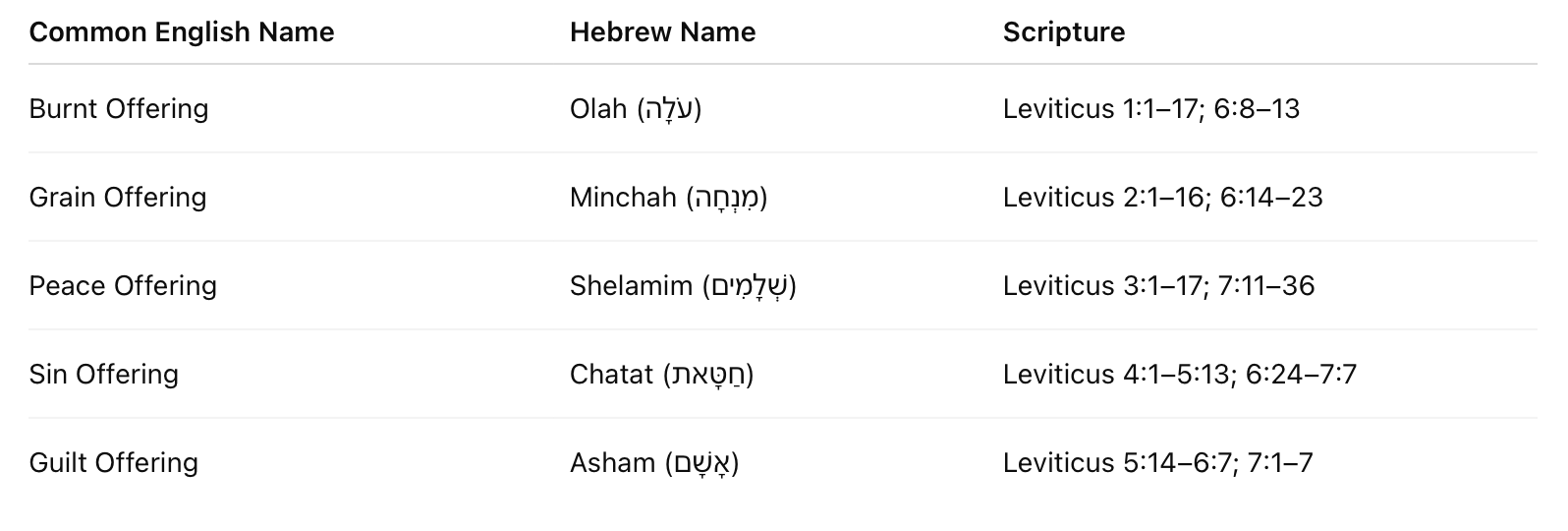
Not all of these sacrifices dealt with sin. Many functioned as acts of worship, thanksgiving, fellowship, or purification. Recognizing this diversity helps correct the widespread assumption that the sacrificial system existed solely to provide atonement for wrongdoing.
Instead, the sacrificial system operated within a rich framework of worship, holiness, and covenant relationship. Through these offerings, the people of Israel were able to approach the presence of God and live in communion with Him.
Sacrifices and Ritual Purification
Many sacrifices addressed ritual impurity, not moral guilt.
Examples include:
childbirth
skin disease
contact with a corpse
The New Testament and the Sacrificial System
Why the Laws of Sacrifice Still Matter
Because sacrifices cannot presently be offered without a Temple, some readers assume that the laws governing them are now irrelevant. Yet Jewish tradition has long emphasized that the study of these laws remains meaningful even when the sacrificial system cannot be practiced.
In the Talmud, Rabbi Yitzchak reflects on the repeated phrase in Leviticus, “This is the law of the sin offering” and “This is the law of the guilt offering,” explaining that one who studies the laws of the sin offering is regarded as though he had offered a sin offering, and one who studies the laws of the guilt offering is regarded as though he had offered a guilt offering (b. Menachot 110a).
While this statement reflects later rabbinic interpretation, it highlights an important insight: the laws of sacrifice were never intended to be ignored when sacrifices were impossible. Studying these institutions remains essential for understanding the covenantal framework of Scripture and the theological meaning of Messiah’s work.