Banner on a Mountain
Sign of the Son of Man
Thus says the Lord GOD, "Behold, I will lift up My hand to the nations and set up My standard to the peoples." (Isaiah 49:22)
Isaiah refers to the Messiah as a “signal for the peoples” (Isaiah 11:10) and “a standard for the nations” (Isaiah 11:12). The LORD will set up His "standard" for the peoples (Isaiah 49:22, 62:10). An important Hebrew word is at work in these prophecies from Isaiah. The English translation renders the Hebrew word nes (נֵס) as “standard.” The word nes can also be translated as "miracle," but in this context, it means a pole with an emblem or banner attached. "Like a flagpole on a hill. It is a signal for gathering, and they place a banner on the end of it," Rashi explains.
When mustering troops, the king or military leader would lift his standard on a hilltop visible to the surrounding villages and draw attention with the blast of a shofar. The men of the villages who heard the sound of the trumpet would look up to the hilltop and see the standard implanted above them. They then knew that they must set aside everything and hurry to the hilltop to join the muster. Isaiah says to the inhabitants of planet earth, "As soon as a standard is raised on the mountains, you will see it, and as soon as the trumpet is blown, you will hear it" (Isaiah 18:3).
In the battle with Amalek, Moses stood on a hilltop and raised his own staff as a standard over the battlefield while Joshua led the children of Israel against the Amalekites (Exodus 17). Aaron and Hur steadied the arms of Moses, and they named that location, "The LORD is My Banner (nes)." In this instance, the word nes, which can mean either a standard or a miracle, refers to both the staff that Moses lifted as a pole over the battlefield and the miraculous victory that the LORD worked on the battlefield.
Nes (נֵס) = 1. A miracle. 2. A standard, a flagpole, a banner, or signal used to muster and lead an army.
That same ambiguity lends itself to the revelation of the Messiah at the end of the age. Isaiah depicts the Messiah as the standard-bearer of the LORD who lifts the nes (announced by trumpet blast) to summon the exiles of Israel and muster the nations:
The nations will resort to the root of Jesse, who will stand as a signal (nes) for the peoples... And He will lift up a standard (nes) for the nations and assemble the banished ones of Israel, and will gather the dispersed of Judah from the four corners of the earth. (Isaiah II:10-12)
The nes metaphor (including both a trumpet blast and the lifting up of a standard) provides context for Yeshua's otherwise cryptic words about the "sign" of the Son of Man that heralds His second coming. The Septuagint often translates the word nes with the Greek semeion (σημεῖον, e.g., Isaiah 11:12) or the closely related sussmion (σύσσημον, e.g., Isaiah 49:22). The same word appears in Matthew 24:30 as the "sign" of the Son of Man, alluding to the nes passages from Isaiah:
Then the sign (semeion) of the Son of Man will appear in the sky, and then all the tribes of the earth will mourn, and they will see the Son of Man coming on the clouds of the sky with power and great glory. And He will send forth His angels with a great trumpet and they will gather together His elect from the four winds, from one end of the sky to the other. (Matthew 24:30-31)
Isaiah depicts the Messiah as the standard-bearer of the LORD, carrying His banner at the head of the hosts of heaven. The Messiah Himself is the miracle-the risen Yeshua returned from heaven. He will be "lifted up" in the sight of all the tribes of Israel and also before all nations and peoples. The tribes of Israel "will look on Me whom they have pierced; and they will mourn for Him, as one mourns for an only son, and they will weep bitterly over Him like the bitter weeping over a firstborn" (Zechariah 12:10). The peoples of the world will turn pale, tremble with fear, and cry out, "How long must i see the standard and hear the sound of the trumpet?" (Jeremiah 4:21).
What happens to the people? If you keep reading into Zechariah 12–14, the mourning is not portrayed as hopeless grief but as repentant recognition that leads to cleansing and restoration. Zechariah 12–14 describes a climactic “Day of the LORD” centered on Jerusalem.
The nations gather against Jerusalem, but the LORD intervenes and defends His people. In the midst of crisis, God pours out a spirit of grace, and the people of Jerusalem look upon the One they pierced and mourn deeply. This repentance leads to cleansing, as a fountain is opened to remove sin and impurity. Idolatry and false prophecy are eliminated, and a refined remnant is restored in covenant relationship with God.
In chapter 14, the nations again attack Jerusalem, but the LORD personally appears, reshaping the land and defeating His enemies. Living waters flow from Jerusalem, and the LORD becomes King over all the earth. Survivors from the nations come yearly to worship Him, and holiness permeates all of life.
Zechariah 12–14 reads very naturally within a Deuteronomic covenant framework (curse → siege → repentance → restoration), and Paul’s language in Romans 9–11 especially seems to echo that same covenant logic.
The verse: “They will look on Me whom they have pierced…” is applied to Jesus in:
Gospel of John 19:37
Book of Revelation 1:7
In this reading:
The mourners include Israel broadly.
The mourning represents recognition of Messiah.
It can include previously unbelieving Jews.
Zechariah’s wording is striking:
“They will look on Me whom they have pierced…”
God is speaking, yet someone is pierced. But the passage intentionally fuses divine and human dimensions.
The NT does two things with Zech 12:10:
Applies it to Jesus’ crucifixion (John 19:37).
Projects it into eschatological recognition (Rev 1:7).
Revelation 1:7 is especially relevant:
“Every eye will see Him, even those who pierced Him, and all tribes of the earth will wail…”
This expands the mourning beyond Israel, but still includes those responsible. However, in the Book of Zechariah 12, the mourning is clearly:
House of David
House of Nathan
House of Levi
Families of Jerusalem
In other words: tribes/families within Israel.
The Hebrew word there refers to clans of Israel, not Gentile nations.
So when John echoes Zechariah, some argue he preserves that Israel-centered scope. Elsewhere in Revelation (Revelation 7 → 12 tribes of Israel sealed & Revelation 21 → tribal names on gates), “tribes” often retains Israelite meaning.
Isaiah’s language is not only regathering Israel — it also depicts Gentile attraction:
“The root of Jesse… will stand as a signal (nes) for the peoples; of Him shall the nations inquire.” (Isa 11:10)
The “lifting up” motif is crucial to the nes imagery. Yeshua explicitly uses that language:
“As Moses lifted up the serpent in the wilderness, so must the Son of Man be lifted up…”
— Gospel of John 3:14
Lifting Up the Son of Man
I, if l am lifted up from the earth, will draw all men to Myself. (John 12:32)
In the Torah, God told Moses to make a bronze serpent and set it on a nes (Numbers 21:8).
The Gospel of John homiletically links the nes of the serpent in the wilderness with the messianic nes of Isaiah II. He says, "As Moses lifted up the serpent in the wilderness, even so must the Son of Man be lifted up" (John 3:14). The Gospel of John alludes to the cross on which Yeshua Himself was lifted up (John 12:33), but it also has in view the eschatological lifting of a banner for the summoning of the nations. The resurrected Yeshua is that banner. Yeshua says, "I, if I am lifted up from the earth, will draw all men to Myself" (John 12:32). As a signal for the people and a standard for the nations, He draws all men to Himself, and they flock after Him.
Early Christian apocalypses imagined the "sign of the Son of Man" that appears in the sky to be the cross itself:
For the coming of the Son of God shall not be mundane but as lightning that shines from the east to the west, so will I come upon the clouds of heaven with a great host in my majesty; with my cross going before my face will I come in my majesty with all my saints, my angels. (Apocalypse of Peter 1)
When the Messiah comes ... He will walk upon the heavens' vaults with the sign of the cross leading Him. The whole world will behold Him like the sun which shines from the eastern horizon to the western. (Apocalypse of Elijah 3)
Perhaps the "sign of the Son of Man" involves the appearance of a cross as the Christian apocalypses imagine, but the ultimate meaning is the miracle (nes) of the appearance of the risen Yeshua Himself, coming with the clouds, like a banner (nes) on a mountain, accompanied by the blast of the shofar. In that hour "must the Son of Man be lifted up" (John 3:14), as Yeshua says, "I, if 1 am lifted up from the earth, will draw all men to Myself" (John 12:32). "Every eye shall see him, even those who pierced Him, and all the tribes of the earth will mourn over Him. So it is to be. Amen" (Revelation I:7).
Herald of the Gospel
Get yourself up on a high mountain, O Zion, bearer of good news, lift up your voice mightily, O Jerusalem, bearer of good news; lift it up, do not fear. Say to the cities of Judah, "Here is your God!" (Isaiah 40:9)
The LORD promised to send Jerusalem “A messenger of good news (mevasser, מְבַשֵּׂר)” (Isaiah 41:27). What could be better news to the inhabitants of the land of Israel than the message that the war is over, the invaders have been defeated, and the Messiah now controls Jerusalem? The arrival of the Messiah alters the message of the gospel from "the kingdom of heaven is near" to "the kingdom of heaven is here." Likewise, the Aramaic version of the Bible translates the proclamation, "Here is your God!" as "Behold, the kingdom of your God has been revealed!" (Targum Yonatan).
At the time of the messianic redemption, heralds of the good news climb the hills that surround Jerusalem to announce the good tidings of peace, happiness, salvation, and the revelation of the kingdom. Jewish tradition offers Elijah the privilege of bearing that "good news" to Zion and all Israel. The feet of Elijah stand on the mountains that surround Jerusalem as he announces the news of goodness, salvations, and consolations:
How lovely on the mountains are the feet of him who brings good news, who announces peace and brings good news of happiness, who announces salvation, and says to Zion, "Your God reigns!" (Isaiah 52:7)
Nineteenth-century Torah scholar Malbim sees four expressions of the good news in Isaiah 52:7:
ANNOUNCES PEACE: The first expression proclaims peace from enemies.
BRINGS GOOD NEWS OF HAPPINESS: The rebuilding of the Temple and the restoration of the Davidic dynasty, i.e., the King Messiah.
WHO ANNOUNCES SALVATION: The ingathering of the exiles.
SAYING TO ZION, "YOUR GOD REIGNS!": The manifestation of the kingdom of heaven throughout the land and among all nations. (Malbim on Isaiah 52:7)
Stepping into the Robber’s Den
Then the LORD spoke to Moses, saying, "Tell the sons of Israel to raise a contribution for Me; from every man whose heart moves him you shall raise My contribution." (Exodus 25:1-2)
After the shofar and the revelation at Mount Sinai, the LORD summoned Moses to ascend the mountain and enter His presence. Moses ascended into the glory of the LORD that rested atop Sinai. He saw the "greater and more perfect tabernacle, not made with hands, that is to say, not of this creation." The LORD instructed him to make a Sanctuary on earth as "a copy and shadow of the heavenly ... according to the pattern which was shown you on the mountain" (Hebrews 8:5). He told Moses to raise a voluntary contribution from the children of Israel to build the Tabernacle.
After the shofar and the revelation at Mount Zion, the Messiah enters Jerusalem from the east. Let's follow Him as He does so. He proceeds directly from the top of the Mount of Olives toward the Temple Mount, crossing the Kidron Valley. The picturesque eastern gates of the Temple Mount, which have been sealed shut for centuries, open to receive Him: "Lift up your heads, O gates, and be lifted up, O ancient doors, that the King of glory may come in!" (Psalm 24:7). He is the King of Glory who ascends the hill of the LORD.
The risen Messiah passes through those broken gates and ascends to the desecrated place of the Sanctuary, where the Lawless One, who opposed God and exalted himself "above every so-called god or object of worship, took his seat in the temple of God, displaying himself as being God" (2 Thessalonians 2:4).
Having only just arrived from the transcendent and indescribable heavenly Temple where He serves as "a minister in the sanctuary and in the true tabernacle, which the Lord pitched, not man" (Hebrews 8:2), Yeshua's heart is grieved to see the sad state of the holy place on earth. He gazes on the broken stones of that place, which is supposed to be "a copy and shadow of the heavenly" (Hebrews 8:5). The desecrations and defilements of the Lawless One are still evident, even among the collapsed ruins and devastation left behind by the earthquake that rocked the city on Yeshua's arrival. Here are the broken idolatrous images and symbols of the abomination. Icons of strange worship still deface the courtyards. The flags, pennants, and standards of foreign nations still drape the walls. They hang limply from their poles:
Your adversaries have roared in the midst of Your meeting place; they have set up their own standards for signs ... they have defiled the dwelling place of Your name. (Psalm 74:4-7)
Yeshua quotes the passage from Jeremiah that says, "Has this house, which is called by My name, become a den of robbers in your sight? Behold, I, even I, have seen it" (Jeremiah 7:I1, cf. Mark II:17). As He once overturned the tables of the money changers and the seats of the merchants and drove out those buying and selling with a whip of cords, zeal for His Father's house once more consumes Him (Mark II:15-17; John 2:17). The standards of the nations are removed; the idols are toppled; the remains of those who worshiped the Beast are carried away. Observing the fallen stones, the Messiah resolves, "I will raise it up again" (John 2:19).
Unlike Moses, who summoned the children of Israel to provide the materials for the building of the Sanctuary, the Messiah summons the nations to raise a contribution. He gives them the opportunity to undo the wrongs that they have inflicted on the house of God. He says to them, "Is it not written, 'My house shall be called a house of prayer for all the nations? But you have made it a robbers' den" (Mark II:17):
Then in that day the nations will resort to the root of Jesse, who will stand as a signal for the peoples; and His resting place will be glorious. (Isaiah I1:10)
Note: There is no explicit passage where the Messiah verbally summons the nations to fund or materially build the Temple. However, there is substantial prophetic material describing the nations bringing wealth, offerings, and resources to Jerusalem / the Temple in the Messianic age.
One of the strongest prophetic motifs is the wealth of the nations flowing to Jerusalem.
One of the strongest expressions of this theme appears in Isaiah 60. There the prophet declares, “The wealth of the nations shall come to you” (Isaiah 60:5):
“The wealth of the nations shall come to you.” (60:5)
“They shall bring gold and frankincense…” (60:6)
“All the flocks of Kedar shall be gathered to you… they shall come up with acceptance on My altar.” (60:7)
The imagery intensifies as he describes caravans bearing gold and frankincense (60:6) and flocks ascending “with acceptance on My altar” (60:7). The nations are not merely political allies; they actively contribute resources for worship. They supply materials, sacrificial animals, and wealth directed toward the service of the Temple. This language comes remarkably close to the concept of a “contribution,” echoing the earlier pattern in which Israel brought offerings for the construction of the Tabernacle.
Isaiah continues this vision by declaring, “Foreigners shall build up your walls, and their kings shall minister to you” (Isaiah 60:10). The nations are not only donors but also laborers in the restoration of Jerusalem. While this prophecy had an initial historical resonance in the post-exilic period, it is frequently read eschatologically as well, portraying a future age in which Gentile rulers and peoples actively participate in rebuilding and honoring the dwelling place of God.
Royal tribute imagery further reinforces this pattern. Psalm 72, a messianic psalm, envisions kings from distant lands bringing gifts to the anointed ruler: “May the kings of Tarshish and of the coastlands render Him tribute… may the kings of Sheba and Seba bring gifts” (Psalm 72:10). Here the Messiah is depicted as a universal king receiving international tribute. The offerings are not coerced reparations but expressions of allegiance and recognition of rightful sovereignty.
Similarly, Isaiah 66:20 describes the nations bringing the scattered sons of Israel “as an offering to the LORD… to My holy mountain Jerusalem.” In this passage, the nations function almost in a priestly capacity, assisting in the regathering of Israel and participating in the worship of the LORD. Their involvement is not peripheral but integrated into the restoration of covenant order.
The theme extends into prophetic visions of pilgrimage. In Zechariah 14:16–19, the surviving nations ascend yearly to celebrate the Feast of Booths. Though the text does not explicitly describe financial contributions, pilgrimage in biblical practice involved offerings, tribute, and sacrificial participation. Economic contribution is therefore implied within the framework of festival worship.
Haggai adds yet another dimension: “I will shake all nations, so that the treasures of all nations shall come in, and I will fill this house with glory” (Haggai 2:7–9). Here again, wealth flows from the nations into the Temple, contributing to its glory. The filling of the house is directly connected to resources drawn from the Gentile world.
Historically, a typological precedent appears in the Persian period. In Ezra and Nehemiah, kings such as Cyrus and Darius fund the rebuilding of the Temple, providing materials and protection. This historical reality becomes a prophetic pattern: Gentile rulers financing and supporting the house of God. The prophets transform this post-exilic experience into a broader eschatological vision.
The New Testament reframes Temple theology in various ways depending on interpretive approach, yet even there the tribute motif persists symbolically. In Revelation 21:24–26, the nations bring their glory and honor into the New Jerusalem. While the imagery is transformed and cosmic in scope, the pattern remains: the wealth and splendor of the nations are directed toward the dwelling place of God.
In evaluating the claim that the Messiah summons the nations to raise a contribution, it must be stated clearly that there is no direct biblical passage in which the Messiah issues a Sinai-like fundraising command. The prophets do not record Him verbally instructing the nations to donate materials for Temple construction in the manner of Moses gathering Israel’s offerings for the Tabernacle.
However, the thematic and prophetic foundation for such an idea is strong. The Scriptures repeatedly describe the nations bringing wealth, building Jerusalem, offering sacrifices, and honoring the Messianic King with tribute. The pattern that emerges is typological rather than strictly exegetical: just as Israel contributed materials for the Tabernacle at Sinai, so in the Messianic age the nations bring wealth and honor to Zion.
This analogy may be summarized as follows: at Sinai, Israel contributed materials for the construction of the Tabernacle under the mediation of Moses; in the Messianic vision of Zion, the nations bring wealth and tribute as the Temple is glorified under the reign of the Messiah. The comparison is interpretively creative, but it is deeply rooted in recurring prophetic motifs.
One important nuance must be maintained. In most prophetic texts, the nations’ contributions flow from recognition of the LORD’s kingship. They are acts of homage and worship rather than explicit reparations for wrongdoing. While it is theologically possible to frame their offerings as a form of restitution, that dimension is an inference rather than an explicit prophetic declaration.
In synthesis, there is clear biblical evidence that the nations will bring wealth to Zion, assist in building, offer tribute to the Messianic King, and participate materially in Temple-centered worship. What is absent is a direct narrative in which the Messiah formally commands the nations to fund the Temple as Moses commanded Israel. The idea, therefore, rests not on explicit command but on the cumulative force of prophetic imagery that anticipates a future in which the nations materially honor the dwelling place of God under the reign of His Messiah.
Your Light Has Come
Arise, shine; for your light has come, and the glory of the LORD has risen upon you. (Isaiah 60:1)
The last time Yeshua was in the Temple, He said to the crowds therein, "From now on you will not see Me until you say, 'Blessed is He who comes in the name of the LORD'" (Matthew 23:39).
As He left the Temple that day, He told His disciples, "Do you not see all these things? Truly I say to you, not one stone here will be left upon another, which will not be torn down." He departed through the Temple's eastern gates on His way to the Mount of Olives, as it says, "Yeshua came out of the temple and ... was sitting on the Mount of Olives." His disciples came to Him and asked, "When will these things happen, and what will be the sign (semeion) of your coming?" (Matthew 24:1-3).
In the Apostolic Era, the destruction of the Temple in 70 CE could only be understood as the victory of Gog and Magog over Jerusalem and the people of Israel. The destruction of the Temple was the chief token of that victory. The early believers considered the Roman crucifixion of the Messiah, which took place forty years earlier, as a portent of the Roman destruction of the Temple. Likewise, the resurrection of Yeshua portended the restoration of God's house: "Destroy this temple, and in three days I will raise it up" (John 2:19).
After the Romans burned the Temple and left not one stone standing upon another, the disciples of the risen Messiah awaited the fulfillment of His words, "I will raise it up." They looked to the numerous prophecies of the Bible that predict a rebuilding and restoration of the Temple in the end of days. The re-establishment of the Temple is the chief token of the kingdom. As the Prophet Ezekiel said, "The nations will know that I am the LORD who sanctifies Israel, when My sanctuary is in their midst forever" (Ezekiel 37:28).
In the Messianic Era, "the mountain of the house of the LORD will be established as the chief of the mountains and will be raised above the hills, and all the nations will stream to it" (Isaiah 2:2). The people of the nations will eagerly make pilgrimage to the Temple, saying, "Come, let us go up to the mountain of the LORD, to the house of the God of Jacob" (Isaiah 2:3). Isaiah 60 depicts the revelation of God going out to the nations from Zion like a light radiating out into the darkness.
Picture the Messiah taking His stand atop the roof of the Temple in the midst of the shattered ruins of the aftermath. He now stands "on the pinnacle of the Temple" where the Satan had once tempted Him, "Throw Yourself down [to prove that you are the Messiah, the Son of God], for it is written, 'He will command his angels concerning you"" (Matthew 4:6). Today, the Son of Man has come "in His glory, and all the angels with Him" (Matthew 25:31). He takes His place on the rooftop, and in a blaze of glory, reveals Himself as Messiah to all Israel, so that the people might reply, "Blessed is He who comes in the Name of the LORD":
Our Rabbis taught: At the time that King Messiah comes, He stands on the roof of the temple and announces to Israel and says "Humble ones! The time of your redemption has arrived, and if you do not believe, look at my light that has shone upon you," as it is said, "Arise, shine; for your light has come, and the glory of the LORD has risen upon you" (Isaiah 60:1). But not upon the idolaters, as it is said "For behold, darkness will cover the earth" (60:2). (Yalkut Shimoni)
Israel basks in the light of the revelation of the Messiah. But "it is too small a thing" for the Messiah "to raise up the tribes of Jacob and to restore the preserved ones of Israel." The LORD expands the luminescence of His light to the whole world, saying, "I will also make You a light of the nations so that my salvation may reach to the ends of the earth" (Isaiah 49:6):
At that time, the Holy One, blessed be He, shines the light of King Messiah and of Israel, and they all walk by the light of King Messiah and of Israel, as it is said, "Nations will come to your light, and kings to the brightness of your rising" (Isaiah 60:3), and they come and lick the dust under the feet of King Messiah, as it is said, "They will bow down to you with their faces to the earth, and lick the dust of your feet" (Isaiah 49:23). They all come and fall on their faces in front of King Messiah and before Israel and say, "Let us be servants for you and for Israel." (Yalkut Shimoni 1l:499, Isaiah 60:1)
My Father’s House
He said to them, "Why is it that you were looking for Me? Did you not know that I had to be in My Father's house?" (Luke 2:49)
Bible students who have learned the Bible from a replacement-theology perspective are sometimes puzzled by the numerous prophecies about the rebuilding of the Temple during the Messianic Era. After all, if Yeshua died for sins and abolished the sacrifices, why would we need a Temple? To get past theologically uncomfortable prophecies about the future Temple and the restoration of the Levitical system, teachers sometimes spiritualize those passages away, deny that they have a future application, or use some other hermeneutical trick to negate the plain meaning of the text. Correcting the error is beyond the scope of this lesson, but students who find the idea of the restoration of the Temple and the Levitical system perplexing should consult my book What About the Sacrifices and my two-volume commentary, Holy Epistle to the Hebrews.
In short, the Temple is God's house on earth. The biblical narratives unfold in and around it. The Torah, the Prophets, and the Writings all revere the Temple as holy and precious, and they elevate it as a central concern for both Israel and the LORD. The fate of the nation is closely tied to the Temple. When the Temple falls, the people go into exile. When the LORD redeems His people, the Temple is rebuilt. The destruction of the Temple brings the greatest national tragedy possible, and the prophets look toward its ultimate rebuilding.
Jewish eschatology looks forward to the rebuilding of the Temple as a hallmark of the Messianic Era. The daily liturgies of Jewish prayer continually beseech God for the restoration of His holy house in Zion, petitioning for its rebuilding three times a day. Maimonides ranks the rebuilding of the Temple as one of the chief criteria that the Jewish people will use to identify the Messiah.
Numerous prophecies associate the rebuilding of the Temple with the Messianic Era. Ezekiel 40-46 describes the details of the Messianic-era Temple and the ceremonial services that will take place in it.
The purpose of the Temple in the Messianic Era will be exactly as stated in the Torah: "That I may dwell among them" (Exodus 25:8). The prophets explain that the Temple of the Messianic Era will be a permanent dwelling place for God among His people. The LORD declares, "This is the place of My throne and the place of the soles of My feet, where I will dwell among the sons of Israel forever" (Ezekiel 43:7).
The Third Temple
Then there was given me a measuring rod like a staff; and someone said, "Get up and measure the temple of God and the altar, and those who worship in it." (Revelation II:1)
Jewish sources speak of three Temples. The First Temple, built by Solomon, was destroyed by Nebuchadnezzar in 586 BCE. The Second Temple, rebuilt by the generation of Ezra and Nehemiah, endured until the war with Rome in 70 CE. The Third will be the Temple of the Messiah and the Messianic Era, as described by the Prophet Ezekiel (40-48).
FIRST TEMPLE: Solomon's Temple until the Exile
SECOND TEMPLE: Return from exile through the New Testament Era
THIRD TEMPLE: Temple of the Messianic Era
The rabbis agree that the Third Temple is the Temple of the Messianic Era, but they disagree over how this will come about. Most hold that it will not be rebuilt until the Messiah comes, but some maintain that the commandment to build the Temple applies as soon as the Jewish people have sovereignty over the Temple Mount. This implies that a preliminary version of the Third Temple might be built prior to the coming of the Messiah-if the Jewish people ever obtain control of the Temple Mount. In an upcoming lesson, we consider the possibility that the attempt to build the Temple and reinstitute its services might be the catalyst that triggers the War of Gog and Magog (lesson 21).
So long as we are projecting the prophecies about the Beast, the Abomination of Desolation, the interruption of the sacrificial services, and the defiling of the holy place as things that are yet to happen in the future, we will need some type of restored Temple and Levitical service before the arrival of the Messiah. The antichrist defiles it and seats himself within it. The Messiah cleanses it and calls for its restoration. That's the premise we have been working with thus far in our studies for End of Days, but it's important to know that there are other ways the prophecies might be fulfilled. For example, we might just as well argue that the abomination and the interruption of the daily sacrifices already occurred at the end of the Second Temple Era.
The rebuilding of the Temple, prior to the coming of the Messiah, is not absolutely necessary to fulfill Bible prophecy. However, the prophets are firm on the idea that there will be a restored Temple during the Messianic Era, after the Messiah's arrival.
Earthly or Heavenly Temple
Maimonides taught that the Messiah Himself will build the Temple in Jerusalem, just as Moses oversaw the construction of the Tabernacle. The building of the Temple will prove His identity as the Messiah (Mishneh Torah, Hilchot Melachim II:1). This agrees with the opinion of the sages: "King Messiah will come and rebuild the Sanctuary" (Leviticus Rabbah 9:6; Numbers Rabbah 13:2).
Rashi, on the other hand, transmits another opinion about the future Temple. He teaches that God Himself will build the Temple, and it will descend to Jerusalem from heaven. The Temple that descends from above is the heavenly Sanctuary "not made with [human] hands" (Hebrews 9:1I), as it says in Exodus 15:17, "The place, O LORD, which You have made for Your dwelling, the Sanctuary, O LORD, which Your hands have established." Tradition holds that the Temple on earth will be replaced with "the perfect Temple to be built by God," i.e., the heavenly Temple of New Jerusalem (Pesikta Rabbati 20:3).
MAIMONIDES: The Messiah will build the Temple.
RASHI: The Temple will descend from heaven.
According to Maimonides opinion, the Temple of the Messianic Era will be built under the authority of King Messiah, but it will be a Temple "made with hands" (Hebrews 9:24). According to apocalyptic tradition behind Rashi's opinion, the heavenly Temple "not made with [human] hands" will descend from heaven to earth (Hebrews 9:I1). Apocalyptic Jewish literature supports the view of Rashi, anticipating the arrival of the heavenly Temple (e.g., I Enoch 90:29; 2 Baruch 4:3; 2 Ezra 10:27), but a literal reading of the biblical prophets agrees with Maimonides.
This classic conflict in Jewish eschatology finds resolution in the book of Revelation. The apocalypse of John makes room for a Third Temple that must be rescued from the Beast by the coming of the Messiah (Revelation II:2). Then, at the end of the thousand-year kingdom, the new heaven and the new earth of the World to Come will render both the Levitical services and the Temple obsolete. At that time, the Third Temple and Messianic Jerusalem will be replaced, so to speak, by the New Jerusalem, which descends from above so that "the tabernacle of God is among men" (Revelation 21:1-4). John says, "I saw no temple in it, for the Lord God the Almighty and the Lamb are its temple" (Revelation 21:22). This indicates that, prior to the descent of New Jerusalem in the World to Come, there was a Temple in "the camp of the saints and the beloved city" Jerusalem (Revelation 20:9).
The Tribute of the Nations
This is the contribution which you are to raise from them: gold, silver and bronze, blue, purple and scarlet material, fine linen, goat hair. (Exodus 25:3-4)
When the LORD commissioned Moses to build the Tabernacle, He instructed him to raise a contribution of the raw materials from the sons of Israel. In the future to come, the contributions for the construction of the Temple, its sacrificial services, and its upkeep will come from the nations (Matthew 17:25-26).
The Temple Tax and the Royal Exemption of the Son
In Matthew 17:24–27, the Gospel records an exchange between Jesus and Peter concerning the Temple tax, a half-shekel contribution historically required for the maintenance of the Temple, its sacrificial services, and its daily operations. God instructs Moses:
“Each one who is numbered in the census shall give this: half a shekel… as a contribution to the LORD… to make atonement for your souls.” (Exodus 30:11–16)
When collectors approach Peter and ask whether Jesus pays the tax, Peter answers in the affirmative. Upon entering the house, however, Jesus initiates a teaching moment through a question framed in royal terms: “From whom do the kings of the earth collect customs or poll-tax, from their sons or from strangers?” Peter responds, “From strangers.” Jesus then concludes, “Then the sons are exempt” (Matthew 17:25–26).
The immediate purpose of this exchange is to reveal Jesus’ identity and authority in relation to the Temple. By using the analogy of earthly kings, Jesus establishes a principle: rulers do not tax their own household; rather, they levy taxes upon subjects and outsiders. Applied to the Temple, the implication is clear. If the Temple is the house of God — the dwelling place of the divine King — then the Son of that King is not obligated to pay the Temple tax. Jesus is asserting His unique filial relationship to God and, by extension, His authority over the Temple itself. The point is theological and Christological before it is economic or institutional.
At the same time, the narrative concludes with Jesus instructing Peter to pay the tax anyway, miraculously providing the coin from a fish’s mouth. This action underscores His voluntary humility. Though exempt, He chooses not to cause unnecessary offense. Thus the passage simultaneously affirms His divine sonship and His willingness to operate within existing social and religious frameworks for the sake of peace.
The interpretive question arises when this royal analogy is extended beyond its immediate context. Some theological readings suggest that if the “sons” are exempt from taxation, then the financial burden of supporting the Temple must fall upon “strangers” — that is, the nations. From this perspective, Matthew 17 becomes part of a broader eschatological pattern in which the Messiah reigns from Zion while the Gentile nations bring tribute, wealth, and material contributions to the Temple and its service.
However, it is important to recognize that this conclusion is not explicitly stated in the text itself. Matthew 17 does not describe a future Temple, nor does it record the Messiah commanding the nations to fund its construction or maintenance. The passage establishes only the principle of royal exemption: sons do not pay taxes to their father’s house. Any application of this principle to a future Messianic economy depends on theological synthesis rather than direct exegesis.
That synthesis typically draws upon prophetic passages such as Isaiah 60, which speaks of the wealth of the nations flowing to Zion; Haggai 2, which envisions the treasures of the nations filling the house of God with glory; and Psalm 72, where kings bring tribute to the Messianic ruler. When these texts are read together, a pattern emerges in which Gentile nations materially honor the reign of the Messiah and contribute to the glorification of Jerusalem and its sanctuary. Within that broader prophetic framework, Matthew 17’s analogy may be seen as conceptually compatible — the sons are exempt while tribute flows from the nations.
Nevertheless, the distinction between explicit teaching and typological extension must be maintained. The core message of Matthew 17 concerns Jesus’ identity as the Son and His authority over the Temple, not the funding structure of a future sanctuary. The idea that the nations will finance the Temple in the Messianic age is supported thematically by prophetic literature, but it is not directly taught in this Gospel passage.
In summary, Matthew 17:25–26 presents a royal analogy in which the sons of the king are exempt from taxation, affirming Jesus’ divine sonship and His unique status in relation to the Temple. While this principle can be integrated into a larger theological vision in which the nations bring tribute to Zion, such an application represents interpretive development rather than explicit biblical assertion.
After the War of Gog and Magog, the Messiah Himself takes authority over the construction:
"Behold, a man whose name is Branch ... He will build the temple of the LORD. Yes, it is He who will build the temple of the LORD, and He who will bear the honor and sit and rule on His throne" (Zechariah 6:12-13).
The sages of the Talmud said that the Second Temple was destroyed as a punishment for the sin of baseless hatred. It stands to reason, then, that the Third Temple will be built by love. For God so loves the world that He will send His only begotten Son back to the world. In love, the Messiah summons the nations from the four corners of the earth to act as His agents in this endeavor. The LORD has granted Him the nations as His personal inheritance and His share of the spoils from the war: "I will surely give the nations as Your inheritance, and the very ends of the earth as your possession" (Psalm 2:8). God has made Yeshua "a witness to the peoples, a leader and commander for the peoples" and "the ruler of the kings of the earth" (Isaiah 55:4; Revelation I:5).
The LORD says to the Messiah, "Behold, you will call a nation you do not know, and a nation which knows you not will run to you, because of the LORD your God, even the Holy One of Israel; for He has glorified you" (Isaiah 55:5).
Yeshua replies, "You have placed me as head of the nations; a people whom I have not known serve me. As soon as they hear, they obey me; foreigners submit to me. Foreigners fade away, and come trembling out of their fortresses" (Psalm 18:43-45).
The nations readily donate both the laborers and the materials for the construction project: "Foreigners will build up your walls, and their kings will minister to you" (Isaiah 60:10). "Those who are far off will come and build the temple of the LORD" (Zechariah 6:15). This is like the days of King Solomon when he employed craftsmen from Tyre and brought cedars from Lebanon.
Once more, the lumber comes from Lebanon and Syria: "The glory of Lebanon will come to you, the juniper, the box tree and the cypress together, to beautify the place of My sanctuary; and I shall make the place of My feet glorious" (Isaiah 60:13). Instead of soldiers and armies, the nations now send teams of architects, artisans, and laborers to Jerusalem: "Your builders hurry, your destroyers and devastators will depart from you" (Isaiah 49:17, Great Isaiah Scroll). The wealth of the nations will flow to Zion like a river to adorn the Temple:
"I will shake all the nations; and they will come with the wealth of all nations, and I will fill this house with glory," says the LORD of hosts. "The silver is Mine and the gold is Mine," declares the LORD of hosts. (Haggai 2:7-8)
In this way, the Temple fulfills its destiny as a house of prayer for all nations, and the whole world finds a share in the house of God.
The Temple in Heaven
According to all that I am going to show you, as the pattern of the tabernacle and the pattern of all its furniture, just so you shall construct it. (Exodus 25:9)
The LORD instructs Moses to build the Tabernacle according to the pattern revealed to him on the mountain, that is, the pattern of the heavenly Temple. Jewish teaching explains that God showed Moses the heavenly Sanctuary and instructed him to build the Tabernacle and its furnishings as "a copy and a shadow of the heavenly things" (Hebrews 8:5). The earthly Sanctuary reflects the higher heavenly reality.
Later apocalyptic tradition further developed this idea with vivid images of the supernal Temple, a heavenly altar, and the angelic priesthood. In the holy of holies of the heavenly Temple is the actual throne of God. The Epistle to the Hebrews nominates Yeshua for the position of high priest in that heavenly Temple, and the action in the book of Revelation centers in and around the courts of the heavenly Temple.
John's tour of the heavenly Temple is not intended as abstract symbolism but a glimpse of an active, liturgical space. He sees the heavenly throne room where the Seraphim and Cherubim chant the heavenly liturgies and the twenty-four elders cast their crowns before the One who sits on the throne (Revelation 4-5). He sees the spirits of the seven archangels that burn like torches to create a heavenly menorah. He sees a golden altar before the throne where the prayers of the saints rise like incense, echoing the daily incense service performed by the priesthood in Jerusalem (Revelation 8:3-4). He sees the heavenly ark of the covenant going forth from within the innermost chambers (Revelation II:I9). He sees an angelic priesthood carrying out the services of the heavenly Sanctuary like Levitical priests on earth: Angels in white robes serve around the throne, take fire from the altar, offer up incense, sound trumpets, and pour out bowls like ritual libations. The book concludes with the revelation of New Jerusalem, a city shaped entirely by the Temple's holy of holies, the place of God's throne. The city's dimensions mirror the cubical dimensions of the holy of holies, and the Divine Presence fills it so completely that "no Temple is seen," not because the Temple is considered abolished by the cross but because the earthly copy has now completely given way to the heavenly original: "For the Lord God the Almighty and the Lamb are its temple" (Revelation 21:22).
We are getting ahead of the story. We have a long way to go before we arrive at New Jerusalem. For now, we are still sifting through the ruins of Old Jerusalem in the aftermath of Gog and Magog.
The Middle Bar
The middle bar in the center of the boards shall pass through from end to end. (Exodus 26:28)
Like the central beam of the Tabernacle that passes through the whole structure, from one end to the other, King Messiah spans the transition from this world to the World to Come. When He first arrives on the Mount of Olives, His scarred feet stand not on the soil of the future World to Come but the soil of this current world. At that point, the work of building and transformation begins.
Imagine the view from atop the broken Temple on the day after His arrival. The Messiah looks out on a world demolished by the wars, plagues, travails, and supernatural disasters of the tribulation. Governments are in complete disarray. Populations are devastated. Anarchy threatens to run amok in foreign countries. Shattered infrastructure disables society. The collapse of the Beast's economy and currency disrupts commerce and world trade. Ruined agricultural production means food supplies run scarce. Poison pollutes water supplies. Cities still smolder, and human carnage is yet tangled in the wreckage. The smoke of uncountable fires rising from fallen Babylon and all her daughters chokes the sky and dims the light of the sun and the moon. Corpses blanket the battlefields of Gog and Magog across the land of Israel. Human beings remain on earth in the mortal state; death is still a part of the world.
As explained above, the Messiah will build the Third Temple in Jerusalem, but in the World to Come, there will be no Temple. This distinction highlights the difference between the Messianic Era and the World to Come.
Ordinarily, the apocalyptic worldview divides history neatly into two ages: this current age and the utopian age to come. Since the ambiguous Hebrew word olam (עוֹלָם) can be translated into English as age or world, we refer to these two distinct periods of time as “the two ages” or “the two worlds.”
• Olam Hazeh (עוֹלָם הַזֶּה): this current age / this world
• Olam Habah (עוֹלָם הַבָּא): the age to come / the World to Come
It seems like the World to Come should commence with the arrival of the Messiah, but a closer look at the prophecies indicates that the world over which the Messiah reigns is not the unchanging, timeless world of immortal life in New Jerusalem described in the closing chapters of Revelation. Instead, the Messianic Era, also called the kingdom of heaven, represents a transitional stage between the two worlds. In some ways, the kingdom overlaps both this current world and the World to Come because it involves both the mortal state (normal human beings) and the immortal (resurrected):
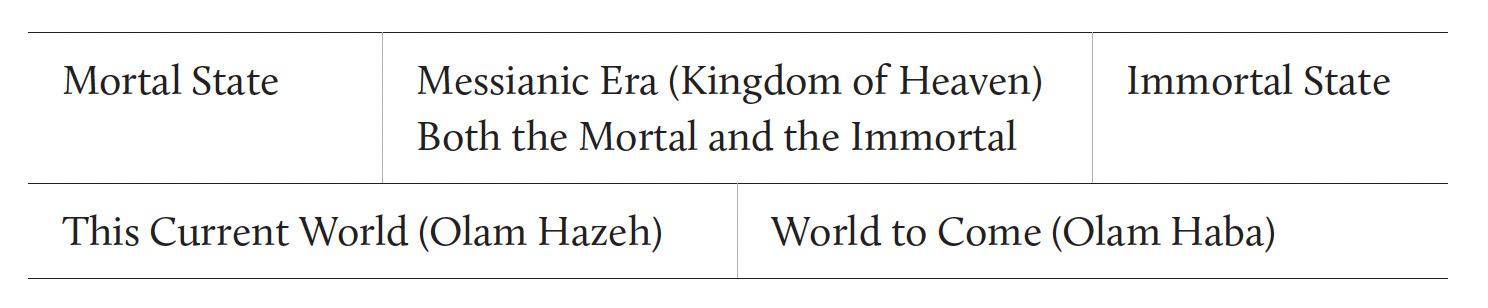
Yimot HaMashiach
Then you shall erect the tabernacle according to its plan which you have been shown in the mountain. (Exodus 26:30)
The Messianic Era should be understood as an intervening transitional stage between this current world and the eternal state of the World to Come. The sages referred to the Messianic Era as the Days of the Messiah, that is, the Yimot HaMashiach (יְמוֹת הַמָּשִׁיחַ), but they disagreed on the details and the duration of those days.
Some believed that the Days of the Messiah would last one thousand years. After all, the prophets refer to the Days of the Messiah as the Day of the LORD, and "a thousand years in Your sight are like a day that passes" (Psalm 90:4 literal, cf. b.Sanhedrin 97b; 2 Peter 3:8). Therefore, the Days of the Messiah should last one thousand years:
Such are the Days of the Messiah. And how many are the Days of the Messiah? Rabbi Eliezer says, "One thousand years, as it is said, "[A thousand years in Your sight are] like a day that passes." (Midrash Tehillim, Psalm 90:4)
That millennial opinion agrees with the book of Revelation, but it's not the only opinion in rabbinic sources. According to the Talmud, Rabbi Eliezer also opines, "The Days of the Messiah are forty years," as it says, "For forty years I [endured] that generation" (Psalm 95:10). Eleazar ben Azaryah argued for seventy years on the strength of the passage that says, "Seventy years like the days of one king" (Isaiah 23:15). Rabbi Yehudah HaNasi thought that the Days of the Messiah will last three generations, or according to another idea he came up with, for three hundred and sixty-five years to represent the days of one year. Rabbi Dossa said, "Four hundred years," a duration also suggested in the apocalypse of 2 Ezra (7:26). Some sages anticipated two thousand years. Rabbi Abbahu anticipated the Days of the Messiah lasting seven thousand years. Many more opinions could be cited, and all of them bring a proof text from the Bible to argue their case. Whatever the duration might be, the apocalypse of 2 Baruch looks for the Messiah to reign "until the world of corruption is at an end, and until the times are fulfilled" (2 Baruch 40:3). Although the sources disagree on the duration of the Messianic Era, they generally agree that it will be an intervening transitional stage between this current world to the World to Come:
Olam Hazeh (עוֹלָם הַזֶּה): this current age / this world
Yimot HaMashiach (יְמוֹת הַמָּשִׁיחַ): Days of the Messiah
Olam Habah (עוֹלָם הַבָּא): the age to come / the World to Come
The Talmud explains that the main difference between this current age and the Messianic Era is that, in the Days of the Messiah, the governments of the world will be under the control of King Messiah:
A person should not imagine that, in the Messianic Era, anything in the normal world will be annulled or that something new will be introduced into the creation. For the world will continue on its path ... Our sages said that the only difference between this world and the Messianic Era will be the subjugation of the kingdoms. This appears in the literal meaning of the words of the Prophets. The Messianic Era will begin with the War of Gog and Magog. (Maimonides, Hilchot Melachim 12:2-3)
This means that the kingdom is technically part of this current age. However, during the righteous reign of King Messiah, life on planet earth will transform into the very best possible version of this current world:
In that time, there will no longer be famine or war, not even jealousy or competition. Instead, goodness will spread over everything. And all life's delights will be as common as dust. And the whole world will have no other occupation but only to know the LORD. And therefore the people of Israel will be renowned as great sages, as knowers of secret things, and they will attain a knowledge of their Creator to the full extent that human capacity allows, as it is written [in Isaiah II:9], "For the earth will be full of the knowledge of the LORD as the waters cover the sea." (Hilchot Melachim 12:4)
The Day of the Lord
You shall make a veil of blue and purple and scarlet material and fine twisted linen; it shall be made with cherubim, the work of a skillful workman (Exodus 26:31)
The kaleidoscopic swirl of prophetic oracles and apocalyptic visions blends the redemption of the Messianic Era with the reward of the World to Come. The New Testament tends to lump it all together without much concern for distinguishing between the Days of the Messiah and the World to Come. Likewise, Jewish eschatology sometimes conflates the ideas, but not always. Many texts carefully differentiate between the two future eras.
The book of Revelation does separate the coming kingdom of heaven from the new heavens and new earth of the World to Come. In John's vision, he saw the new heavens and the new earth of the World to Come arriving at the conclusion of the thousand years of Messiah's reign over this world (Revelation 20-21).
It might be helpful to imagine the thousand-year Messianic Era (i.e., the kingdom, the Days of the Messiah) to function as a transition into the World to Come, occupying a share in both this present world and the coming world. At the conclusion of that transitional era, the present world will be reborn into a new heaven and a new earth, as it says in Isaiah 65:17:
"For behold, I create new heavens and a new earth, and the former things shall not be remembered or come into mind."
THE DAY OF THE LORD
Days of the Messiah = Messianic Era = Kingdom of Heaven = Thousand years of Messiah's reign over this world
World to Come = New Heaven and New Earth = New Jerusalem
The Talmud claims that all the Bible's prophecies about Israel's restoration and a future utopia refer to the Messianic Era but not to the World to Come. This opinion is based on the passage in Isaiah that describes the future reward of the righteous as something that has neither been seen nor imagined in this world:
From days of old they have not heard or perceived by ear, nor has the eye seen a God besides You, who acts in behalf of the one who waits for Him. (Isaiah 64:3[4])
All the prophets prophesied only in regard to the Messianic Era, but regarding the World to Come, "No eye has seen, O God, beside you, what he has prepared for the one that waits on him." (b.Sanhedrin 99a)
According to this idea, all the prophetic promises about a coming utopian era of peace and prosperity pertain only to the Messianic Era. During the Messianic Era, life will continue here on earth under King Messiah's rule. People will be born, live out their days, and die.
The prophecies about the Messianic Era describe what life will be like in the Days of the Messiah. At the conclusion of those days, however, a new state of existence commences in which the righteous receive the great reward. Not even the prophets have seen into that new state of existence. They are unable to describe what the World to Come will be like because they have not heard or seen "what He has prepared for the one that waits on Him."
The Veil Between The Worlds
You shall hang up the veil under the clasps, and shall bring in the ark of the testimony there within the veil; and the veil shall serve for you as a partition between the holy place and the holy of holies. (Exodus 26:33)
The LORD told Moses to divide the Tabernacle into two sacred spaces: the holy place and the holy of holies. He instructed him to separate the two spaces with a veil to serve "as a partition between the holy place and holy of holies."
In the Second Temple Era, a double-hung curtain separated the two sacred spaces. The two curtains had a cubit of open space between them through which the high priest could pass as he transitioned from the holy place to the holy of holies on the Day of Atonement. The sages expressed some uncertainty about the status of the space between the curtains. Did that cubit of space belong to the holy place or the holy of holies?
The writer of the book of Hebrews explains that the sacred spaces of the Sanctuary symbolize the two ages. "The outer one, in which were the lampstand and the table and the sacred bread," and "priests are continually entering ... performing the divine worship ... is a symbol for the present time" (Hebrews 9:2, 6, 9). The holy of holies, into which only the high priest could enter once a year, symbolizes the World to Come:
Behind the second veil there was a tabernacle which is called the Holy of Holies having a golden [censer] and the ark of the covenant covered on all sides with gold, in which was a golden jar holding the manna, and Aaron's rod which budded, and the tables of the covenant; and above it were the cherubim of glory overshadowing the mercy seat; but of these things we cannot now speak in detail. (Hebrews 9:3-5)
Since the holy of holies symbolizes the World to Come, "we cannot now speak in detail" because "no eye has seen, nor ear heard, nor the heart of man imagined, what God has prepared for those who love him" (I Corinthians 2:9; Isaiah 64:3[4]). Nevertheless, we can speak in detail about the liminal space between the holy place and the holy of holies because "the prophets prophesied only in regard to the Messianic Era." That cubit of space between the sanctuaries belongs to both the holy place and the holy of holies. Likewise, the Messianic Era creates a partition between this world and the World to Come, and it shares elements of both.
The Temple, the Messiah, and the Two Ages
The Torah portion, Truma, records the instructions given to Moses for the construction of the Tabernacle. The LORD declares:
“Let them construct a sanctuary for Me, that I may dwell among them. According to all that I am going to show you, as the pattern of the tabernacle and the pattern of all its furniture, just so you shall construct it.” (Exodus 25:8–9)
From the beginning, the earthly sanctuary was built according to a heavenly pattern. It was never merely a building; it was a dwelling place for the Divine Presence among Israel.
In our study of the end of days, we discuss the construction of the Third Temple — a concept that is absolutely fundamental to Jewish eschatology. In biblical and Jewish thought, exile consists of two dimensions:
The Jewish people driven from the land and scattered among the nations.
The destruction of the Temple.
Jewish mysticism teaches a direct correlation between these two realities. Just as Israel is dispersed, so too the Shekinah — God’s dwelling presence — goes into exile with His people. In this understanding, redemption must address both aspects of exile:
The ingathering of the Jewish people.
The rebuilding of the Temple.
Numerous prophecies connect the rebuilding of the Temple with the Messianic era. Most explicitly, Ezekiel 40–46 describes in extraordinary detail the Messianic Temple, its layout, its priesthood, and its sacrificial services. The LORD declares:
“The nations will know that I am the LORD who sanctifies Israel, when My sanctuary is in their midst forever.” (Ezekiel 37:28)
Yet this vision appears to conflict with traditional Christian teaching, which often claims that the death of Christ replaced the Temple, the priesthood, and the sacrificial system. If that were true — if the Levitical system were permanently abolished — why would prophecy anticipate a Temple in the Messianic era? Why return to such a system at all?
The tension begins with a misunderstanding — first of Paul, and then of Hebrews.
The Misunderstanding of Paul
Even during his lifetime, Paul was accused of teaching Jews to abandon Moses and the Torah. In Acts 21:20–21, James and the elders in Jerusalem tell Paul:
“You see, brother, how many thousands there are among the Jews of those who have believed, and they are all zealous for the Torah. They have been told about you, that you are teaching all the Jews who are among the Gentiles to forsake Moses…”
These accusations were false. James affirms Paul’s Torah observance:
“There is nothing in what they have been told about you, but that you yourself also live in observance of the Torah.” (Acts 21:24)
To demonstrate this publicly, Paul participates in Temple sacrifices and pays for the Nazirite offerings of other believers. Later, recounting the event, he says:
“I came to Jerusalem to bring alms to my nation and to present offerings… they found me occupied in the temple, having been purified.” (Acts 24:17–18)
In Acts 24:17 the word translated “offerings” is προσφοράς (prosphoras, accusative plural of προσφορά, prosphora), and it can mean sacrificial offerings—i.e., offerings presented to God in a cultic/Temple context.
Paul never explicitly states that the Torah, the Temple, or the sacrificial system has been “done away with.” Such a conclusion reflects a later theological construction rather than Paul’s own language. What Paul does articulate is far more nuanced and covenantal in nature, addressing the function of the Torah in relation to justification, Gentile inclusion, and the work of Messiah, rather than arguing for the abolition of Israel’s covenantal institutions.
The verse most frequently cited to support the claim that Paul believed the Torah was abolished is Romans 10:4: “Christ is the telos of the law.” However, the Greek word τέλος (telos) does not inherently mean “termination.” Its semantic range includes meanings such as goal, culmination, purpose, or aim. Thus, the passage can just as naturally be understood to mean that Messiah is the goal or intended fulfillment toward which the Torah points. This reading is reinforced by Paul’s own explicit statements elsewhere. In Romans 3:31 he asks, “Do we then nullify the law through faith? May it never be! On the contrary, we uphold the law.” Likewise, in Romans 7:12 he affirms, “So then, the law is holy, and the commandment is holy and righteous and good.” These are not abolitionist statements; they reflect reverence for the Torah’s divine origin and moral authority.
Another passage often invoked is Ephesians 2:15: “Having abolished in His flesh the law of commandments in ordinances…” Yet even here Paul does not claim that the Torah itself has been destroyed. The context is the reconciliation of Jews and Gentiles, and the phrase “law of commandments in ordinances” refers to the legal and social barriers that divided the two groups. The Greek verb καταργέω (katargeō) does not necessarily mean annihilation; it can mean rendered inoperative, deprived of power, or made ineffective in a specific function. Paul’s concern is the removal of covenantal hostility, not the erasure of Torah revelation.
When it comes to sacrifices and Temple worship, Paul never states that they have been abolished. On the contrary, the book of Acts depicts him continuing to participate in Temple life decades after the resurrection. He undergoes purification rites (Acts 21:26), pays for Nazirite sacrifices on behalf of others (Acts 21:23–24), and testifies that he came to Jerusalem “to bring alms to my nation and to present offerings” (Acts 24:17–18). In his legal defense he declares, “I worship the God of our fathers, believing everything laid down in the Law and written in the Prophets” (Acts 24:14). Such language affirms continuity, not cancellation.
What Paul does argue is that the Torah cannot serve as the mechanism of justification. It reveals sin but does not provide the power to overcome it. Righteousness, he insists, comes through Messiah. Gentiles, therefore, do not need to become Jewish or undergo circumcision in order to enter the covenant people of God. The New Covenant introduces a new mode of participation in which the Spirit internalizes God’s instruction. This is not equivalent to saying that the Torah no longer exists. Rather, Paul distinguishes between Torah as covenant boundary marker, Torah as revelation of God’s will, and Torah as a means of justification. He rejects the last of these, not the Torah itself as Scripture.
The Epistle to the Hebrews—traditionally but uncertainly attributed to Paul—adds another dimension. Hebrews 7:12 states that a change in priesthood necessitates a change in law. Yet even here the Torah is not portrayed as evil or meaningless. The sacrificial system is said to sanctify ritually but not to grant eternal perfection. Its fulfillment is located in Messiah’s heavenly priesthood. Significantly, Hebrews frames its argument in eschatological terms: “It is the world to come of which we are speaking” (Hebrews 2:5). The discussion concerns ultimate redemption, not the immediate invalidation of Temple practice.
As for the Temple itself, Paul never calls it illegitimate or obsolete. While he can apply Temple imagery metaphorically to believers—“You are God’s temple” (1 Corinthians 3:16)—he continues to worship at the Jerusalem Temple in practice. He never writes that the Temple system has been canceled or invalidated.
In summary, Paul teaches that Messiah fulfills the covenant promises, that the Law’s condemning power has been broken, and that believers are not under Torah as a justification covenant. He proclaims that Gentiles are included in the people of God without circumcision and that the Spirit writes God’s instruction upon the heart. Yet he simultaneously affirms that the Torah is holy, that he believes everything written in the Law and the Prophets, that he participates in Temple ritual, and that he presents offerings in Jerusalem.
Therefore, it must be stated plainly: Paul never explicitly declares that the Torah, the sacrificial system, or the Temple has been abolished. The language of abolition arises from later interpretive frameworks, not from Paul’s own explicit claims.
Paul describes himself — decades after his Damascus experience — as:
“A Pharisee, a son of Pharisees.” (Acts 23:6)
He never presents himself as having abandoned Judaism or the Torah. Instead, his message was that Gentiles did not need to become Jewish in order to enter the kingdom. He taught Gentile believers not to undergo circumcision because doing so would place them under full Torah obligation (Galatians 5:3). His teaching addressed Gentiles — not Jews.
Paul directed his teachings about circumcision, Jewish legal identity, and covenant obligations specifically to Gentile believers. He instructed Gentile disciples not to undergo circumcision or take on the full stringencies of Jewish law because they were not Jewish. For Paul, to be Jewish meant to live “under the law,” as he himself did, and as he says regarding Yeshua—that He was “born of a woman, born under the law.” But this was not Paul’s message to Jewish people. We see, for example, that he circumcised Timothy because Timothy had a Jewish mother. Paul himself remained Torah-observant. He continued to identify as a Jew—a “Hebrew of Hebrews,” a Pharisee—and even decades after his Damascus Road experience he could still say, “I am a Pharisee, a son of Pharisees” (Acts 23:6).
This creates tension for conventional interpretations of Paul, but it also raises an important question for the idea that Messiah’s death rendered the Temple obsolete. If that were the case, why do we find Paul and other Jewish believers in Yeshua continuing to participate in Temple worship and offering sacrifices? When Paul’s writings are read within a Jewish framework rather than through a replacement-theology lens, he never explicitly says that the Torah is abolished, the Temple is obsolete, or the sacrificial system is canceled. Instead, his core argument is that disciples from the nations do not need to become Jewish in order to enter the kingdom and inherit eternal life. They should not place themselves under Torah covenant obligation by becoming Jewish, because God is the God of all nations, not only of Israel. Yet Paul is equally clear: if a Gentile does choose circumcision—that is, takes on Jewish covenant identity—he is then obligated to keep the whole Torah, just as Paul himself does (Galatians 5:3).
The idea that Paul abolished the Torah, Temple, or sacrifices is a later interpretive development, not his own claim.
The Misreading of Hebrews
A similar misunderstanding occurs when the Epistle to the Hebrews is read through a replacement-theology lens. Contrary to popular assumption, Paul did not write Hebrews, and the letter is not arguing that Christianity replaces Judaism.
Hebrews exhorts Jewish believers not to abandon allegiance to Yeshua under pressure — particularly pressure related to Temple access and priestly legitimacy. The author argues that Messiah serves as a High Priest in the heavenly sanctuary, not the earthly one.
Critically, the writer states plainly:
“It is the world to come concerning which we are speaking.” (Hebrews 2:5)
Hebrews is discussing Olam HaBa — the world to come — not merely this present age, and not even necessarily the Messianic era in its earthly manifestation.
The argument unfolds carefully:
The earthly Temple is a “copy and shadow” of the heavenly (Hebrews 8:5).
The Levitical priesthood serves in that copy.
The sacrifices sanctify “for the cleansing/purification of the flesh” (Hebrews 9:13).
But they cannot impart eternal life.
It is “impossible for the blood of bulls and goats to take away sins” in the sense of securing eternal redemption (Hebrews 10:4). The Levitical system was never designed to grant resurrection and eternal inheritance. It addresses ritual and covenantal purification within this present world.
To secure eternal redemption — participation in the world to come — a heavenly High Priest must offer a transcendent sacrifice in the heavenly sanctuary (Hebrews 9:12–14).
The distinction is crucial:
Earthly Temple vs. Heavenly Temple
Levitical priesthood vs. Heavenly priesthood
Sinai covenant vs. New Covenant
This age vs. the world to come
Hebrews distinguishes these categories. It does not collapse or replace one with the other.
Why a Temple in the Messianic Era?
If Messiah ministers in the heavenly sanctuary, why would there be a Temple in the Messianic era?
Because the purposes differ.
The Temple in the Messianic era fulfills the same purpose stated in the Torah:
“That I may dwell among them.” (Exodus 25:8)
As long as this present world endures, the Temple functions as the dwelling place of God’s manifest presence among Israel. Ezekiel records the LORD saying:
“This is the place of My throne… where I will dwell among the sons of Israel forever.” (Ezekiel 43:7)
However, when we move beyond the Messianic era into Olam HaBa, the world to come, the structure changes entirely. In Revelation 21:22, John writes:
“I saw no temple in it, for the Lord God the Almighty and the Lamb are its temple.”
In the ultimate new creation, heaven and earth are fully united. The entire cosmos becomes holy space. There is no need for a localized sanctuary because God’s presence fills all.
Thus we see a progression:
This present age — Temple as shadow and dwelling place.
Messianic era — Temple as the center of divine presence among Israel and the nations.
World to come — no Temple, because God Himself is the Temple.
The Temple is not replaced; its function reaches fulfillment.