The Septennate
End of Years of Days
Now it happened at the end of two years of days, and Pharaoh was dreaming, and behold, he was standing above the Nile. (Genesis 4I:I, my translation)
This Torah portion is titled Miketz. This title comes from the first verse of the Torah reading, which says tha Pharaoh’s dreams came “at the end (mikketz, מִקֵּץ) of two years of days." Most translations of the Bible smooth out the awkward Hebrew by translating the term to read, "At the end of two full years," or something equivalent to that. The language conveys the idea of two complete years. The sages explained that it means Pharaoh had his troubling dreams precisely two years, to the very day, after releasing his cupbearer and hanging his baker (Genesis 40).
If we remove the prepositional prefix from the title, we get ketz (קֵץ), which means "ending." The sages noticed that the Hebrew phrase "at the end of two years of days" sounds similar to the eschatological term Ketz HaYammim (קֵץ הַיָּמִים), that is, "the end of days" (Genesis Rabbah 89:1).
Rabbi Eliezer taught that Pharaoh's dream occurred on Rosh HaShanah, the day that comes after a full year of days, and at the end of the summer. Rosh HaShanah means "head of the year," i.e., the new year. Unlike the secular calendar year, the Jewish year occurs in September, at the beginning of the agricultural year. If Pharaoh had his dream on Rosh HaShanah, the day of the dream would count as the first day of the first year of plenty.
Jewish tradition says that the heavenly court convenes on Rosh HaShanah to issue decrees and judgments concerning the fates of nations and the fates of individuals for the ensuing year. On that particular Rosh HaShanah, God announced the judgment concerning Egypt's agricultural yields for the next fourteen years. Joseph explained that the decision was a divine edict from heaven:
Now as for the repeating of the dream to Pharaoh twice, it means that the matter is determined by God, and God will quickly bring it about. (Genesis 41:32)
The Bible refers to Rosh HaShanah as the Day of Remembrance and the Festival of Trumpets (Leviticus 23:24). The Torah calls it a day for trumpet blowing. Think of it as the festival that celebrates the future trumpet of the Messiah and the end of days. Rabbi Eliezer taught, "On Rosh HaShanah, Joseph came out from prison... and in the future the Jewish people will be redeemed in the final redemption with the coming of the Messiah" (b.Rosh HaShanah Iob-Ia).
References
This lesson is adapted from Daniel Lancaster's teachings in The End of Days, as presented by First Fruits of Zion for the Torah Club.
The Summer is Near
Now learn the parable from the fig tree: when its branch has already become tender and puts forth its leaves, you know that the summer is near. (Matthew 24:32)
The word ketz (ending) is similar to the Hebrew word kayitz (קַיִץ), which means summertime or summer fruit, especially regarding figs. Summertime (kayitz) comes at the end (ketz) of the biblical year. That wordplay appears in Amos 8:1-2, where God shows the Prophet Amos a basket of figs (kayitz) and then explains the meaning of the vision as "the end (קֵץ) has come for My people Israel."
Yeshua employs the same wordplay when He says to His disciples, "Now learn the parable from the fig tree: when its branch has already become tender and puts forth its leaves, you know that the summer (ketz/kayitz) is near." It's part of His answer to the question, "When will these things happen, and what will be the sign of Your coming, and of the end of the age" (Matthew 24:3). His disciples understood Hebrew, and they understood Yeshua's pun about the coming summer as a warning to pay attention to the early indications of the Day of the LORD:
Now learn the parable from the fig tree: when its branch has already become tender and puts forth its leaves, you know that the summer [end] is near. So, you too, when you see all these things, recognize that He is near, right at the door. Truly I say to you, this generation will not pass away until all these things take place. (Matthew 24:32-34)
Behold the fig tree and all the trees; as soon as they put forth leaves, you see it and know for yourselves that summer [the end] is now near. So you also, when you see these things happening, recognize that the kingdom of God is near. Truly I say to you, this generation will not pass away until all things take place. (Luke 21:29-32)
He says we should be able to recognize the nearness of the hour by means of observation and deduction (cf. Matthew 16:1-3). Indications of the end of days, like buds on a fig tree, should be pretty obvious to those who are paying attention. But why a fig tree?
At the very least, the fig tree alludes to prophecies about the future Messianic Era. The prophets say that, in the days of the Messiah, everyone will "sit under his own vine and fig tree" (Micah 4:4; Zechariah 3:10). It's an idiom that means everyone has an abundance and lives without scarcity (I Kings 4:25; 2 Kings 18:31). Therefore, the budding of the fig tree should be understood as early indications of the coming kingdom: when you see the early signs of the kingdom, you will know that the end is near.
To be more specific, the fig tree symbolizes Israel, Jerusalem, and the Temple. Only a few days before the conversation about the fig tree putting forth its leaves, Yeshua had cursed a fig tree that bore no fruit as a prophetic sign of the coming destruction of Jerusalem and the Temple (Matthew 21:19-20). Likewise, in His parables, the fig tree symbolizes the whole nation (Luke 13:6-8). On that basis, Christian prophecy teachers have suggested that the budding and blossoming of the fig tree alludes to the reestablishment of the Jewish people in the land of Israel and in Jerusalem.
That interpretation led some Christians to anticipate the rapture on Rosh HaShanah of 1988. In his popular booklet 88 Reasons Why the Rapture Will Be in 1988, Edgar Whisenant suggested that the fig tree prophecy referred to the rebirth of Israel as a nation in 1948. Whisenant pointed out that the generation that sees the fig tree blossom does not pass away before the end and that, in the Torah, a biblical generation lasts for forty years (Matthew 24:32-34; Numbers 32:13). Adding forty years to 1948 brought him to 1988 as the year of the rapture of the church. Rosh HaShanah of 1988 came and went, but Jesus did not come, and the church did not go.
References
This lesson is adapted from Daniel Lancaster's teachings in The End of Days, as presented by First Fruits of Zion for the Torah Club.
Apocalypse of Peter
As for you, learn a parable from the fig-tree: as soon as its shoots have come forth and the twigs have grown, the end of the world shall come. (Apocalypse of Peter 2)
The early Jewish believers did not miss the wordplay in Matthew 24:32. They knew Yeshua was talking about more than just horticulture and the change in seasons. The apocryphal book called Apocalypse of Peter paraphrases "summer is near" as "the end of the world shall come."
Apocalypse of Peter was not really written by Peter. It's an apocryphal text compiled in the second century. Some scholars believe it was written around the time of the massacre of the Jewish believers of Jerusalem by the false messiah Bar Kochba (135 CE). The text weaves together sayings from Matthew 24, Mark 13, and Luke 21 to expand on Yeshua's predictions about the end of days. Some early churches counted Apocalypse of Peter among the books of their New Testament canon. That doesn't mean that we should consider it reliable or another book of the Bible or anything like that. It's not. But for our purposes, Apocalypse of Peter can give us a window into how early Jewish believers interpreted Yeshua's predictions. Unfortunately, we no longer possess a complete version of the original. Scholars have tried to piece it together from quotations by the church fathers, an incomplete version preserved in Coptic, and another version from a Greek manuscript discovered inside the tomb of a monk in 1887.
The apocalypse starts with the disciples approaching Yeshua where He is seated on the Mount of Olives overlooking Jerusalem. They ask Him, "What are the signs of your coming and of the end of the world so that we may observe and warn those coming after us?" His reply paraphrases and reframes key sayings from the eschatological discourse (Matthew 24:4-5, 26-27,30,32, 16:27):
Be careful that no one leads you astray, and do not fall into doubt or serve other gods. For many will come in my name, saying, "1 am the Christ." Do not believe them, and do not go after them.
For the coming of the Son of God will not be hidden. Just as lightning flashes from the east to the west, so will I come on the clouds of heaven, in great glory, surrounded by a vast host. Before me the sign of the cross will go, and in my majesty I will appear, shining with a brightness seven times greater than the sun, together with all my holy ones and angels.
Then my Father will place a crown upon my head, and I will judge the living and the dead, and I will repay each one according to what he has done.
And as for you, learn a parable from the fig-tree: as soon as its shoots have come forth and the twigs have grown, the end of the world shall come. (Apocalypse of Peter 1-2)
References
This lesson is adapted from Daniel Lancaster's teachings in The End of Days, as presented by First Fruits of Zion for the Torah Club.
The Fig Tree Is Israel
Then the branches of the fig tree, that is, the house of Israel, will again put forth shoots. (Apocalypse of Peter 2)
As the conversation continues, Peter replies, "Explain the fig tree to me. How should we understand it? Every year of its life, a fig tree sends forth shoots and yields fruit for its owner. What does the parable of the fig tree mean?"
Yeshua explains that the fig tree is the Jewish people: "Have you not understood that the fig tree is the house of Israel?" This second-century interpretation of Yeshua's words is remarkably similar to that of many Christian Zionists who believe that the budding of the fig tree symbolizes the return of the Jewish people to the land and formation of the modern state. Using similar language, the synagogue prayer for Israel frames the establishment of the modern state as "the first blossoming of our redemption." Just because Jesus didn't come and rapture the church in 1988 does not mean they were wrong about the identity of the fig tree.
The reply in Apocalypse of Peter is worth quoting at length, if only for its mention of Enoch and Elijah as the two witnesses of the apocalypse in the struggle against the antichrist (compare Hippolytus, On Christ and Antichrist 43):
Have you not understood that the fig tree is the house of Israel? Truly, I tell you: when the branches of the fig tree put forth shoots in the last days, then false Christs will arise and stir up expectation, saying, "1 am the Christ who has now come into the world."
Yet this deceiver is not the Christ. When they reject him, he will strike them down with the sword, and many will be slain as martyrs. Then the branches of the fig tree, that is, the house of Israel, will again put forth shoots, and many will be martyred by his hand.
At that time Enoch and Elijah will be sent to instruct them, declaring that this one is the deceiver who was destined to come into the world and perform signs and wonders so as to lead astray. Therefore, those who die at his hand will be counted as martyrs - numbered among the good and righteous ones who have pleased God in their lives (Apocalypse of Peter 2)
References
This lesson is adapted from Daniel Lancaster's teachings in The End of Days, as presented by First Fruits of Zion for the Torah Club.
The Seven Years of the Son of David
Let the food become as a reserve for the land for the seven years of famine which will occur in the land of Egypt, so that the land will not perish during the famine. (Genesis 41:36)
Joseph interpreted Pharaoh's dreams to refer to two distinct seven-year periods. He predicted seven years characterized by abundant agricultural prosperity, followed by seven years of abject famine.
The Bible reckons days and years in cycles of seven. The cycle of seven began at creation. In six days God created the heavens and the earth, and on the seventh day He rested. Henceforth, the Bible counts days in sets of seven with the Sabbath falling on each seventh day. Similarly, the Bible counts years in sets of seven with a Sabbatical Year once every seventh year (Leviticus 25:3-4). The prophetic visions of the book of Daniel also number off the years in sets of seven (Daniel 9). The Hebrew term shavua (שָׁבוּעַ) literally means "seven," and it can refer to a week of days, a week of seven years, or to any set of seven.
The seven years preceding the Messiah's arrival are called the Shavua Sheben David (שְׁבוּעַ שֶׁבֶן דָּוִד), "Seven of the Son of David." The sages predicted a seven-year period before the advent of the Messiah that would be characterized by increased suffering and a series of signs and portents. They connected the seven years of the Son of David with the idea of the birth pangs of the Messiah and the time of Jacob's Trouble. Just as a mother's labor contractions become most intense before the final push and the moment of birth, so too, Israel will go through an intense season of tribulation in the last years leading up to the Messiah.
Jewish apocalyptic literature predicts seven years of cataclysms, natural disasters, earthquakes, conflagrations, plagues, pestilences, famines, persecutions, wars, and rumors of wars. Hoping to avoid those travails, several of the talmudic sages used to say, "Let the Messiah come after I am dead":
Rabbi Yochanan warned, "During the generation in which the Son of David comes, Torah scholars decrease, and as for the rest of the people, their eyes fail with sorrow and grief, and troubles increase. Harsh decrees will be introduced; before the first passes, the second comes quickly." (b.Sanhedrin 97a)
One often-quoted passage from the Talmud alludes to the story of the years of plenty and famine in Egypt as it speculates about the order of signs and calamities that will occur in the last seven years before the Messiah comes:
Our rabbis taught, "In the seven [years] of the son of David's coming, in the first year, the verse [from Amos 4:7 that says], I would send rain on one city and on another city I would not send rain, will be fulfilled. In the second, the arrows of hunger will be sent forth. In the third, a great famine, during which men, women, infants, the devout and men of deeds will die, and the Torah will be forgotten by her students. In the fourth, plenty and no plenty. In the fifth, great plenty, when men will eat, drink and rejoice, and the Torah will return to its disciples. In the sixth, voices [or noises]. In the seventh, wars. And at the end of the seven, the Son of David will come." Rabbi Yosef objected, "But many such sevens have passed, yet he has not come." (b.Sanhedrin 97a)
In another place, the Talmud explains that the synagogue liturgy recites the prayer for redemption as the seventh blessing in the series of eighteen to allude to the belief that the Messiah will come at the end of the seventh year of the Son of David:
Why did they place the blessing for redemption as the seventh in the sequence? Rava said, "Since they are destined to be redeemed in the seventh year, they put it in the seventh place." In the sixth, voices [or noises]. In the seventh, wars. And at the end of the seven, the Son of David will come. The war [of the seventh year] is the beginning of the redemption. (b.Megillah 17b)
References
This lesson is adapted from Daniel Lancaster's teachings in The End of Days, as presented by First Fruits of Zion for the Torah Club.
The Master of Dreams
Then Pharaoh said to his servants, "Can we find a man like this, in whom is a divine spirit?" So Pharaoh said to Joseph, "Since God has informed you of all this, there is no one so discerning and wise as you are." (Genesis 41:38-39)
God gave Joseph the spiritual gift of dreams and dream interpretation. Joseph's brothers called him "this master of dreams" (Genesis 37:19). The symbolism in the dreams offered prophetic glimpses of the future, but the symbolism needed to be interpreted to be understood. God filled Joseph with the Holy Spirit of wisdom, discernment, and knowledge to decode the meanings.
The seer Daniel had a lot in common with Joseph. Like Joseph, he was forcibly taken from his home in the promised land and dragged into captivity in a foreign land. Joseph was a teenager when sold into Egypt. Daniel was a young teen when Nebuchadnezzar deported him along with members of the royal family and nobility of Judah to Babylon in 605 BCE (Daniel I:1-3). Like Joseph, Daniel found himself serving as an interpreter of dreams, a wiseman, and a close advisor to the most powerful man in the world. Like Joseph interpreting Pharaoh's dreams, Daniel interpreted the symbolism in Nebuchadnezzar's dream of the statue (Daniel 2), his dream of the tree (Daniel 4), and Belshazzar's handwriting on the wall (Daniel 5). But when it came to his own visions, Daniel needed help with interpretations. He asked one of the angelic beings who stands before the throne of glory to explain the vision of the four beasts that rise from the sea (Daniel 7). The angel Gabriel was needed to explain the vision of the ram and the goat (Daniel 8) and the vision of the kings of the north and the south (Daniel 10-12).
Daniel also struggled to understand Jeremiah's prophecies about the restoration of Jerusalem, the fall of Babylon, and the duration of the Babylonian exile. Jeremiah seemed to predict that the exile and the desolation of Jerusalem would endure seventy years (Jeremiah 25:10-12, 29:10). By the time Daniel received a scroll of Jeremiah's prophecies, he had already been in captivity nearly seventy years. He had lived through the fall of Babylon (539 BCE) and was by then a captive of King Darius of Persia. He wondered if the time for the final redemption was at hand. He devoted himself to a period of prayer and fasting, confessing the sins of the nation on behalf of the whole people and beseeching God to show mercy to His people and His holy city by restoring the nation, rebuilding Jerusalem, and restoring the Temple. As Daniel was still fasting and praying, the angel Gabriel appeared to him to explain Jeremiah's prophecy of the seventy years until the final redemption:
SEVENTY SEVENS NOT SEVENTY YEARS
Seventy weeks have been decreed for your people and your holy city, to finish the transgression, to make an end of sin, to make atonement for iniquity, to bring in everlasting righteousness, to seal up vision and prophecy and to anoint the most holy place. (Daniel 9:24)
SEVEN WEEKS AND SIXTY-TWO WEEKS
So you are to know and discern that from the issuing of a decree to restore and rebuild Jerusalem until Messiah the Prince there will be seven weeks and sixty-two weeks; it will be built again, with plaza and moat, even in times of distress. (Daniel 9:25)
THE SEVENTIETH WEEK
Then after the sixty-two weeks the Messiah will be cut off and have nothing, and the people of the prince who is to come will destroy the city and the sanctuary. And its end will come with a flood; even to the end there will be war; desolations are determined. And he will make a firm covenant with the many for one week, but in the middle of the week he will put a stop to sacrifice and grain offering; and on the wing of abominations will come one who makes desolate, even until a complete destruction, one that is decreed, is poured out on the one who makes desolate. (Daniel 9:26-27)
References
This lesson is adapted from Daniel Lancaster's teachings in The End of Days, as presented by First Fruits of Zion for the Torah Club.
Seventy Sevens
Seventy weeks have been decreed for your people and your holy city. (Daniel 9:24)
The sages derived the notion of the Seven Years of the Son of David from the prophecy of the seventy weeks in the book of Daniel. Gabriel's oracle draws its organizing structure from the Torah's laws of the Sabbatical Year, which measure off time in seven-year cycles (Leviticus 25). Just as the Sabbatical cycle operates on sets of seven years —weeks of years, if you will —the prophecy of seventy weeks also organizes itself into sets of seven: "Seventy [sevens] have been decreed for your people and your holy city."
Christian and Jewish interpreters have made valiant attempts to interpret the prophecy of the seventy weeks. Most interpretations read the seventy weeks as sets of seven-year cycles for a total span of 490 years from the "decree to rebuild and restore Jerusalem until Messiah" (Daniel 9:25) and the destruction of the city and Sanctuary. The various reckonings of prophecy teachers fail to precisely match the historical record, but that's not surprising. Apocalypses use numbers symbolically without regard for literal precision. Even if the seventy sevens are intended as precisely 490 years it's not clear where the count-off begins or where it ends.
Nevertheless, the broad strokes of the prophecy found fulfillment in the Second Temple Era. The angel Gabriel said that, within the seventy sevens, a decree to rebuild Jerusalem would be issued, the city of Jerusalem and the Temple were to be rebuilt, and the Messiah was to come (and also be cut off). An enemy prince was to arise, make "a firm covenant with many," defile the Temple with an idol, and destroy both the city and the Temple before being destroyed.
A decree to rebuild Jerusalem will be issued.
The city will be rebuilt in times of duress.
An anointed one (Messiah) will come and be cut off, left with nothing.
The people of the coming prince will destroy Jerusalem and the sanctuary.
The coming prince will make a firm covenant with many.
The coming prince will defile the Sanctuary and put a stop to the daily sacrifices.
God will pour out destruction on the coming prince.
In 539 BCE, Cyrus, the king of the Persian Empire did issue a decree "to restore and rebuild Jerusalem" and "to anoint the most holy place." A century later, Artaxerxes reissued the same decree. The Jewish people who returned from exile rebuilt the city and the Holy Temple within it (as the books of Ezra and Nehemiah relate) during times of distress. The Messiah, the anointed one, did come and was cut off, as the prophecy states (Daniel 9:26). He died "to finish the transgression, to make an end of sin, to make atonement for iniquity, to bring in everlasting righteousness" (Daniel 9:24). After the death of Messiah, Jerusalem's end came "with a flood" (Daniel 9:26). Titus, the prince of Rome (the emperor's son) came with his people to "destroy the city and the sanctuary" (Daniel 9:26). The Romans defiled the Temple Mount and built a temple to Jupiter on it, as the prophecy says, "and upon the temple shall be an abomination of desolations" (Daniels 9:27 LXX).
References
This lesson is adapted from Daniel Lancaster's teachings in The End of Days, as presented by First Fruits of Zion for the Torah Club.
Times, Times, and Half A Time
From the issuing of a decree to restore and rebuild Jerusalem until Messiah the Prince there will be seven weeks and sixty-two weeks. (Daniel 9:25)
Gabriel divides the seventy sevens into two distinct eras: seven sevens and sixty-two sevens for a total of sixty-nine. At the end of those sixty-nine weeks, the Messiah is cut off and the people of the prince to come destroy Jerusalem and the Temple (Daniel 9:26).
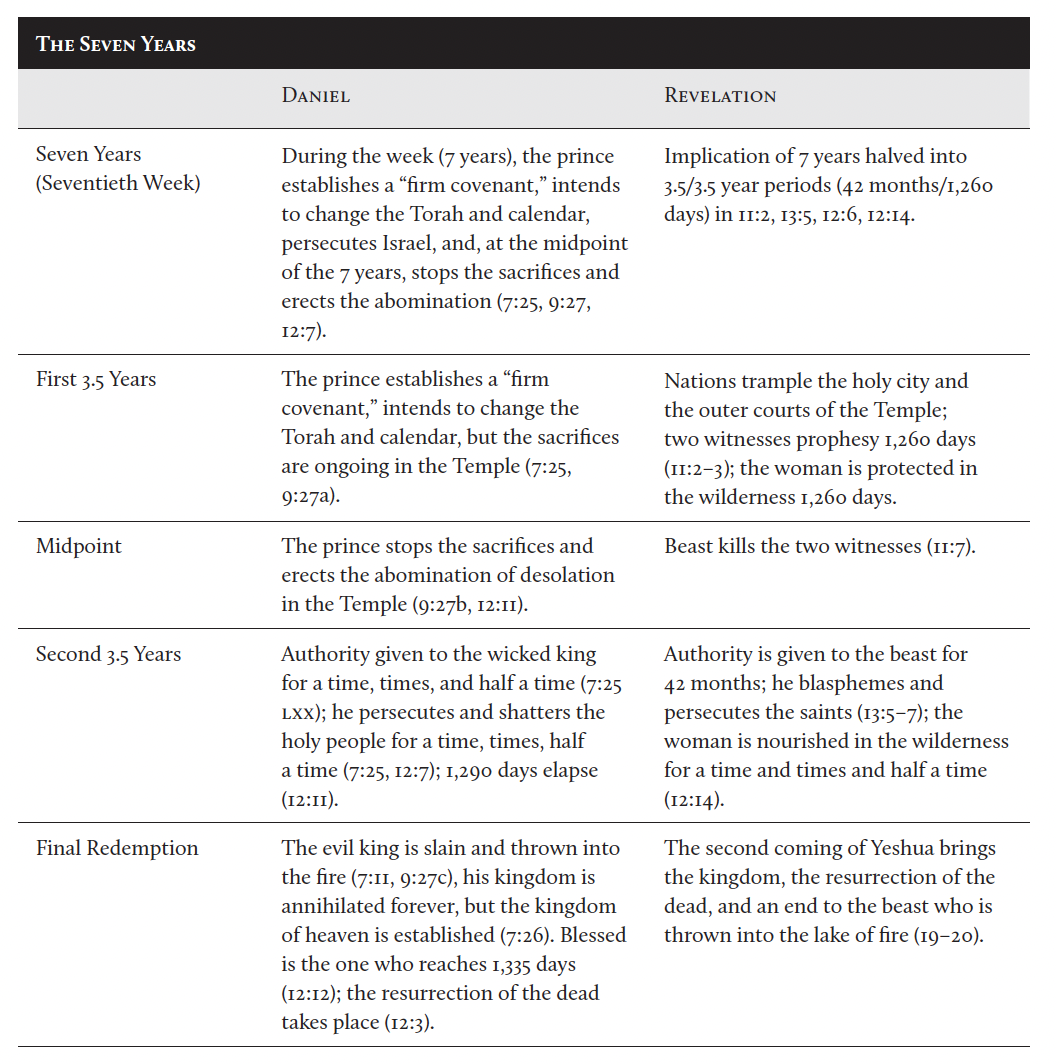
What happened to the seventieth week? The angel Gabriel divides the final week into two separate eras. The prince to come makes a "firm covenant" with the multitude, but after three and a half years, he puts an end to the sacrifices and sets up an idol (abomination of desolation) in the Temple until a complete destruction is poured out on him.
This character is the same as the blasphemous king from Daniel 7:25, who "will speak out against the Most High and wear down the saints of the Highest One, and he will intend to make alterations in times and in law." He follows in the footsteps of Antiochus Epiphanes, the villain of the Hanukkah story, who also put an end to the daily sacrifices and set up an abomination of desolation in the Temple (Daniel II:31). Antiochus also exalted himself above every god and blasphemed against the LORD (Daniel II:36) and was "enraged at the holy covenant" (Daniel II:30).
The new villain is a second Antiochus Epiphanes-type of character. He will persecute the Jewish people. "They will be given into his hand for a time, times, and half a time" (Daniel 7:25), a duration commonly interpreted as three and a half years.
A Time = one year
Times = two years
Half a Time = one half year
For the duration of "a time, times, and half a time" the power of the holy people will be shattered under him (Daniel 12:7). "From the time that the regular sacrifice is abolished and the abomination of desolation is set up, there will be 1,290 days" (three and a half years plus one month) until the final redemption (Daniel 12:11). Those who endure and keep waiting until 1,335 days are considered blessed, presumably because they will witness the final redemption and resurrection (Daniel 12:13).
The book of Revelation identifies the cruel blaspheming prince as "the beast," i.e., the antichrist. The material in Revelation also makes a few attempts to organize around the division in the seventieth week. The nations trampled the holy city and the outer courts of the Temple for forty-two months (three and a half years) while the two witnesses in Jerusalem testify against the wickedness (Revelation II:2). The two witnesses have the power to shut up the sky so that it will not rain for the full duration of three and a half years as happened "in the days of Elijah, when the sky was shut up for three years and six months, when a great famine came over all the land" (Luke 4:25), for "he prayed earnestly that it would not rain, and it did not rain on the earth for three years and six months" (James 5:17). At the end of that term, the beast makes war on the two witnesses and puts them to death (Revelation 1I:7), and their bodies are left in the streets for three and a half days (Revelation II:9-II).
Subsequently, the dragon invests the beast with his authority to be worshiped in the place of God. As the beast utters blasphemies against God and against the Temple for forty-two months, the nations worship him, "Who is like the beast!" For the duration of that second three and a half years, he takes power over all nations and persecutes the saints "to overcome them" (Revelation 13:1-7).
Likewise, the vision of the dragon pursuing the woman in Revelation 12:6-14 divides into two subsequent three-and-a-half-year periods. First, the woman (Israel) flees "into the wilderness where she had a place prepared by God, so that there she would be nourished for one thousand two hundred and sixty days," that is, three and a half years (Revelation 12:6). Then the dragon is thrown down from heaven and intends to persecute the woman again, "But the two wings of the great eagle were given to the woman, so that she could fly into the wilderness to her place, where she was nourished for a time and times and half a time, from the presence of the serpent" (Revelation 12:14).
It should be obvious that the book of Revelation derives much of its material from Daniel's prophecies about the seventieth week, but it's not a good idea to press apocalyptic texts too literally. As mentioned above, specific numbers in apocalyptic literature are more about the symbolism than they are about laying out a precise schedule.
References
This lesson is adapted from Daniel Lancaster's teachings in The End of Days, as presented by First Fruits of Zion for the Torah Club.
The Seven Years in Irenaeus
Therefore when you see the abomination of desolation which was spoken of through Daniel the prophet, standing in the holy place (let the reader understand), then those who are in Judea must flee to the mountains. (Matthew 24:15-16)
Irenaeus (c. 180 CE), the second-century bishop of Lyons, claims to transmit apostolic tradition on several texts. He was a disciple of Polycarp, the disciple of John, and he had a copy of Papias' five-volume work titled Expositions on the Sayings of the Lord, which preserved oral traditions of the apostles. In his own five-volume book, Against Heresies, Irenaeus correlates the villain from the last seven years with the antichrist of 2 Thessalonians 2 to give us a summary of the rise and fall of antichrist. He is "the man of lawlessness ... the son of destruction, who opposes and exalts himself above every so-called god or object of worship, so that he takes his seat in the temple of God, displaying himself as being God" (2 Thessalonians 2:3-4):
Thus the Apostle plainly points out [antichrist's] apostasy, that he exalts himself above all that is called God or worshiped -that is, above every idol (for though men call them gods, they are not truly gods) — and that he will strive by tyranny to put himself forward as God. (Irenaeus, Against Heresies 5:24)
For Irenaeus, the antichrist is a Roman Emperor who imposes an idolatrous form of monotheism on the world by presenting himself as the only true god and then requiring his subjects to worship an idol of himself in the Temple of God:
He will transfer his rule to Jerusalem and will sit in the temple of God, deceiving those who worship him, as if he were the Christ ... He also marks out the length of his tyranny, during which the saints will be driven into flight- those who offer a pure sacrifice to God ... three years and six months make up this half-week. (Against Heresies 5:24)
Irenaeus identifies the man of lawlessness (and his idol) as the abomination of desolation referred to by Yeshua in Matthew 24:15, and he correlates that lawless one with the boastful horn of Daniel 8 that defiles the Temple and erects the abomination. Antichrist will rule over the earth for three and a half years, exercising a despotic campaign against the faithful (Daniel 8:23-25, LXX). Irenaeus turns back to 2 Thessalonians to prove that, at the end of the seven years, the Messiah will arrive and slay that lawless one with the breath of His mouth and bring him to an end by the appearance of His coming (2 Thessalonians 2:8):
When this antichrist has laid waste all things in the world, he will rule for three years and six months, sitting in the temple at Jerusalem. Then the Lord will come from heaven, in the clouds, in the glory of the Father, and will cast this man and those who follow him into the lake of fire. But for the righteous He will bring in the times of the kingdom— that is, the rest, the sanctified seventh day — and will restore to Abraham the inheritance that was promised to him. In that kingdom the Lord declared that "Many will come from the east and from the west and will recline at table with Abraham, Isaac, and Jacob." (Irenaeus, Against Heresies 5.30)
References
This lesson is adapted from Daniel Lancaster's teachings in The End of Days, as presented by First Fruits of Zion for the Torah Club.
The Seven Years Interrupted
If the first sixty-nine weeks concluded in the Second Temple Era, when did the seventieth week occur, and why didn't the Messiah come at its conclusion?
Christian dispensationalists suggest that there has been a delay in the program of the seventy weeks since the first century because the Jewish people did not heed the message of Jesus or accept Him as Messiah. According to this view, the first sixty-nine "weeks" extend from the decree to rebuild Jerusalem until the coming of Messiah. At that point, the prophetic timeline has been interrupted by the new "dispensation" of the church age, which has lasted until the present. We are still waiting for the last seven years to begin.
That's not an unreasonable approach. The idea is similar to the pause in the program suggested in earlier lessons. The seventieth week is reserved for the end of the age. They divide the last week into two periods: the Tribulation (first three and a half years) and the Great Tribulation (second three and a half years). That schedule follows a very literal reading of Daniel and Revelation, and it generally corresponds well with the testimony of apostolic fathers like Irenaeus.
But there are other ways to divvy up the years. As stated above, the numbers of the years need not be taken with rigid literalism. Apocalyptic visions rarely provide exact chronological precision about how events will unfold. Instead, they unveil potential outcomes for moments in history. They show us the deeper spiritual forces at work behind history, enabling us to discern the recurring patterns that shape it.
During the Second Temple Era, Rome made a "firm covenant" of peace with the Jewish people. That peace endured until Nero. Under those arrangements, Rome had sovereignty over Judea, Jerusalem, and the Temple Mount with its outer courts, but they agreed not to intrude into the Sanctuary (Revelation II:2). That covenant of peace concluded when the beast turned against the disciples of Yeshua, destroyed the Temple of God, and ultimately erected a temple to Jupiter in its place. When the wheels in the prophetic clock resume their motion, perhaps the remaining time, times, and half a time will commence-not necessarily as a literal forty-two months but rather as a sequence of signs and world events that follow the general patterns indicative of the end.
References
This lesson is adapted from Daniel Lancaster's teachings in The End of Days, as presented by First Fruits of Zion for the Torah Club.
Many Antichrists
Children, it is the last hour; and just as you heard that antichrist is coming, even now many antichrists have appeared; from this we know that it is the last hour. (I John 2:18)
The main problem with a rigid and literal interpretation of the seven years in Daniel and Revelation is that it didn't happen-not precisely like that, and certainly not in that specific order of events. Instead, the apocalyptic visions of Daniel and Revelation offer glimpses into the hidden spiritual forces shaping history. So far, they have not been entirely useful for determining exact sequences of events or the timing of the final redemption. Yet, they have proven strikingly accurate in portraying the way world events consistently bend toward a particular direction.
Julius Caesar made "a firm covenant" with the Jewish people after Pompey's conquest of Jerusalem (63 BCE). He granted Jews protection of ancestral customs, both in Judea and Diaspora communities.
Caesar Augustus also made "a firm covenant" with the Jewish people as the first emperor of Rome. He guaranteed Jewish rights throughout the empire to remain monotheistic, to assemble together for worship, to send contributions to the Temple in Jerusalem, and to observe their holy days and dietary laws.
The Emperor Gaius Caligula seems to have been hellbent on being the antichrist. Unlike earlier emperors, who were deified mainly after death, Caligula openly presented himself as a god while alive. He dressed as Jupiter, carried his thunderbolt, and demanded temples and statues as if he were the king of the gods. He broke the "firm covenant" with the Jewish people, insisting that his images be placed in synagogues. Just ten years after the death and resurrection of Yeshua, he sent the Roman legions marching toward Jerusalem to install an enormous idol of Jupiter (in his own image) in the holy of holies. His legions were already in Galilee before word reached them of his assassination, bringing an end to the plan (41 CE).
A few decades later, Nero put in a strong bid for the title of antichrist. He emulated Caligula's flamboyance. After the fire of Rome (64 CE), he launched the first state-sponsored persecution of the believers. At that time, he erected in Rome an enormous 100-foot golden idol of himself as the sun god Apollo (Colossus Neronis) around the same time he sent his legions against Jerusalem (66 CE), but he committed suicide before the fall of Jerusalem.
After Nero's death, Emperor Vespasian's son Titus sacked the holy city, destroyed the Temple, placed a sanctuary to Jupiter on its ruins, and brought an end to the First Jewish Revolt (70 CE), which had lasted about three and a half years. Titus left parts of the Tenth Legion to occupy the ruins of Jerusalem. Vespasian imposed a punishing tax on the Jewish people, forcing them to pay tribute to the temple of Jupiter, and he turned his attention to hunting down the surviving members of the house of David.
A few decades later, Vespasian's younger son, Domitian, took a swing at being the antichrist (95 CE). He filled the empire with idols of himself and demanded that everyone address him as "my lord and my god." Near the end of his reign, he singled out the Christians for persecution by designating them as an illegal superstition. He banished John to the Island of Patmos, where he saw the Revelation. The believers referred to Domitian as the Nero Redux (Nero Revived) and as antichrist.
After Domitian, Trajan conducted military campaigns against the Jewish people in the Kitos War, and he maintained the ruthless persecutions against the Christians (II5 CE).
Hadrian brought peace. He renewed Rome's "firm covenant" with the Jewish people and promised to rebuild Jerusalem and the Holy Temple (II7 CE). After visiting the ruins of Jerusalem, he changed his mind and elected to build a temple to Jupiter on the Temple Mount instead, installing a permanent abomination of desolation. In protest to Hadrian's plans for Jerusalem, a Jewish false messiah rose up to challenge him. Bar Kochba declared himself Messiah and led a vicious three-and-a-half-year revolt against Rome (132-135 CE). During the war, he massacred the Jewish believers in Yeshua who remained in Jerusalem. Hadrian punished the Jews by enacting laws making aspects of Torah observance illegal. The Jewish people referred to those days as the great persecution.
Each of the above candidates had some antichrist qualities, and, starting with Caligula, each one of them earned the title of antichrist from the believers living in his generation.
References
This lesson is adapted from Daniel Lancaster's teachings in The End of Days, as presented by First Fruits of Zion for the Torah Club.
The Fig Tree Blossoms
During the World War Il Era, Adolph Hitler was widely believed to be the antichrist. Few candidates have shown themselves more adept at the job. In 1938, the Gestapo began sending prisoners to concentration camps. Jews were forced to register their assets with the state, prohibiting major transactions and limiting their right to buy and sell. Kristallnacht marked the loss of economic freedom and the beginning of open persecution. But the Nazis did not implement the "Final Solution" (the plan for the systematic extermination of the Jewish people) until 1942, some three and a half years later. Over the remaining three and a half years of the war, the concentration camps became the machinery of genocide. Six million were murdered in a campaign that annihilated families, communities, and centuries of Jewish life across Europe. It was a time of trouble for Jacob, "a great tribulation" for Israel, "such as has not occurred since the beginning of the world until now" (Matthew 24:21). The dragon invested the beast with his authority, and it was also given to him to make war with the Jewish people and to overcome them (Revelation 13:4-7).
He did not overcome them.
A remnant remained.
Out of the ashes of 1945 came the rebirth of Jewish presence and sovereignty in the land of Israel. In 1948, the modern State of Israel was established. Many believe it to be a first blossoming of the redemption, the budding of the fig tree, the beginning of summer, and the beginning of the end:
On Mount Zion there will be those who escape. For out of Jerusalem will go forth a remnant and out of Mount Zion survivors. The zeal of the LORD of hosts will perform this. (Obadiah 17; Isaiah 37:32)
References
This lesson is adapted from Daniel Lancaster's teachings in The End of Days, as presented by First Fruits of Zion for the Torah Club.