The Name of the Beast
End of the Generation
Joseph died, and all his brothers and all that generation. (Exodus I:6)
Joseph died expecting the redemption from Egypt to occur within his generation. He told his brothers, "I am about to die, but God will surely take care of you and bring you up from this land to the land which He promised on oath to Abraham, to Isaac and to Jacob" (Genesis 50:24). He made his brothers swear to carry his bones with them when they left Egypt. But they did not leave Egypt. "All his brothers and all that generation" died in Egypt, waiting for the redemption.
Yeshua told His disciples, "There are some of those who are standing here who will not taste death until they see the Son of Man coming in His kingdom" (Matthew 16:28). He told them that they could expect to see the redemption within their generation: "Truly 1 say to you, this generation will not pass away until all these things take place" (Matthew 24:34). Yeshua died, rose from the dead, and ascended. All His brothers and all His generation also died, but they did not see the Son of Man coming in His kingdom.
The death of the generation of Yeshua has left the world hanging in suspense, waiting for the redemption He foretold. As if to offer a token fulfillment of His promise that some of His disciples would not die before seeing the redemption, John the son of Zebedee received a vision of the coming of the Son of Man. Shortly before his death at the end of the first century, John saw the apocalyptic vision recorded for us in the book of Revelation. He saw how things might have played out.
History followed a different path. In His great mercy for the nations, God has withheld the day of wrath until this very day. Like the children of Israel sojourning in Egypt, waiting three generations for the day when God would fulfill His promises to the forefathers, the Jewish people wait in exile for the day of redemption and the coming kingdom of Messiah.
The kingdom draws ever nearer. The redemption is at hand. The things foreseen in John's vision grow ripe. "Knowing the time, that it is already the hour for you to awaken from sleep; for now salvation is nearer to us than when we believed. The night is almost gone, and the day is near" (Romans I3:II-I2).
Passover of the Future
The sons of Israel were fruitful and increased greatly, and multiplied, and became exceedingly mighty, so that the land was filled with them. (Exodus 1:7)
The ongoing return of the Jewish people to the land of Israel after nearly two thousand years of exile is one of the clearest indications that the end of days is at hand. Not only are the people of Israel back in the land of Israel (as predicted by the prophets), they have been fruitful, increased, and multiplied "so that the land was filled with them." The modern State of Israel has become "exceedingly mighty" —so much so that its adversaries fear it. The stage is set for the final redemption.
The sages taught that the final redemption will follow the pattern established by the redemption from Egypt. Moses was "the first redeemer," and the Messiah is "the last redeemer." The story of the exodus is called "the Passover of Egypt;" the final redemption is called "the Passover of the future." In the future, the events of the final redemption will eclipse the memory of the exodus from Egypt:
"Therefore behold, days are coming,"declares the LORD, "when it will no longer be said, 'As the LORD lives, who brought up the sons of Israel out of the land of Egypt, but, 'As the LORD lives, who brought up the sons of Israel from the land of the north and from all the countries where He had banished them? For I will restore them to their own land which I gave to their fathers. (Jeremiah 16:14-15)
Yeshua offered His disciple John a revelation of how those dramatic events play out. He told him to "write the things which you have seen, and the things which are, and the things which will take place after these things" (Revelation I:19). We can use the story of the exodus from Egypt and the vision granted to John on Patmos to take our own glimpse of the coming day of salvation.
A New King
Now a new king arose over Egypt, who did not know Joseph. (Exodus 1:8)
A new king, one who did not know Joseph, rose to power over Egypt and over the children of Israel. If Moses (the first redeemer) corresponds to the Messiah (the last redeemer), the wicked Pharaoh corresponds to the antichrist. The wicked spirit of antichrist (Satan) manifests in world leaders committed to destroying Israel and preventing the redemption. Like the Roman emperors in the days of the apostles, the Egyptian Pharaohs considered themselves as divine incarnations of the gods, and they demanded to be worshiped and revered as such. That conviction set them at odds with the children of Israel. Nowadays, modern world leaders have found their own pretenses for war against the Jewish people, but it often comes down to religion.
The new king, "who did not know Joseph," can be compared to religious anti-Semites who do not know Jesus (despite professing His name). The Pharaoh can be compared to today's world powers, who obey "the god of this world." Satan orchestrates history's otherwise inexplicable, consistent pattern of unrelenting anti-Semitism. He knows that the potential for redemption and the coming kingdom of heaven remains so long as the Jewish people survive, and that terrifies him. Therefore, he wages war against Israel, as the prophecy says, "He persecuted the woman who gave birth to the male child" (Revelation 12:13).
Egypt represents this present age, which is in bondage to the "god of this world" and the "prince of the power of the air" (2 Corinthians 4:4; Ephesians 2:2). The redemption from Egypt corresponds to both Israel's redemption from exile and the ultimate redemption of humanity from the kingdom of darkness that rules this present world. Satan hopes that, if he can annihilate the Jewish people, he will thwart the prophecies about the messianic redemption and the fall of his kingdom. Those who harbor anti-Semitism and hatred for God's people fulfill the will of their father the devil, just as the Master said:
You are of your father the devil, and you want to do the desires of your father. He was a murderer from the beginning, and does not stand in the truth because there is no truth in him. (John 8:44)
The Footsteps of the Messiah
Remember, O Lord, the reproach of Your servants; how I bear in my bosom the reproach of all the many peoples, with which Your enemies have reproached, O LORD, with which they have reproached the footsteps of Your [Messiah]. (Psalm 89:50-51)
Jewish sources refer to the last generation before the kingdom with the eschatological term Ikveta d’Meshicha (עִקְּבְתָא דְּמְשִׁיחָא). It's an Aramaic phrase meaning "the footsteps of the Messiah" (literally "heels of the Messiah"). The expression comes from talmudic and midrashic literature. It refers to the period immediately preceding the coming of the Messiah. The term suggests that, figuratively speaking, the Messiah is so near that the generation can hear His approaching footsteps. It's derived from Psalm 89:51, "Your enemies have reproached, O LORD, with which they have reproached the footsteps of your Messiah (Ikvot Meshicheka, עִקְּבוֹת מְשִׁיחֶךָ)." The entire psalm is about God's covenant with David and His promises to the Davidic monarchy. The psalm complains that God has allowed foreign nations to overrun the land, the people, and the anointed Davidic king. It beseeches God to remember His covenant loyalties to David and rescue the anointed king (Messiah). The king says, "I bear in my bosom the reproach of all the many peoples, with which your enemies have reproached, O LORD, with which they have reproached the footsteps of your Messiah."
What man can live and not see death? Can he deliver his soul from the power of Sheol? Selah. Where are Your former lovingkindnesses, O Lord, which You swore to David in Your faithfulness? Remember, O Lord, the reproach of Your servants; how I bear in my bosom the reproach of all the many peoples, with which Your enemies have reproached, O LORD, with which they have reproached the footsteps of Your anointed [Messiah]. (Psalm 89:48-51)
They "reproach the footsteps" of the Messiah by dismissing Him. They have no fear of Him. The people say, "He will not come." They do not fear the approaching King.
The Wicked and Adulterous Generation
They have acted corruptly toward Him, they are not His children, because of their defect; but are a perverse and crooked generation. Do you thus repay the LORD, O foolish and unwise people? Is not He your Father who has bought you? He has made you and established you. (Deuteronomy 32:5-6)
The generation of the Ikveta d'Meshicha is expected to be a little rough around the edges. Moses sets the tone in his apocalyptic Song of Moses (Deuteronomy 32). He warns that, in the end of days, "a perverse and crooked generation" will incite the wrath of the Day of the LORD. The Talmud suggests that the last generation before the coming of the Messiah will be either completely wicked or completely righteous (b.Sanhedrin 98a). That's a broad generalization to remind us that there are two ways the redemption might come: the hard way or the easy way. The hard way is the Day of Wrath. Think of Noah's flood. Think of Sodom and Gomorrah. The easy way is the Day of Salvation. Think of the kingdom. Think of the reward of the righteous: "At that time your people, everyone who is found written in the book, will be rescued" (Daniel 12:1).
Yeshua knew His generation was heading toward the hard way, and He attempted to reverse the direction. In exasperation, He complained, "You unbelieving and perverted generation, how long shall I be with you? How long shall I put up with you? (Matthew 17:17). "This generation is a wicked generation" (Luke II:29), "an evil and adulterous generation (Matthew 16:4). Although they had eyes, they did not see the truth; although they had ears, they did not listen to the truth. If they had listened and understood and turned from sin, He could have healed them (Matthew 13:13-16). Since they declined their opportunity to repent, their fate would be worse than the people of Sodom and Gomorrah in the final judgment. At that time, even the Gentiles of Nineveh and Ethiopia will be in a position to condemn them because they heeded the teachings of Jonah and Solomon (Matthew 12:41-42). After His resurrection and ascension, Yeshua's disciples took up His plea, "Be saved from this perverse generation!" (Acts 2:40).
Generation Last and Lost
So long as human beings have been around to offer social commentary, we've been complaining about the utter disaster of the next generation. Kids these days! Am I right? The rabbis had a similar cynicism about the idea of human progress. From the rabbinic perspective, each subsequent generation degenerates a little bit further. Rather than evolving toward enlightenment, the human race spiritually devolves-unless it has strong spiritual leadership to reverse the tendency.
Chasidic Jewish teaching compares the generations of humanity to a human body. The earliest generations occupied a higher spiritual level. Spiritual giants like the patriarchs belonged to the level of the head, neck, and shoulders. The following generations of the biblical era also belonged to higher limbs in the body, but subsequent generations comprise lower body parts. The final generation reaches the lowest point of all: the generation of the Ikveta d’Meshicha (עִקְּבְתָא דְּמְשִׁיחָא), which can be literally translated as "the heels of the Messiah." Like the common English idiom "bottom of the barrel," we are talking about the bottoms of the feet.
The Mishnah uses the term "Footsteps of the Messiah" or "Heels of the Messiah" to refer to the final generation before the Messiah comes, and it's the bottom-of-the-barrel generation. Jewish apocalypses characterize that last generation as foolhardy, morally inverted, and societally corrupt (e.g., 2 Baruch 70). The Mishnah's description of the final generation anticipates an era characterized by moral decline, social turmoil, and spiritual confusion:
In [the generation of] the footsteps of the Messiah, impudence will increase and inflation will rise. The vine shall bring forth its fruit, but wine will be expensive. The kingdom shall turn to heresy, and there will be none to reprove.
The meeting house of the religious authorities will become a place of sexual promiscuity. The Galilee shall be destroyed, the Golan will be desolate, and the refugees shall go round from city to city, but none will show them favor.
The wisdom of scribes will unravel. People who fear sin will be held in disgust, and truth will be absent.
The youth will shame their elders; elders will rise before children: "For son treats father contemptuously, daughter rises up against her mother, daughter-in-law against her mother-in-law; a man's enemies are the men of his own household" (Micah 7:6). The face of the generation will be like the face of a dog; a son will no longer be ashamed before his father. And upon what is there for us to rely? Only upon our Father in heaven. (m.Sotah 9:15)
It sounds like a description of the current generation, but we aren't the first generation to think so. Probably every generation reading this text thinks it applies to them. High prices, heretical teachings, clergy sex scandals, wars in the Middle East, refugee problems, and the disintegration of the family are not necessarily new developments in the course of human history. However, it does seem as if those things have been enormously heightened recently.
Family Problems
Son treats father contemptuously, daughter rises up against her mother, daughter-in-law against her mother-in-law; a man's enemies are the men of his own household. (Micah 7:6)
The last generation will witness a time of international turmoil and warfare. The sages say, "When you see kingdoms clashing— these against these-look for the feet of the Messiah" (Genesis Rabbah 42:4). The Mishnah recites Micah 7:6 to indicate that the wars of the last generation will also take place within the family unit. It's a scripture that Yeshua also quoted to warn about the disintegration of family relationships before the redemption:
Do not think that I came to bring peace on the earth; I did not come to bring peace, but a sword. For I came to set a man against his father, and a daughter against her mother, and a daughter-in-law against her mother-in-law; and a man's enemies will be the members of his household. (Matthew 10:34-36)
Before the utopian era of peace on earth could commence, there would be a time of conflict, trouble, and persecution. He said, "I have come to cast fire upon the earth" (Luke 12:49). He warned His disciples that, during those days, the younger generation would turn against the previous generation and betray them. The three children (son, daughter, daughter-in-law) defy the older generation (father, mother):
Do you suppose that I came to grant peace on earth? I tell you, no, but rather division; for from now on five members in one household will be divided, three against two and two against three. They will be divided, father against son and son against father, mother against daughter and daughter against mother, mother-in-law against daughter-in-law and daughter-in-law against mother-in-law. (Luke 12:51-53)
Many parents in today's world can affirm the trend toward intergenerational conflict. The rapid pace of social change, fueled in part by the online interconnectedness of peers, creates dramatic discrepancies in values and convictions between generations. It's not at all unusual for godly parents to lose their children to the godless values of the next generation. What's the solution to the intergenerational rift that comes during the time of the Footsteps of the Messiah? According to Malachi, the LORD will send the Prophet Elijah to heal families:
Behold, I am going to send you Elijah the prophet before the coming of the great and terrible day of the LORD. He will restore the hearts of the fathers to their children and the hearts of the children to their fathers, so that I will not come and smite the land with a curse. (Malachi 3:23-24 [4:5-6])
Post-Torah Israel
Rabbi Yisrael Meir HaKohen (1838-1933), known as the Chofetz Chaim, believed that the Mishnah's description of the last generation predicted modern secularism. In the same way sociologists and historians can now speak of post-Christian Europe and even a post-Christian America, it's possible to speak of post-Torah Israel. The so-called Enlightenment (Haskalah) reached Judaism in the 1800s. It promoted rationalism, humanism, liberalism, progressivism, relativism, and secular education while, at the same time, denying Torah, tradition, Jewish law, and the fear of the LORD. That mass exodus from Jewish faith reached a zenith by the end of the nineteenth century, resulting in Reform Judaism or, more often, complete secularism, assimilation, and atheism. In the post-World War Il Era, Chasidic leaders attributed the mass apostasy of the Jewish people embracing secularism (and Secular Zionism) to the Ikveta d’Meshicha. They believed they were seeing the "perverse and crooked generation" that Moses warned about. From out of that secular soup came the great tribulation of World War Il, the Holocaust, the establishment of the State of Israel, and the current moment:
Rabbi Yanai said: If you see generation after generation reviling and blaspheming God, anticipate the footsteps of King Messiah. That is what is written: "For Your enemies revile the LORD; they revile the footsteps of your Messiah." What is written immediately after that? "Blessed be the LORD forever, amen and amen." (Song of Songs Rabbah 2:13, Psalm 89:52-53).
The Wounded Heel
Come, let us deal wisely with them, or else they will multiply and in the event of war, they will also join themselves to those who hate us, and fight against us and depart from the land. (Exodus I:I0)
Pharaoh persecuted, mistreated, brutalized, and enslaved the Jewish people in an attempt to break them. Not only did he see them as a threat to his power, but he also feared the day that they might "fight against us and depart from the land." He bent his efforts toward keeping the Jews from returning to the land promised to their forefathers. He tried to stop the redemption.
Likewise, Satan sees the existence of the Jewish people as a threat to his power. He continually strives against them. He cannot directly fight against God, but he can fight against His people.
The last generation before the coming of the Messiah is called Ikveta d'Meshicha, literally, "The Heels of the Messiah." By the way, it's interesting that the name Jacob (Yaakov, יַעֲקֹב) is based on the same word (akev, עָקֵב),, meaning "heel" (Genesis 25:26). Jacob's other name is Israel. That information should shed light on the cryptic pronouncement in Genesis 3:15:
I will put enmity between you and the woman, and between your seed and her seed; he shall bruise you on the head, and you shall bruise him on the heel. (Genesis 3:15)
The LORD says that He will put enmity between the serpent and the woman and between his seed and her seed. The serpent will wound the man's heel (a painful and potentially deadly venomous bite), but the man will wound the head of the serpent (a deadly, crushing stomp on the head). Jewish tradition explains the text in terms of the animosity between the serpent and the Jewish people:
When people are occupied with Torah, snakes have no power to harm any Jew, and the people of Israel are able to kill them; but when Israel neglects the words of Torah, the serpent bites at their heel... Then the serpent has the ability to be sent against Israel and kill, as it is said: "The LORD sent fiery serpents among the people and they bit the people, so that many people of Israel died." (Midrash Aggadah, Genesis 3:15; Numbers 21:6)
The animosity between the woman and the serpent and between their respective offspring culminates in the end of days. The serpent wounds the "heel," but the Messiah heals the heel:
There will be a remedy for the sons of the woman, but for you, serpent, there will be no remedy. [For the sons of the woman] there will be a remedy for the [wounded] heel in the days of the Messiah King. (Targum Pseudo-Jonatan, Genesis 3:15)
Revelation 12 dramatizes the enmity between the serpent and the woman. The dragon persecutes the woman and tries to destroy her. The dragon tries to devour her child: the Messiah. If the "seed of the woman" is understood as the Messiah, then his wounded heel must be the Ikveta d'Meshicha, the last generation: the Heels of the Messiah. The serpent inflicts a deadly, venomous wound on the last generation of Israel before the coming of the Messiah. (For example, six million Jews died in the Holocaust.) That wounding, however, turns out to be the serpent's undoing. The same heel into which he sinks his poisonous fangs crushes his head.
The Serpent’s Strategy
If it is a son, then you shall put him to death; but if it is a daughter, then she shall live. (Exodus I:16)
Today's war against babies and fertility follows the serpent's diabolical agenda.
An interesting idea in the Talmud suggests that "the Son of David will not come until all the souls in the [heavenly] abode [waiting to be born] have finished [being born into bodies]" (b. Yevamot 62a). That notion was probably derived from the apocalypse of 2 Baruch, in which God explains the day until the redemption as an effort to use all the souls He created:
I remember those who are yet to be born. When Adam sinned and death was pronounced ... the total number of those who would be born was fixed. A place was prepared for that number where the living would dwell and the dead would be kept. Therefore, until that appointed number has been completed, no one will live again. (2 Baruch 23)
Maybe that idea seems pretty outlandish to us, but it's what people believed in the days of the apostles. Maybe Satan believes it, too. By aborting babies and reducing human fertility, he attempts to delay the coming of the Messiah.
The Jewish apocalyptic text called Sibylline Oracles transmits early Christian eschatology but also preserves very early Jewish eschatology that, at many points, predates the New Testament. One passage in Sibylline Oracles sees the reduction of human fertility as an indication that the antichrist draws near:
Of the last generation, evil-doers, cruel and foolish; nor perceiving this, that when the tribes of women cease to bear, the harvest-time of mortal men is come. And ruin threatens when impostors come instead of prophets speaking on the earth. And Beliar will come, and many signs will work for men. And then of holy men Elect and faithful there will be confusion, and a plundering of them and of the Hebrews. (Sibylline Oracles 2:203-213, Milton S. Terry, trans., 1890)
The book of Revelation indicates that Satan has an appetite for babies: "The dragon stood before the woman who was about to give birth, so that when she gave birth he might devour her child" (Revelation 12:4). Likewise, Pharaoh instructed the midwives, "If it is a son, then you shall put him to death" (Exodus I:16). That's not a good way to curb population growth. If he were only trying to curb the population growth of the Hebrews, he should have let the sons live but not the daughters. The sages explain that he was not trying to curb the population growth; he was trying to prevent the redeemer of Israel from being born. Jewish tradition holds that astrologers had warned him that the one destined to redeem the Hebrews was about to be born.
So long as the Jewish people remain on earth, they constitute a threat to Satan's kingdom because God might send the Messiah to redeem them at any moment. But what if there were no Jews left in the world? Could the promises of God be thwarted? That's the diabolical goal.
Names of the Beast
It is the last hour; and just as you heard that antichrist is coming, even now many antichrists have appeared; from this we know that it is the last hour. (I John 2:18)
Antichrist is Satan's strategic piece for accomplishing the diabolical goal. The evil one raises up world leaders to solve "the Jewish problem" for him. He isn't particular about who he uses for the job. In the days of Moses, Pharaoh the Egyptian was the man. In the days of Isaiah the prophet, Sennacherib the Assyrian went up to bat. In the story of Esther and Mordechai, the wicked Haman schemed to kill the Jewish people. In the days of the Maccabees, Antiochus Epiphanes made himself the model of antichrist. The Apostolic Era saw a series of Roman emperors, one after another, in candidacy for the role. Since then, plenty of others have filed their applications for the job. Satan does not need to revive the Roman Empire before he can carry out his plans. He does not need to appoint a new Imperial Caesar from Italy to accomplish his objectives. In recent times, Adolph Hitler took up the mantle. In today's world, Jihadist Islam campaigns to eliminate the Jewish people. As it says in the Passover Haggadah, "It was not only one man [Pharaoh] who rose up to destroy us: in every single generation people rise up to destroy us, but the Holy One, blessed be He, rescues us from their hand."
The term antichrist is ordinarily not part of the lexicon of Jewish eschatology, but the idea of a tyrannical world leader who implements cruel measures against the Jewish people in the end of days is nearly a certainty:
Rabbi Eliezer said, "If they do not repent, the Holy One, Blessed be He, will establish a king over them whose decrees are as harsh as Haman's. Then the Jewish people will repent and be restored to righteousness." (b.Sanhedrin 97b)
In Christian eschatology, the antichrist has many names. Ezekiel names him "Gog, prince of Rosh, Meshech and Tubal (Ezekiel 38:3). The book of Daniel calls him the "little horn" (Daniel 7:8), "the beast" (Daniel 7:I1), "the prince who is to come" (Daniel 9:26), and "the one who makes desolate" (Daniel 9:27).
Paul refers to him as the man of no Torah: "man of lawlessness," "lawless one," "the son of destruction," and "the man of sin" (2 Thessalonians 2:2-8).
Paul also calls the antichrist "Beliar" (2 Corinthians 6:15), a name derived from the Biblical Hebrew word belial (בְּלִיַּעַל), which means worthlessness. Biblical Hebrew uses the idiom "son of Belial" to refer to a no-good fellow. Later apocalyptic texts began referring to Satan as Beliar, and Christian apocalypses followed suit by applying the name Beliar or Son of Beliar to the antichrist. For example, Sibylline Oracles refers to the antichrist as "Beliar, from the great Caesars" (3:75).
Beliar = Same as Belial (בְּלִיַּעַל). A name derived from the Biblical Hebrew word for worthlessness that apocalyptic texts assigned to Satan or the antichrist.
Other names for the antichrist appear throughout Christian literature. Apocalypse of Elijah names the antichrist lawless one, son of lawlessness, and shameless one. Apocalypse of Peter calls him false-christ and deceiver. Didache names him "the deceiver of the world."
The Name of the Beast
The name of the beast. (Revelation 13:17)
Three decades before John's vision on Patmos, the disciples of Yeshua already assumed that Nero was the antichrist. He was the first Roman emperor to target the believers for persecution. He had Simon Peter crucified and the Apostle Paul beheaded. He sent the Roman army against the Jewish people to destroy Jerusalem. "He began to plunge into unholy pursuits, and armed himself even against the religion of the God of the universe (Eusebius, Ecclesiastical History 2.25.1).
Nero believed that every man secretly harbored the same lustful degeneracy that he did. Therefore, he despised all chastity, modesty, and virtue as deceitful. He respected only men who shamelessly indulged themselves in lewd depravities. Nero surrounded himself with men and women dedicated to debauchery. Paul's critique of Roman high society aptly depicts Nero's court (Romans 1:26-27).
First-century believers needed to be careful about what they said and what they wrote. Like believers living under authoritarian regimes today, they needed to speak in codes and symbols to avoid being arrested for crimes against the government. The book of Revelation uses apocalyptic symbolism to avoid naming Rome, the Roman government, or Roman officials. For example, John described Rome as "Babylon, the great mother of harlots" (Revelation 17:5). He described the empire as a seven-headed "beast" on which a harlot rides. John explains to "the mind which has wisdom" that "the seven heads are seven mountains on which the woman sits" (Revelation 17:9). Rome was already called the city that sat on seven hills.
To avoid naming Nero, the first-century believers referred to him as "the Beast," a title they borrowed from the book of Daniel's descriptions of the dreadful fourth beast with iron teeth. Nero's contemporaries also referred to him as a beast. For example, the first-century writer Philostratus said, "As to this wild beast, which many call a tyrant, I know not either how many heads he has, nor whether he has crooked talons and jagged teeth." Nero's psychotic spectacles might have inspired the nickname. For the entertainment of the crowds in the circuses, the emperor disguised himself "in the skin of some wild beast, and when let loose from the cage, he violated men and women bound to the stake" (Suetonius, Lives of the Caesars: Nero 12.20).
Number of the Beast
Here is wisdom. Let him who has understanding calculate the number of the beast, for the number is that of a man; and his number is six hundred and sixty-six. (Revelation 13:18)
The book of Revelation also uses the rabbinic code language of Hebrew gematria to avoid directly naming Nero. It turns out that the number 666 is not literally a number; it's an encoded name.
Gematria is an ancient, rabbinic method of interpretation that employs a mathematical reading of a text. In gematria, each Hebrew letter is assigned a mathematical value. The reader can then add up the letters of a word to produce a numerical value for that word, which can, in turn, be compared to other words with the same numeric value. The book of Revelation seems to encode Nero's name as the number of the beast by first transliterating the Greek form of his name (Καῖσαρ Νέρων) into Hebrew/Aramaic characters (Keisar Neron, קסר נרון) and then adding the sum of their numerical equivalent.
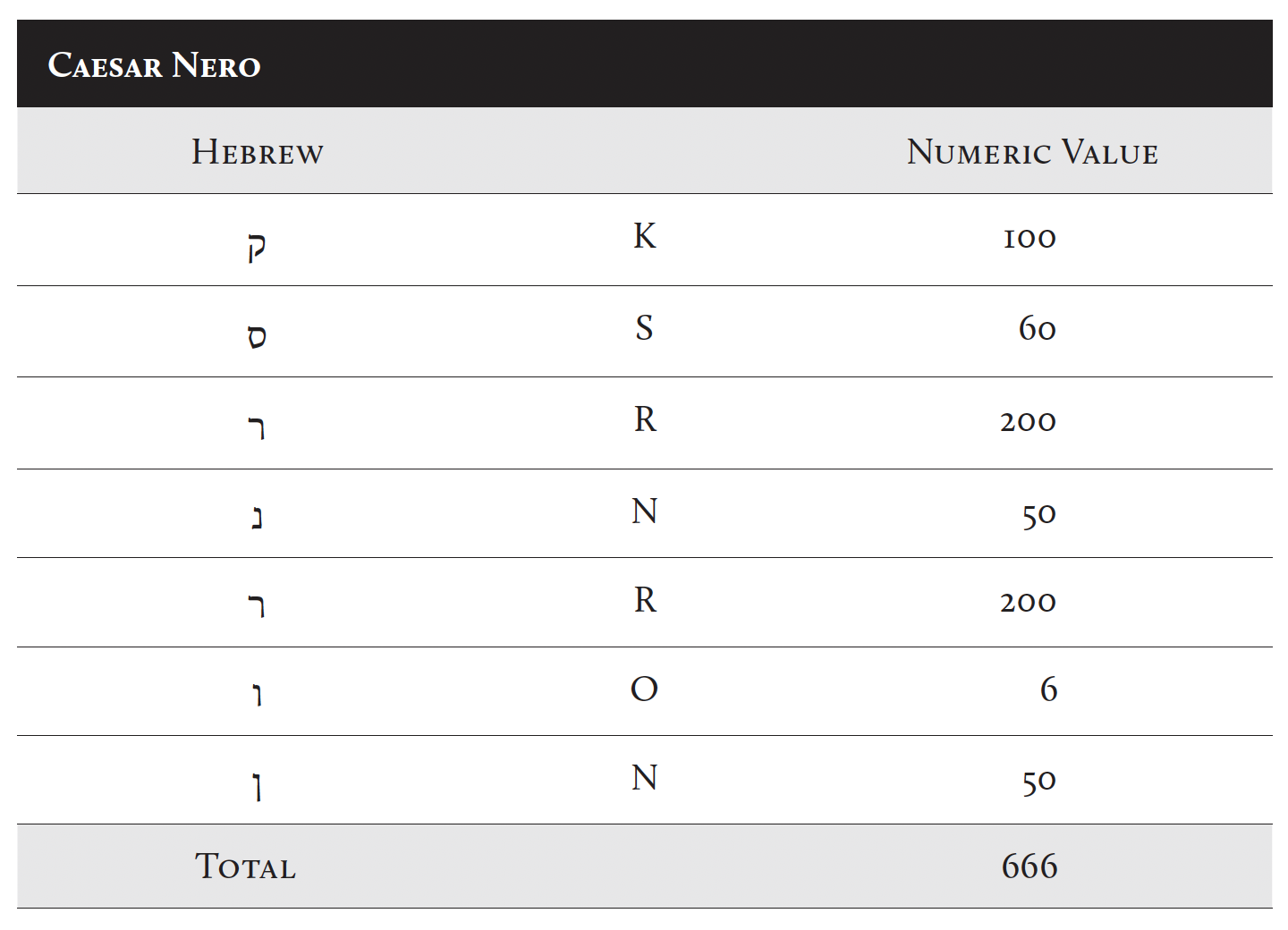
The Sibylline Oracles employ a similar type of cryptic code language to obscure the names of Roman emperors by using the numeric values of the initial Greek letters in their names:
Then one will rule who takes the number three [i.e., γ for Gaius Caligula]. Then shall one whose first letter marks twice ten [i.e., κ for Claudius] ... and one whose mark is fifty [i.e., ν for Nero] shall be lord, a dreadful serpent, breathing grievous war. He will stretch out his hands against his kin, and cut them off, and spread confusion wide, fight, kill the people, and dare countless things. (Sibylline Oracles 5.33–42)
Gaius Caligula (γ) was the wicked emperor who wanted to make war against the Jewish people and place an idol of himself in the holy of holies. His legions were already in the Galilee, on their way to Jerusalem to install the enormous abomination of desolation, when he was assassinated. Nero (v) envied and emulated his uncle Gaius Caligula. He made it his goal to live more lavishly than he did and outspend him. He picked up Caligula's demonic legacy and took it to new extremes. In every way possible, Nero became the agent of Satan on earth, the incarnation of evil, and the spirit of antichrist.
More examples of encoding names occur in the Sibylline Oracles. We are told that the sum of letters in the secret name of God is equivalent to 837: "Of the whole sum the hundreds are twice eight, and thrice three tens, with seven" (I:170-171). Likewise, the cypher for the Greek name Jesus (Ἰησοῦς), is equivalent to 888: "Four vowels and the consonant in him two times are told; and the whole sum I name: for eight ones, and as many tens to these, and yet eight hundred will the name reveal" (1:384-389).
Nero Redux
I saw one of his heads as if it had been slain, and his fatal wound was healed. And the whole earth was amazed and followed after the beast. (Revelation 13:3)
Even after his death, the early Christians continued to think of Nero as the antichrist. Early Christian tradition anticipated that Nero would rise again from the dead and return as the world deceiver. The Sibylline Oracles frequently mention the return of Nero as a matricidal fugitive from the ends of the earth who shall overpower all things and make himself equal to God (Sibylline Oracles 5.466-492, 8.85-96, 12.99-121). In the Christian apocalypse titled Ascension of Isaiah, the antichrist is Beliar, incarnated in the flesh as Nero. The book of Revelation depicts Nero as "the beast which was and is not" (Revelation 17:11), who rises from the dead:
I saw one of his heads as if it had been slain, and his fatal wound was healed. And the whole earth was amazed and followed after the beast. (Revelation 13:3)
The notion of Nero as the antichrist became so fixed in the early church that, in Christian Armenia, the word for antichrist was simply Nero.
The Roman historian Tacitus (Histories 2) explains why the idea of Nero as antichrist persisted even after Nero's death. Not long after the emperor's suicide, rumors circulated that Nero had not died and that he was coming again. Certain pretenders took advantage of the rumors, claiming to be Nero. Early Christians began to anticipate the return of Nero in the role of antichrist in much the same way they anticipated the return of Christ:
Hence some crazed men believe that [Nero] has been borne away and kept alive, for [Sibylline Oracles] declares that "the matricide, though an exile, will come back from the ends of the earth," so that, since he was the first persecutor, he may also be the last and herald the arrival of the devil when he comes to lay waste the earth and overturn the human race" (Lactantius, de Mortibus Persecutorum).
At the time of John's exile to Patmos, the Emperor Domitian seemed like he could be the new Nero—a new emperor in the spirit of Nero. Meanwhile, rumors circulated that Nero had been discovered in Parthia (kings of the east), where he was raising an army to conquer Rome (cf. Revelation 16:12). The book of Revelation alludes to both notions.
In the century after John's revelation on Patmos, Christians began trying new combinations for decoding the number 666 into a name. Using Greek numerical values instead of Hebrew, Irenaeus made a few feeble suggestions, but he warned against such speculation:
It is less hazardous to await the fulfilment of the prophecy, than to be making surmises, and casting about for any names that may present themselves, inasmuch as many names can be found possessing the number mentioned; and the same question will, after all, remain unsolved. (Against Heresies 5:24)
Armilus
He opened his mouth in blasphemies against God, to blaspheme His name and His tabernacle, that is, those who dwell in heaven. (Revelation 13:6)
A dramatic Jewish legend dating from the Byzantine Era and further embellished in subsequent centuries provides the name of the antichrist as Armilus (ארמילוס). One source explains the name as Greek for "He will destroy a nation." That's a false etymology (ἁρπάζω/λαός) intended to communicate that Armilus has one job: destroy the nation of Israel. More realistically, Armilus is best understood as a thinly veiled code for Rome. The name Armilus rearranges the letters of the name Romulus, the founder of Rome.
The earliest surviving source for the legend of Armilus appears in the apocryphal apocalypse called Sefer Zerubbabel. In the apocalypse, the angels Gabriel and Michael grant the biblical character Zerubbabel (one of the ancestors of Yeshua) an ascension to the heavenly Sanctuary, where he sees visions of the spiritual forces behind the scenes and revelations about the future. He requests to see the end of days. They show him the Messiah son of David imprisoned in a dungeon in Rome. They show him the wars of the last years, culminating with the rise of Armilus and the war of Gog and Magog. The legend took shape in various retellings, some of which are preserved for us in obscure collections of midrash.
In those legends, the Armilus character combines the antichrist of earlier Jewish and Christian apocalypses with elements of Roman Christianity as Jews experienced it in the late Byzantine Era. Armilus is presented as the son of Belial (Satan). He is miraculously born from out of the statue of a woman in Rome. He is called "the king of fierce countenance" (cf. Deuteronomy 28:50; Daniel 8:23). He is "the son of Satan, the spawn of the stone statue" worshiped in Rome:
There he showed me a marble statue in the shape of a maiden. She was beautiful of form and face and indeed very beautiful to behold. Then he said to me, "This statue is the consort of Belial. Satan will consort with it, and a son named Armilus will emerge from it." (Sefer Zerubbabel)
Various texts provide beastly and monstrous descriptions of Armilus in keeping with apocalyptic tradition:
At the end of nine months, she splits open and a male child emerges in human form. His height is twelve cubits, and his width is two cubits. His eyes are red and crooked, the hair of his head is golden-red like gold, and the soles of his feet are green. He has two crowns on his head, and they call him Armilus. (Otzar Midrashim, Midrash R. Shimon bar Yochai)
This is the mark of Armilus! The color of the hair on his head is like gold, and [his skin is| green, even to the soles of his feet. His face is a span in width, his eyes are sunken, and he has two heads. (Sefer Zerubabbel)
In those texts, Armilus seems to symbolize an apostate form of Roman Christianity. While the real Messiah son of David remains imprisoned in a gloomy dungeon in Rome, Armilus declares himself to be the Christ: "He will go to Edom and say to them, 'I am your Messiah; I am your god.' He will deceive them, and immediately they will believe in him" (Midrash R. Shimon bar Yochai).
In some versions of the Armilus legend, God gathers the lost tribes of Israel to the Holy Land in a sort of Jewish crusade. Under the leadership of the Messiah son of Joseph, they conquer Jerusalem from the sons of Edom and reestablish the sacrificial system. When Armilus learns that Jerusalem has fallen into the hands of the Jews, he sets out from Rome at the head of a crusade. He musters the nations to join him. He reconquers Jerusalem and kills the Messiah son of Joseph during his siege. The Jews flee into the wilderness, where God provides for them as in the days of Moses.
Meanwhile, Armilus takes up his place in Jerusalem and deceives all nations into worshiping him. He erects an idol in Jerusalem. He commands the Jewish people of the world to abandon the Torah. The Jewish people experience a period of unprecedented tribulation, and the world suffers through a time of tribulation, plague, and famine. Finally, the Messiah son of David arrives and defeats the forces of Armilus in an epic battle that takes place in the land of Israel. The Messiah destroys the imposter with the breath of his mouth and all of his hosts.
The Armilus legends are of interest to us for all sorts of reasons. They transmit an eschatological pastiche, showcasing early expectations about the end of days and the final conflicts. They are part of a broader Jewish polemic against Christianity, but in surprising ways, they reflect New Testament and early Christian ideas about the antichrist. It's fascinating to see how those Byzantine-era legends updated much older strands of apocalypticism.
The Armilus legends heavily influenced the development of Jewish eschatology in the Middle Ages and beyond. Allusions to the legends appear across medieval Jewish literature. Prominent writers like Saidah Gaon and the Vilna Gaon refer to Armilus in their discussions of the final redemption and the role of Messiah.
Some of the legends have resonance with our own day and age because they depict a series of conflicts between the sons of Edom and the sons of Ishmael, that is to say, between the Western world and the Muslim caliphates. The Jewish people were caught in the middle. At the time of their composition, there could be no realistic expectation of a Jewish campaign to take control of Jerusalem (whether from the Byzantine church or the Muslim caliphate). The legend depends on an almost mythical appearance of the ten lost tribes to accomplish that. But in our day, the Jewish people have accomplished what once seemed like a fantasy, setting the stage for the end of days.
We'll take a closer look at some of the texts from the Armilus legends in upcoming lessons. For now, it's sufficient to add the name Armilus to the list of names of the Beast.
The Spirit of the Antichrist
The spirit of the antichrist, of which you have heard that it is coming, and now it is already in the world. (I John 4:3)
The shadowy figure of the antichrist, first introduced in the book of Daniel, has inspired speculation over his identity for centuries. He's apparently a man with many names. In this lesson, we've named several potential candidates from the past. We've seen how both Christian and Jewish communities identified the antichrist through history and how they adapted ancient prophecies and apocalypses to the changing times. It almost seems as if every passing generation offers up a new candidate for the position.
Back in the first century, the Apostle John warned his readers that the spirit of the antichrist was already moving through the world. Likewise, Paul said, "The mystery of lawlessness is already at work" (2 Thessalonians 2:7). Apparently, the spirit of the antichrist, if not the actual person, has been among us for nearly two thousand years. If the spirit of the antichrist and the mystery of Torahlessness were already at work in the days of the apostles, how much more so today!
Rather than trying to decode his name or pin the title of antichrist onto one particular individual, we should learn to recognize the signs of the antichrist. He is a political leader or religious leader inspired by Satan to campaign against the Jewish people. He opposes the observance of the Torah. He holds a position of authority, influence, or power over the nations. He might initiate some type of duplicitous covenant or security agreement that seemingly benefits the nation of Israel (Daniel 9:27; I Thessalonians 5:3).
He contends for control of Jerusalem and control of the Temple Mount at the head of an international force. He puts a stop to Levitical rites. He speaks blasphemously against God. He seeks to erect some type of idolatrous image or shrine in Jerusalem, perhaps even on the Temple Mount itself. He implements genocidal designs against the Jewish people and the disciples of Yeshua. He presents himself as the world's savior and deliverer, and he demands worship and obeisance. That is the spirit of antichrist that was already at work in the days of the apostles. Many antichrists have come and gone since then. Our job is not so much to recognize the specific man as it is to recognize the pattern.
In the end, the "seed of the serpent" will strike and injure the heel of the "seed of the woman," i.e., the Footsteps (heels) of the Messiah-the last generation before the coming of the Messiah. But the Messiah will crush his head beneath his heel:
Behold, I have given you authority to tread on serpents and scorpions, and over all the power of the enemy, and nothing will injure you. (Luke 10:19)